
There are phrases that are born spontaneously after a victory and remain as an anecdote. And there are others that, with the passage of time, acquire a much greater meaning.
“Peru is key,” the phrase that Ignacio Buse wrote on a camera after a great international victory, belongs to that second category.
When Nacho turned it into a celebration, he probably did not imagine that those three words would end up identifying something that is observed today in different disciplines: Peruvian sport is experiencing a special moment.
Buse has been one of the great protagonists. During 2026, he won the titles of the ATP 500 in Hamburg and the ATP 250 in Winston-Salem, and was ranked among the best 35 tennis players in the world.
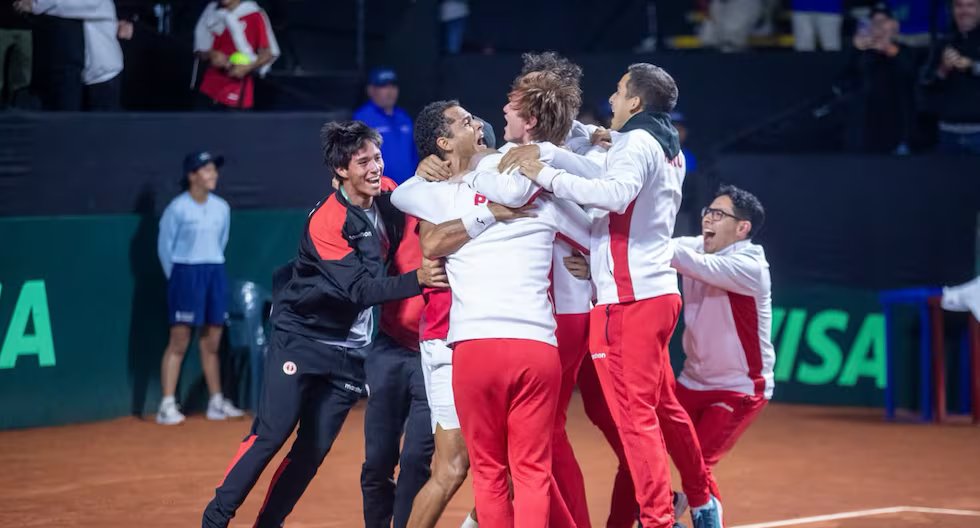
But the true meaning of “Peru is key” appeared again in the Davis Cup. Peru defeated Paraguay 3-2 in World Group I and qualified for the 2027 Qualifiers. It was a team victory, one of those that reminds us that tennis does not depend solely on a figure, but on a generation.
The team came to this series with Ignacio Buse, Gonzalo Bueno and Juan Pablo Varillas among the world’s Top 200, something that had not happened with three Peruvian tennis players since 1994. After that, Buse was called up to the Laver Cup.
But the phenomenon does not end in tennis.
Diego Elías once again won the Pan-American Squash tournament and gold in the South American tournament in 2026; Months earlier, he made history by becoming the first South American to win the PSA Squash Tour finals. Today Diego is a benchmark in world squash.
And while Buse and Elías shine, another discipline with a Peruvian seal is making itself known internationally: the fronton paddle. The last South American Games Santa Fe 2026 were the perfect setting for a sport that has something that no other discipline has: it was born in Peru. Valeria Garcés and Kevin Martínez took the South American gold without encountering opposition.
Ángelo Caro, Stefano Peschiera, Cristhiana de Osma, Natalia Cuglievan, Inés Castillo, Nicolás Pacheco, among many others, carry the Peruvian flag to international podiums.
They all have something in common: despite the difficulties, they compete far from home and represent Peru with the same flag that Buse brought to that camera when he wrote: PERU IS KEY.
Perhaps that is why the phrase has taken on a different dimension.
Because he doesn’t just talk about Buse. It speaks of a generation that is demonstrating that Peruvian sport can compete, win and carve out a space on international stages with passion and suffering.
But Peru is much more than its sporting triumphs, it has been building its own identity for centuries, made of culture, traditions and history. It is in Machu Picchu, in the Andean and Amazonian heritage, in our dances and music. It is also in our gastronomy, in potatoes, chili, quinoa, and in that extraordinary mix of cultures that has brought our flavors to the tables of the world.
Therefore, perhaps “Peru is key” is much more than a phrase written by a tennis player on a camera. It can become a way of understanding this moment: Peru has something of its own to offer the world and has the conditions to emerge.
A country with an ancient history, a diverse culture, an admired gastronomy and a generation that, from sports and many other areas, is showing that it can occupy an important place on the world stage.
Peru is key. Key to remembering who we are, valuing what we have and understanding that we still have a lot to show the world if we unite.
*El Comercio opens its pages to the exchange of ideas and reflections. In this plural framework, the Diario does not necessarily agree with the opinions of the columnists who sign them, although it always respects them.