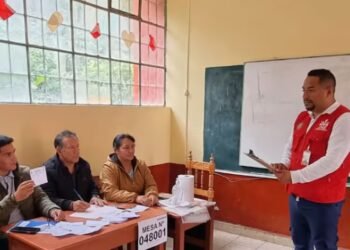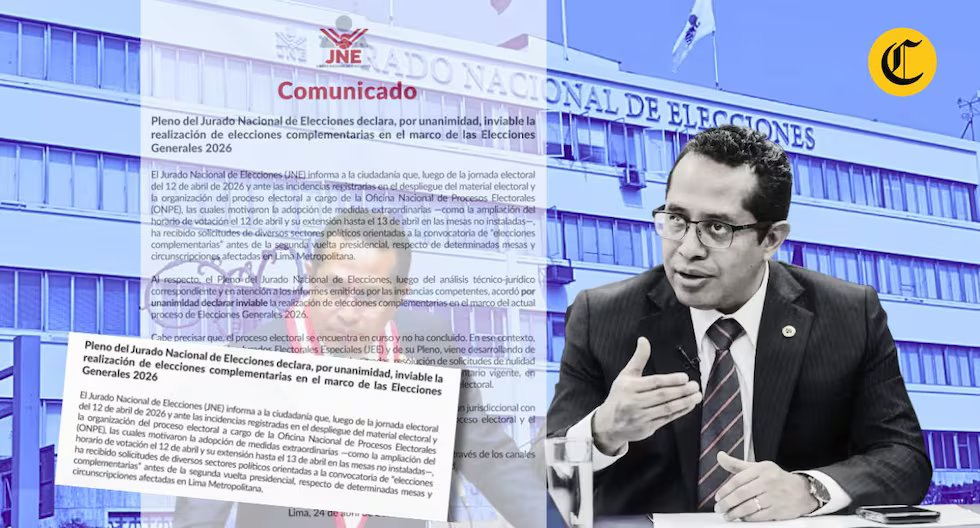

After an exhaustive analysis, the plenary session of the National Election Jury (JNE) – made up of five members – submitted to the vote and rejected the holding of complementary elections in those voting stations in Lima that were not installed in time due to the lack of electoral material during the day of Sunday, April 12.
As reported by El Comercio, the Jury unanimously declared the call for complementary elections unfeasible, after evaluating technically and legally that an eventual holding of elections was not possible.
He indicated that, prior to the decision, he received requests from different political sectors for said call in the affected tables of Metropolitan Lima.
“Unanimously agreed to declare the holding of complementary elections unfeasible in the current framework of the 2026 General Election process,” the statement reads.
Days before, this newspaper – in its edition of April 23 – announced that the case was addressed in a reserved meeting, that it was submitted to the vote of the members of the plenary session and that, unanimously (five votes to zero), it was agreed to reject said scenario.
The JNE plenary session is made up of five members: chaired by Supreme Judge Roberto Burneo and made up of Martha Maisch, Gunter Gonzales, Rubén Torres and Aaron Oyarce.
—Request from political parties—
The Jury stated that the electoral process is ongoing and has not yet concluded. In this context, he stated that, through the Special Electoral Juries and their plenary session, the work of reviewing observed minutes, resolution of nullity requests and other actions provided for in the current constitutional, legal and regulatory framework are being carried out continuously.
“All in strict respect of the principles of estoppel, legal certainty and electoral legality,” he said.
He added that the JNE will continue to exercise its jurisdictional function with “firmness, independence and transparency, guaranteeing the integrity of the electoral process and unrestricted respect for the popular will expressed at the polls.”
In the agreement of the plenary session of April 22, 2026 – which this newspaper accessed – it is indicated that it is necessary to ensure compliance with the electoral schedule. Although it is not exhaustive about the request for elections, it asks to respect the electoral deadlines.
“It is up to us to safeguard that this democratic transition is respected; this, coupled with the fact that one of the principles that governs the electoral process is that of preclusion, which sets the tone for the fulfillment of each stage of the process, and that its strict observance allows us to adequately navigate the electoral schedule,” the document states.
—Rafael López Aliaga asks to review irregular minutes—
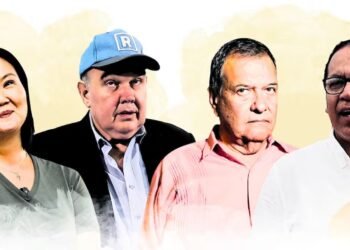
In the afternoon, presidential candidate Rafael López Aliaga (Renovación Popular) held a press conference on the elections regarding the apparent irregularities in the electoral process.
In said event, he stated that for these elections at least 4,600 minutes of the series or numbering 900,000 were registered that have the same patterns of behavior or characteristics of votes in favor of other candidates for the Presidency. He assured that these were distributed in different areas of the country.
“There is a statistical distortion as far as we have investigated. All the minutes of series (numbering) 900,000, which are 4,700 minutes, have the same pattern. This can be verified if Mr. Burneo had the will. His function is to supervise, not the political party. The party should fully trust its entities, the one who counts the votes and the one who supervises,” he said.
For this reason, it asked the JNE to carry out an audit of these minutes.
When asked if he will assume the position of senator if elected, he responded that his decision will be subject to the decisions adopted by the JNE regarding his request to carry out the audit of the tables in which he believes there were irregularities.
“I am going to make a decision based on the results, decisions made by the jury. That will be a condition for me to make a decision.
—What are the steps to follow?—
On the subject, the former director of the Registry of Political Organizations Fernando Rodríguez Patrón indicated that, after the decision of the National Elections Jury, what must continue is the resolution of the minutes observed and the requests for partial or total annulments of the elections, as well as the appeals made by political parties due to the inadmissibility of these resources.
“What remains now is for the JEE to resolve all cases of observed minutes or nullities, which are not the same. The first occurs when it was not accounted for by the Decentralized Offices of Electoral Processes (ODPE),” he indicated.
Meanwhile, the second is filed by a legal representative of the political party against an electoral record.
Let us remember that so far the Special Electoral Juries (JEE) of Lima and different areas of the country have received a total of 51 requests for annulment from various citizens and political parties against the elections to the Presidency, Congress and Andean Parliament, held on Sunday, April 12.
Of that universe, at least 24 requests for total annulment were declared inadmissible, in some cases, due to the lack of personal data, the presentation after the deadline or because, simply, the request was not duly accredited, according to a review by El Comercio on the portal of the National Elections Jury (JNE).
Meanwhile, the expert on electoral issues Silvia Guevara affirmed that, after this decision of the JNE, what should be done is to continue with the resolution of the observed minutes and the pending annulment requests to conclude with the first round of the general elections.
“What is coming is that they continue with the annulment requests as indicated by the regulations, if they have paid the corresponding fees, the issue of whether they have been admitted, whether they are appropriate or not and to resolve formally,” he indicated.
When asked if these requests for annulment could change the result of the elections, she answered that it is a probability that will depend on the number of votes that favor one or another presidential candidate.