“If there was any corruption, the project would have started years ago,” Ruud Souverein, director of Braganza Marketing Group, told the True Time. He rejects accusations that corruption and impure financial gain play a role in agricultural projects that employ Mennonites.
Text Ivan Cairo
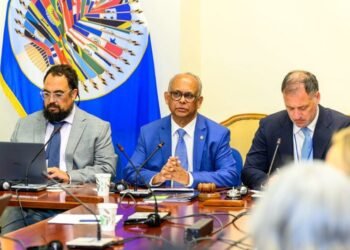
Image Terra Invest Suriname & Guyana
According to him, the very fact that the projects have still not started after years of preparation proves that the company is not trying to get things settled through unauthorized channels. Soverein emphasizes that Braganza and the Mennonites involved are not part of corruption and want all legal procedures to be completed before the projects can be fully implemented.
“After five years of preparation, Braganza has incurred significant costs, without having achieved any financial benefit from the projects so far.”
Ruud Soverein
Braganza has been working on the plans for about five years now. The company started doing this during the Santokhi administration, but then Terra Invest Suriname & Guyana, another Souverein company, took the lead and continued discussions under the Simons administration.
Soverein states that the construction changed at the end of 2025. The government was positive about the agricultural projects, but did not want to conclude direct agreements with Mennonites. It was then decided to give Braganza a management role and to involve Mennonites in the projects because of their agricultural knowledge.
150 US dollars
Sovereign also responds to the commotion surrounding an amount of US$150 per hectare that has recently been linked to the projects. Assembly members who recently surveyed the Tibiti area heard from Mennonites present that they had to pay this amount.
The director says that the wrong impression has been created that the money is paid to Braganza. This concerns a contribution from individual Mennonites to their own cooperative or colony for investments within the projects.
After five years of preparation, Braganza has incurred significant costs, without having achieved any financial benefit from the projects so far, Souvererin explains. He therefore opposes accusations that the company is mainly trying to make money with the projects. The 150 US dollar must also be viewed against the background of the amounts involved in large agricultural and land projects.
Agriculture outside the coastal strip
People also continue to misrepresent the choice to develop agricultural areas inland, says Souverein. Braganza advocates ultimately making approximately 3 percent of Surinamese forest area available for large-scale agriculture. Suriname does not have to give up its position as one of the most forested countries in the world.
The director believes that the country must make a trade-off between full forest conservation and economic development. The three projects that are currently under discussion jointly cover approximately 0.2 percent of the Surinamese forest area, Braganza says.
“Braganza advocates ultimately making approximately 3 percent of Surinamese forest area available for large-scale agriculture”
Soverein indicates that the coastal strip is insufficiently suitable for the intended large-scale agriculture. He refers, among other things, to an agro-ecological zoning study from 2017 and also points to fragmented plots and ownership issues in the coastal areas.
That is why preference is given to the area along the Road to West Suriname. The company talks about agricultural development in demarcated areas with secondary forest and says that strong regulations, spatial planning and enforcement are necessary to prevent uncontrolled expansion.
Suspicions about opponents
Soverein also strongly criticizes environmental activists who oppose the arrival of Mennonites and agricultural projects. He says he has received indications that opponents would have been financially supported to oppose the plans.
He has also heard that religious motives play a role in attempts to keep Mennonites out of Suriname. However, he does not present any concrete evidence to substantiate these suspicions. Soverein acknowledges that it cannot determine whether information that has reached him about this is correct.
However, all the fuss in the media creates an overly negative image of Mennonites. Braganza points to their agricultural experience and to Mennonite communities that have been active for decades in countries such as Belize, Bolivia, Mexico and Paraguay.
Fight over transparency
Another point of contention is the openness surrounding the projects. Sovereign places part of the responsibility for the continued lack of clarity on the government. According to him, Braganza has been asking for years to jointly explain the objectives, conditions and environmental regulations surrounding the projects with the government.
But Braganza himself has been reluctant to answer questions from journalists. This is how questions were asked earlier the True Time about the size of the investments as internal company information and the company stated that it did not wish to conduct the dialogue through the press.
Souverein acknowledges this choice and states that the company consciously opted for carefully formulated press releases and did not always want to give interviews or answer questions by telephone. This method was chosen because almost every statement leads to new questions and reactions, says Souverein. He remains of the opinion that much social unrest could have been prevented if the government and Braganza had jointly provided more clarity from the start.
Sovereign now sounds pessimistic about progress. He does not estimate the chances that the projects can be carried out quietly and according to plan in the short term is high, but assures that the company will continue to try to realize the plans.