HOUSTON.– The NASA Artemis II mission completed one of the most anticipated milestones of contemporary space exploration: he manned flyby to the Moon. After observing little-explored regions of the natural satellite, the four astronauts aboard the Orion capsule This Tuesday they embarked on the journey back to Earthwhich will last approximately four days.
During the most critical point of the journey, the ship was completely cut off with the Earth for about 40 minutes as it passes behind the Moona moment that marked both a technical and emotional challenge for the crew made up of Christina Koch, Victor Glover, Reid Wiseman and Jeremy Hansen. During that period, the astronauts were able to simultaneously contemplate the rising and setting of the Earth.
“It’s wonderful to hear from Earth again.”Koch said when communication was reestablished. In his first statements, he added: “We will always choose the Earth, we will always choose each other.”
He return trip is carried out under a “free return trajectory”a route that allows the ship returns to Earth using mainly lunar gravityincreasing mission security.
Shortly after beginning the return, the astronauts witnessed a solar eclipse, when the Moon came between the ship and the Sun, adding another unique experience to a mission full of milestones.
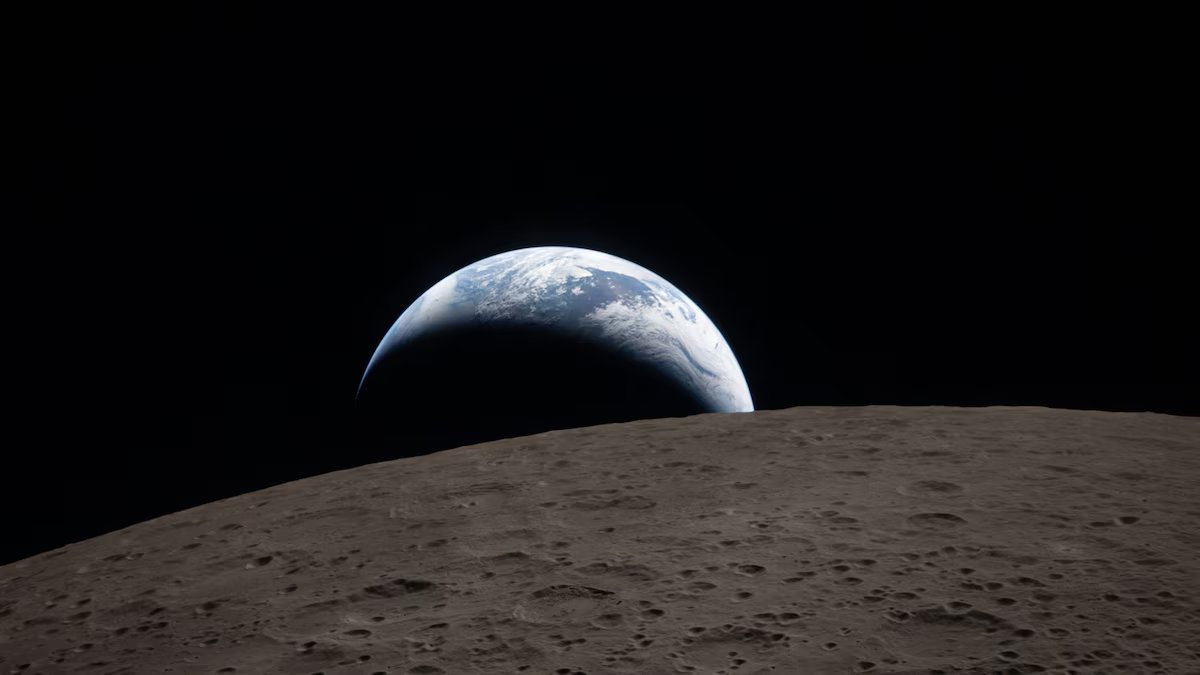
More than 57 years after the famous click made by the Apollo 8 mission of the “dawn of the Earth” (“Earthrise”), the Artemis II astronauts immortalized a “sunset” of our planetin a photo published Tuesday by NASA. The image shows the Earth hiding behind the lunar horizon, a phenomenon known as “earth setting” (“Earthset”).
The legendary “Earthrise” photo of Apollo 8 was taken on December 24, 1968 by American Bill Anders during the first lunar flyby made by humans, along with his compatriots Frank Borman and Jim Lovell.
The four astronauts of NASA’s Artemis II mission reached a historic milestone by traveling further than any human being, surpassing the distance record for a manned mission with 406,771 kilometers —above the 1970 Apollo 13 mark—while performing a unprecedented six-hour flyby of the far side of the Moonwhere they observed a surface subjected to cosmic bombardment and recorded “impact flashes” of meteorites.
The Orion ship, which It passed just over 6,500 kilometers from the lunar surface six days after launch, allowed nearly two dozen scientists to follow these phenomena in real time from the Johnson Space Center in Houstonin what constituted the first trip by astronauts to the vicinity of the satellite since the Apollo era, an advance that, according to Jenni Gibbons from mission control, takes humanity “beyond that frontier.”
Astronaut Jeremy Hansen underscored the sense of achievement: “This moment is meant to challenge this generation and the next, to make sure this record doesn’t last long.”
From their privileged position, the astronauts were able to observe the Moon in an unprecedented way, contemplating its entire diskincluding regions near the poles. Victor Glover enthusiastically described the “terminator,” the line that divides day and night on the lunar surface, while recording scientific data and making detailed descriptions for teams on the ground.
The mission included an intense scientific agenda. The crew, trained in geology, analyzed 35 points of interest on the lunar surface, including ancient lava flows, large impact craters and historical areas such as the Apollo 12 and Apollo 14 moon landing sites. Among the notable formations is the Mare Orientale, a basin more than 900 kilometers in diameter, and the Hertzsprung crater, about 600 kilometers.
One of the most emotional moments of the mission occurred when the astronauts proposed naming two lunar craters.
The first, “Integrity”, in honor of the capsule and the second, “Carroll,” in honor of Commander Wiseman’s deceased wife. “It’s a bright spot on the Moon… and we’d like to call it Carroll,” Hansen said, his voice breaking. NASA reported that it will raise the proposal to the International Astronomical Union.
During the mission, there were also key tests of OCSS pressure suits, designed to guarantee the survival of astronauts in extreme situations up to six days. The crew members evaluated their functioning in real conditions, including daily tasks such as eating or moving inside the capsule.
The key day of the flyover was preceded by a special message: a recording of Apollo astronaut Jim Lovell, who shortly before his death in 2025 left a greeting for the crew. “Welcome to what was once my territory. Don’t forget to enjoy the view,” said the message, which marked a symbolic bridge between generations of space explorers.
After completing the observations, the Orion spacecraft left lunar orbit and began to move away from the satellite’s sphere of gravitational influence. He Ditching is scheduled off the coast of San Diego next Fridaymarking the close of a ten-day mission that already occupies a prominent place in the history of space exploration.
Agencies AFP, ANSA and Reuters