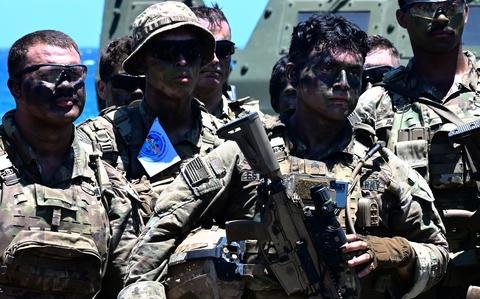

American soldiers gather on the beach following a live-fire coastal defense drill near Laoag, Philippines, May 4, 2026, as part of the annual Balikatan exercise. (Aaron Kidd/Stars and Stripes)
A Washington think tank with ties to Trump administration officials is calling for a dramatic retrenchment of U.S. military power in the Western Pacific, including ending defense alliances with Japan, South Korea, Australia and the Philippines and adopting a non-intervention policy toward Taiwan.
The proposal from Defense Priorities would shift most U.S. forces away from the first island chain near China and concentrate them farther east around Guam, the Northern Mariana Islands, Palau, Micronesia and the Marshall Islands.
The think tank argues its “second island chain” strategy would reduce the risk of war with China while preserving U.S. access to important markets and trade routes. Critics say it would dismantle the security structure Washington has built over seven decades in the region and may encourage allies to develop nuclear weapons.
Defense Priorities published the proposal, A Second Island Chain Strategy for Asia, on its website Sept. 10. The organization advocates a foreign policy of military restraint and says its approach is consistent with principles embraced by President Donald Trump.
Its former contributors include William Ruger, until June the deputy director of national intelligence for mission integration; Michael Dimino IV, deputy assistant defense secretary for Near East and Central Asia; and Justin Overbaugh, deputy director of intelligence.
Jennifer Kavanagh — the report’s author and Defense Priorities’ director of military analysis — argues the United States has two core interests in the region: defending the homeland and preserving access to important economic markets and trade routes.
“The first priority requires little in the way of a forward military presence while the second benefits from a modest air and naval presence to hedge against outcomes that would threaten U.S. interests,” she wrote.
Her proposal represents a sharp departure from the Pentagon’s current approach.

U.S. Marines exit an MV-22 Osprey during combat training with Japan Ground Self-Defense Force soldiers at Camp Hansen, Okinawa, on March 6, 2026. (Ryan M. Breeden/Stars and Stripes)
The 2026 National Defense Strategy calls for deterring China through a “strong denial defense” along the first island chain, which includes Japan, Taiwan and the Philippines, while pressing allies and partners to assume more responsibility for their own defense.
Roughly 80,000 U.S. troops are stationed in Japan and South Korea alone, including about 54,000 in Japan and nearly 25,000 on the Korean Peninsula.
Under the Defense Priorities proposal, fewer than 2,500 U.S. ground troops would remain in Japan by 2035, along with up to two rotational Air Force squadrons and three rotational destroyers or cruisers.
Up to 3,000 rotational troops would remain in the Philippines.
The plan envisions 7,000 U.S. troops and five submarines in Australia and another 5,000 troops, five submarines and two Air Force fighter squadrons spread across Guam and other spots in the second island chain.
It also calls for replacing mutual defense treaties with Japan, South Korea, the Philippines and Australia with narrower security partnerships.
The report describes the South Korea alliance as providing “the fewest benefits to the United States,” citing its costs and the possibility of drawing Washington into war with North Korea. It recommends removing most U.S. forces from the peninsula.
Washington would explicitly rule out military intervention in a conflict over Taiwan, according to the proposal. China considers democratic Taiwan a breakaway province that must eventually be unified with the mainland, by force if necessary.
J. Michael Dahm, a senior resident fellow for aerospace and China studies at the Mitchell Institute for Aerospace Studies, said the proposal would “amount to the dismantling of the post-1951 American security architecture in East Asia.”
Japan and South Korea could respond by expanding their conventional forces or developing nuclear weapons, he said by email Sunday.
Dahm questioned whether countries whose alliances with Washington had been ended would later permit U.S. forces to use their territory or otherwise support the U.S. during a conflict with China.
Grant Newsham, a retired Marine colonel and senior researcher with the Japan Forum for Strategic Studies in Tokyo, said the proposal “undercuts the entire basis — military, political, psychological — for protecting U.S. national interests — and the entire idea of free sovereign nations in the region.”
“Look at Chinese behavior towards the Philippines and Japan over the last decade plus, and towards Taiwan in recent years,” he said by email Sunday. “That gives you a taste of what would come if this report’s recommendations were followed.”