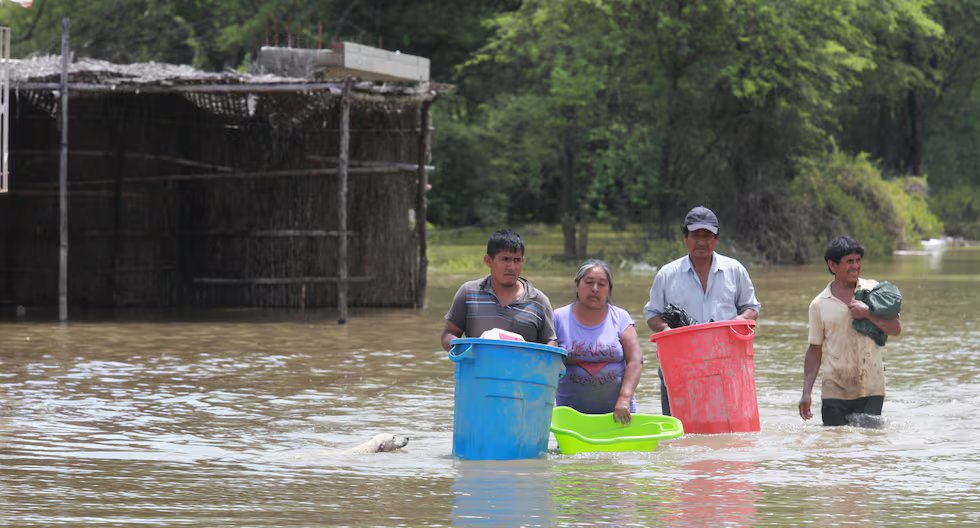
In the capital, 18 districts, mainly located in peripheral areas, are classified as having “high” and “very high” risk in the event of flooding.according to Cenepred; However, nine of these are in the lower half of the budget execution ranking corresponding to Program 068, called: “Vulnerability reduction and disaster response.”
Pachacámac, Los Olivos, San Juan de LuriganchoSan Martín de Porres, Punta Hermosa, Cercado de Lima, Ate, San Bartolo and Lurigancho-Chosica They have to spend at least 40% of the resources assigned to this item before the end of the year. The most critical case is that of Chosica, a town highly vulnerable to the activation of streams during summer rains, where the authorities need to invest 70% of their budget against disasters.
These vulnerable districts are added Carabayllo, Puente Piedra, Chaclacayo, Cieneguilla, Santa Anita, El Agustino, Lurín, Rímac and Comas. Although they have better progress in this area, they also appear on the list of municipalities vulnerable to flooding.
Together, the 18 jurisdictions cover 1,812 square kilometers, equivalent to 64% of the surface of Metropolitan Lima. They concentrate 5,180,073 inhabitants, 51% of the capital’s population.
The lag is not limited to vulnerable jurisdictions. At the closing of this note, the 43 municipalities of Lima had together executed S/35.7 million of the S/64.8 million assigned to PP068, equivalent to 55% of the total.
Pending actions
In his first presentation before the Congress of the Republicthe president of the Council of Ministers, Luis Galarretaemphasized that currently there is a no prevention in the face of the El Niño phenomenon.
What would be the most efficient actions at the municipal and provincial level to adopt a few weeks before the start of the rains? For Mary Mollo, specialist in Disaster Risk Management at ESAN, although the authorities must now focus on reactive management (aimed at addressing emergencies) that is not yet coordinated or organized. At the same time, they should continue with prevention projects, which are key to mitigating future risk scenarios.
“I believe that the role of the municipality must be redefined and stop doinger only reactive management. The expenditure (of budget program 068) achieved in percentages does not express the reduction in vulnerability that these districts have. What it expresses is just how much they have managed to spend on anything, but not necessarily reducing it. “Risk is measured by the degree of vulnerability that a territory has to the threat it faces.”he explains.
Mollo highlights, for example, that in areas of Eastern Lima such as Chosica Projects are required to relocate the population living in areas of high non-mitigable risk. According to the specialist, this district has 21 streams that can be activated.
“The issue of relocation corresponds to corrective management. Areas of high non-mitigable risk should be declared so that they are not inhabited. There must be a complete and lasting move. “Municipalities continue to use document 068 for reactive management, we are not investing in projects to reduce vulnerability”he points out.
Review of the UK’s collaboration in the north
The high risk of rain, landslides and floods is not only typical of Lima, but extends throughout almost the entire Peruvian coastal strip, especially in the north of the country. Tumbes, Piura, Lambayeque, La Libertad and Áncash have 107 districts with “very high” risk of flooding, and they concentrate 3 million inhabitants and 950 thousand homes in this condition, 38% of the total population and homes at “very high” risk at the national level.
How have the main prevention works in this area progressed? In 2020, Peru and United Kingdom they signed a government to government agreement (G2G) to provide technical advice and support to accelerate the reconstruction of infrastructure affected by the 2017 coastal El Niño, including schools, hospitals, health posts, and comprehensive flood solutions.
Since the signing of the agreement, first with the Authority for Reconstruction with Changes (ARCC), whose powers later passed to the National Infrastructure Authority (ANIN), the British consultancy has been made up of UK Delivery Team (UKDT), made up of specialists from the companies Mace, Arup and Gleeds. The agreement between UKDT and the State will be extended until December this year.
In communication with ECDataUKDT indicated that to date it has completed and delivered 85 of the 149 works in which it participated. Of this number, 34 works have been delivered in Piura, a region highly vulnerable to the ravages of El Niño.

Although there was an almost complete delivery of schools and important progress in the completion of hospitals, the delivery of the six storm drainage projects for the northern cities, and 46 of the 51 projects that cover comprehensive solutions, is still pending (see table).
Education and health projects recorded greater progress in conclusion and deliveries. To date, 71 of the 74 projects that received advice from UKDT have been delivered, while in health, 9 of the 18 planned projects have been completed.
Currently there is a 62% probability that a Coastal El Niño will reach an extraordinary magnitude between September 2026 and January 2027 off the Peruvian coast, while for February and March, the magnitude would be between strong and extraordinary. The actions and preparations that the authorities can implement are advancing against the clock.