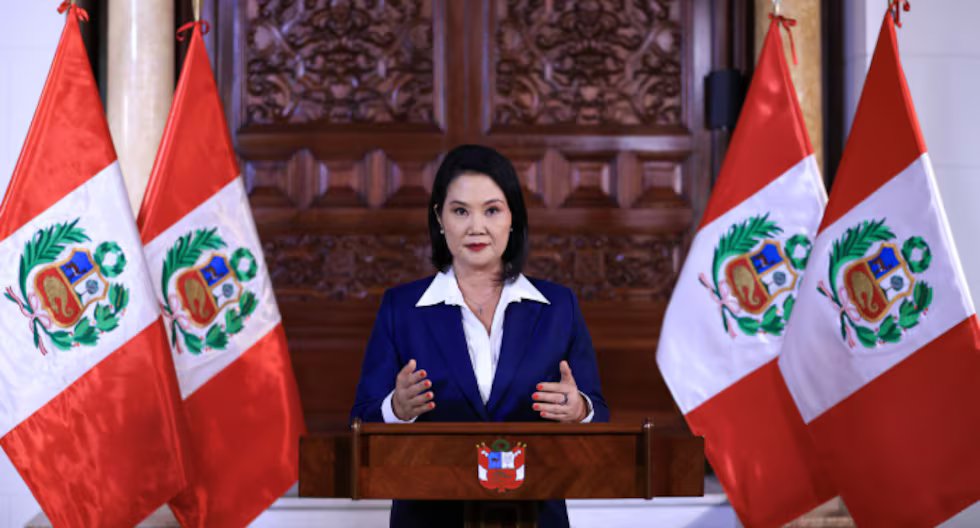

The president Keiko Fujimori Last Thursday, the 5th, he presented an assessment of his first 100 days in office, in which he claimed to have met four established objectives.
These were, according to what he said, identifying the weaknesses of the State, establishing roadmaps to implement his government plan, initiating the execution of measures that he considers a priority and laying the macroeconomic and fiscal foundations. He did not refer to all his campaign promises whose fulfillment he planned for this period.
“We are working for the Peru that we all long for and I tell you, yes it is possible. The first stage has had four objectives that we have achieved,” he said in a message to the nation from Government Palaceafter 10 pm on Thursday.
The president addressed the population in a context marked by the emergency of the El Niño phenomenon (FEN), citizen insecurity, the increase in food prices and the legislative powers that it received from Congress.
His government plan, called Peru with order, considered 68 measures for the first 100 days of administration, linked to citizen security, the fight against corruption, public investment, health, education, infrastructure and social programs.
The president did not refer to the distance between these commitments and the results achieved. He did maintain that he received a country that was not prepared to face the FEN, which he described as the most intense in the last 100 years.
“The FEN will not surprise us again with the same weaknesses,” he assured.
According to him, clearing work was carried out in 179 kilometers of rivers, with progress of 85% of what was scheduled, and more than four million cubic meters of material were removed.
“In Cañete, Chincha and Pisco we completed 35 kilometers of riverside defenses to protect the lives of more than 10 thousand families and prevent the loss of 33 thousand hectares of crops,” he added.
In addition, the president highlighted the reduction of the deadlines for approving works for taxes, from more than six months to 30 days. As he explained, this modification seeks to accelerate the execution of interventions in the face of the emergency.
Fujimori also highlighted the economic prospects and stated that the country could grow 4% over the next few years.
“For the first time in more than five years, the economic analysts consulted by the Central Bank once again project that Peru will grow 4% in the coming years. Businessmen did not feel so optimistic about the economy in the next 12 months for many years,” he stated.
In addition, he recognized citizen insecurity as the main problem facing the country. “Crime rates have increased rapidly in a two-dimensional manner. Not only has the volume and frequency of crime increased, but also the cruelty of the acts,” he said.
However, he added that the government received 7.5 crimes per day. “100 days have passed and today we registered 6.5.”
In terms of security, Fuerza Popular offered during the presidential campaign to put the C5i Command and Video Surveillance Center into operation, strengthen flagrante delicto units, intervene militarily and police in Tumbes and finance the acquisition of smart patrol cars, interconnected cameras and the modernization of police stations.
For the president, her government is “on the right path.” However, according to the latest Datum International survey for América Multimedia, 68% consider that the Government has not made any progress in reducing insecurity. 25% believe that they have made some progress and 3% believe that they have achieved a lot.