SUBMITTED
You can’t buy a newspaper without Mennonites in it. Mennonites are also widely discussed on social media. Few have actually ever met a Mennonite, many have an opinion about it. For the last five years of my life, I have spent every day with groups of Mennonites from all over South America. And I have learned from experience that the Mennonites are fine people. Open, social, hard workers, cheerful and always thinking in solutions, never in problems. That’s what comes to mind when I think of Mennonites. Fortunately, there are many positive stories about the contribution that Mennonites make in many countries in South America.
Anyone who takes note of what a Mennonite colony has managed to achieve in a country like Belize will naturally look with more curiosity at what is now emerging here in Suriname. Take Spanish Lookout. In the late 1950s, a group of Mennonite families came from Mexico to what was then British Honduras, looking for good land and a government that welcomed them. Frank Barkman, one of the first settlers, told Belizean news channel News Five years later: “Our parents were looking for freedom, including religious freedom. We felt very welcomed by the government.” They were not easy years.
“After decades of hard work, they have managed to develop an efficient and modern agricultural and livestock sector, which produces the largest quantity of dairy and meat products in the country”
“I think a lot of people wouldn’t have come if they had known how difficult it was going to be. We had no idea what it meant to go straight into the jungle and build a life there,” said Barkman, co-founder of Quality Poultry Products. What has grown from that is impressive. Spanish Lookout is today one of the most productive communities in all of Belize. Quality Poultry Products, founded by the same Barkman family, now produces thirty thousand pounds of chicken per day and employs more than four hundred people.

Western Dairies, started in 1967 by fourteen farmers and entrepreneurs with little more than an idea, has grown into the country’s only commercial dairy producer: two hundred employees, and forty percent of the milk now comes from farmers outside their own community – surrounding villages that benefit from the infrastructure that the colony has built.
Without this local production, production manager Henry Wiebe calculated, Belize would have to import one and a half million dollars worth of dairy every month. Perhaps the best part is this sentence from Barkman, now president of the company his father founded: “We were made here in Belize. This is our home. This is our country, and everything we do is always the best we can.” Sixty years after its arrival, Spanish Lookout is no longer an outsider, but an obvious part of the Belizean economy — with a scale and craftsmanship that would be the envy of many countries.
That same work ethic, those same skills, that same ability to create something valuable from the ground in a relatively short time, the Mennonite communities now also bring to the agricultural projects in Western Suriname — including Belizeans who come from the exact same tradition as Spanish Lookout. This does not alter the fact that critical questions, about permits, about the precise agreements, about transparency towards the government, are simply part of a major project and deserve an honest answer. But in addition to this justified control, there should also be room for curiosity: what can these people do, what have they already shown elsewhere, and what could that mean for Suriname?
Spanish Lookout is no guarantee that everything will turn out fine in Suriname. But it is an invitation to look at what is being built here with different eyes — with the same curiosity with which Belize now looks back on its own Mennonite pioneers. Today, Spanish Lookout feeds an entire country.
Paraguay
Integrated Mennonites also make major contributions to developments in the agricultural sector in Paraguay. In the Mennonite colonies in the Paraguayan Chaco – where it literally never rains – a wide range of agricultural products are produced, supplied and exported. Agriculture is the basis of the system. Soybean, corn, wheat, peanuts, sesame, sorghum and other crops are integrated with livestock farming and agro-industry. Silos make it possible to receive, dry, clean, sort and store harvests; they also support sales at more favorable times and the supply of animal feed factories.
Their contribution is not limited to primary production: the distinguishing feature is the construction of integrated chains that connect land, producers, cooperatives, technical support, financing, storage, industry, logistics, commercialization and export. “After decades of hard work, they have managed to develop an efficient and modern agricultural and livestock sector, which produces the largest quantity of dairy and meat products in the country.” This would be in an official document of the Paraguayan State / Ministry of Economy and Finance
The current scale makes clear the magnitude of this process. In 2024, Paraguay exported beef worth US$1,719.2 million. Within this national complex, industries associated with Mennonite cooperatives have a relevant position, but the national total should not be confused with the performance of individual slaughterhouses. As a specific reference, Fernheim reported approximately USD 155 million in meat exports in 2024. In Campo 9, La Holanda/Lactolanda will process more than 1.5 million liters of milk per day by 2025, after starting in 1982 with 5,000 liters per day. “It was the agro-industrial success of the Mennonites that brought about an economic and territorial turning point for the entire Chaco region.”
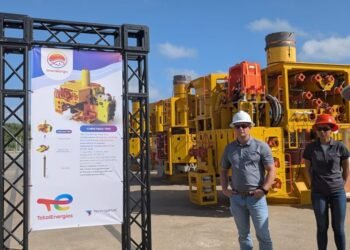
The most important economic lesson is institutional in nature: these communities have transformed difficult-to-access areas into ecosystems that can reinvest capital, process raw materials and maintain local services. Their experience shows in concrete terms how production organization can generate infrastructure, employment, added value and foreign exchange in the long term. How nice would this be to also realize in the interior of Suriname? A good example of how hard and innovative work is being done is the construction of an oil processing factory. In two years and under their own management, the Mennonites built a modern factory and put it into production. The photos show the industrial complex.

The impact on this inland area is enormous. This impact of the colonies extends beyond their own members. The agro-industrial expansion created demand for workers, contractors, transporters, construction companies, technicians, professionals and trading companies. At the same time, civil society organizations and cooperatives developed services in education, health, training and community support.
The government is working with the Chortitzer, Neuland and Fernheim cooperatives on initiatives that seek to balance “production and nature conservation” and generate joint solutions for the Chaco region. The relationship with the government is excellent. The Mennonite cooperatives operate within the Paraguayan institutional framework and maintain regular contacts with government agencies.
INCOOP classifies Chortitzer, Fernheim, Neuland, Bergthal, Sommerfeld and La Holanda as production cooperatives in a high regulatory category. In addition, there are relationships with SENACSA in the field of animal health, with financing institutions and with national, departmental and municipal authorities in infrastructure, production and training projects.
“We also consider ourselves Paraguayans because of our citizenship. We are grateful for a country like Paraguay that has welcomed us so warmly. We must learn the national language and adapt to living together,” says Mennonite Victor Wall.
The images that are now circulating of comparable Mennonite companies elsewhere in South America — complete processing factories, silos, distribution networks, hundreds of jobs, in areas where no one else dared to invest — gives a good idea of what is also possible in Suriname. The prospects are justifiably optimistic, precisely because there are already examples of what these communities have achieved elsewhere.
In the countries of South America, Mennonites make major contributions to the development of the economy, agricultural production and exports. With the foregoing I have tried to contribute to the image, simply from my own experience and from experiences in other countries.
Lionel Blokland, Braganza Marketing Group NV
The editorial staff of the True Time allows readers to submit articles for publication. In principle, all submitted articles will be included, unless the content is harmful, hurtful or insulting to third parties. Pieces posted do not necessarily reflect the views of the True Time. The editors reserve the right not to publish articles, or to shorten or edit them without taking them out of context.