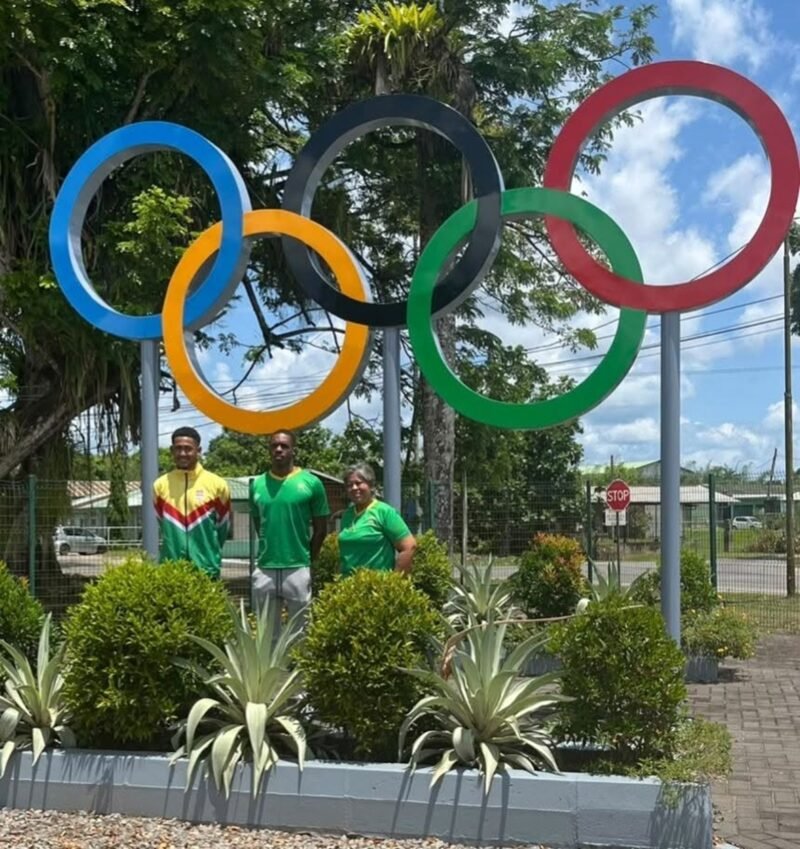
Suriname is participating in the South American Games in Argentina with twelve athletes, spread over seven disciplines. The Surinamese Olympic Committee (SOC) sees the event as an indicator for the further development of Surinamese top sport and expects that each of the participants will perform at their maximum. The task for the twelve athletes is clear: go to Argentina with confidence, give everything and show that even a small Surinamese delegation wants and can perform on the South American stage.
Text Marinio Balsemhof
Image FB SOC
According to the SOC, the participants have been selected on the basis of, among other things, performance, level and development perspective. According to the committee, the fact that Suriname is participating with a relatively small group also underlines where the challenges lie. If the country wants to be present at major international events with more athletes and in more disciplines in the future, more structural investment will have to be made in talent development, coaching, training facilities, international competitions and guidance. This is not only due to the sports organizations. The government and the business community also have a role in this.
“Top athletes should always try to finish as high as possible”
No pressure
The SOC believes that it has deliberately not stated an expected number of medals. His starting point is that every athlete arrives at the start as well prepared as possible and delivers his or her best performance.
A medal is considered the most tangible result, but is not used as the only benchmark. According to the SOC, personal records, improved seasonal performances and strong matches against internationally better opponents can also demonstrate whether an athlete has made progress.
The sports umbrella organization also says that it does not want to saddle individual athletes with the pressure in advance that they must necessarily achieve a medal or place in the final. The expectation is that participants who are close to the regional top will provide strong performances.
Big gap with top countries
Not every delegate athlete was able to prepare for the South American Games under ideal conditions. The opportunities in Suriname differ per category and are not always comparable to those of athletes from larger South American countries.
Surinamese athletes do not always have the same opportunities to regularly participate in international competitions, training camps and qualifying tournaments, the SOC says. An important bottleneck remains the lack of international competition experience.
But money also plays an important role in the preparation and broadcast. The SOC has made every effort to support the athletes as best as possible with the available resources. But higher and, above all, structural investments are necessary if Suriname wants to produce internationally competitive top athletes.
The SOC recognizes that there is a significant difference in level with countries such as Argentina, Brazil and Colombia in various sports. These countries have larger talent pools, more sports infrastructure and significantly more money.
However, according to the sports umbrella organization, this does not mean that Surinamese athletes have no chance in advance. Especially in individual sports, exceptional talent, coupled with good guidance and preparation, can ensure that a Surinamese can compete with the regional top. The athletes are therefore told not to be impressed by the name or reputation of their opponents, but to continue to conduct their own competition.
The SOC emphasizes that the delegation is not just being sent to Argentina to gain international experience. Performance remains the first starting point. “Top athletes should always try to finish as high as possible.”
At the same time, every international confrontation must be used as part of the learning process. Experience and results are therefore not seen as opposites: the experience gained should ultimately lead to better performance.
Structural problem
According to the SOC, the small delegation also exposes a broader challenge within Surinamese sport. Better training facilities, specialized coaching, sports medical guidance, sports science support and structural financial resources are needed to increase the number of top athletes.
Talent identification also needs to be further developed. Young talented athletes must be professionally guided for several years in a row in order to compete with the international top.
According to the SOC, participation in the South American Games should therefore not end when the twelve athletes return from Argentina. Their performance must be evaluated, not only looking at the final ranking. Development, personal progress and future prospects must also be taken into account. For athletes who show further growth opportunities, an individual development program should be drawn up together with the sports associations and coaches. The ultimate aim is a continuous development line towards future major multi-sport events and ultimately the Olympic Games.
Even when an athlete wins a medal in Argentina, that should not be the end point, according to the SOC. It is precisely after this that sufficient support must be available to maintain and further develop the level achieved.
In frame
The XIII South American Games will take place from September 12 to 26 in the Argentine cities of Santa FeRosario and Rafaela. Suriname is represented by the athletes D’Angelo Huisden and Domiguel Werson (coach Deon Boldewijn), the badminton players Rivano Bisphan and Imani Mangroe (coach Gilmar Jones), the boxer Domelzo Schet (coach Maurice Douglas), the taekwondo players Yade Bongsomenggolo and Samero Doebe (coach Jurmen Amiena), the tennis players Yigal Bergen and Joshio Loor (coach Carolina Vera Vera), the cyclist Xavi Wadilie (coach Christopher Gill) and the swimmers Ismaël Holtuin and Zayn Etnel (coach Fabianne Nabibaks). The delegation leader is Desiré Eendragt.