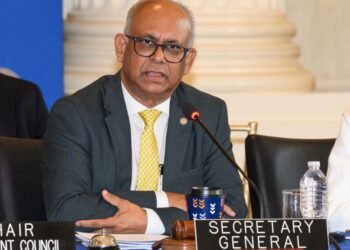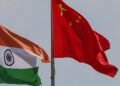
SURINAME IS ALLOWED sovereign country itself determines with which countries it maintains friendly, diplomatic and economic relations. OAS Secretary General Albert Ramdin made this clear to journalists on Friday. It is not up to the Organization of American States (OAS) to force countries to make a choice between the economic and military powers of the United States (US) and China. That is a reassuring message, but ‘sovereign’ does not mean ignoring international power relations. In practice, it is even more complicated for small member countries such as Suriname.
The visit of Venezuelan acting President Delcy Rodríguez to Suriname on Friday is interesting in this light. Suriname and Venezuela have signed a series of cooperation agreements and a joint statement. The agreements concern, among other things, agriculture, food security, fishing, aviation, tourism, education and oil and gas. The latter sector in particular deserves attention. Suriname is on the eve of an important development of the oil sector and will have to deal with numerous foreign parties. Venezuela has enormous oil experience. Why shouldn’t Suriname make use of this or learn from it?
Charting our own course and working with those who want the country in our own interests does require a clear national strategy and a great sense of reality
Yet such choices are not exclusively a matter between Paramaribo and Caracas. Venezuela – as a medium-sized country, mind you – has been at the center of American geopolitics for years. American soldiers captured President Nicolás Maduro and his wife during a military operation at the beginning of this year and transferred them to the US. He is on trial there on suspicion of drug trafficking, among other things.
Rodríguez then took over as ‘acting’ president. She has now been removed from the American sanctions list and is working with Washington, including in the field of oil. It says a lot about geopolitical opportunism in international politics.
Suriname must therefore determine its own interests and take advantage of diplomatic and economic opportunities where they arise. And preferably even more in the Latin American and Caribbean region than in China or the United States. After all, a good neighbor is better than a distant friend. Moreover, joint action can be taken regionally in several areas.
Charting our own course and working with those who want the country in our own interests does require a clear national strategy and a great sense of reality. The United States considers the Western Hemisphere its sphere of influence. Suriname should also not think that Venezuela and China want to do business out of pure friendship. As a small country, Suriname cannot afford naivety, but it is precisely with knowledge of these power relations that it must dare to make its own choices. Also dare to tell Venezuela that we attach great importance to human rights and that large oil reserves do not make the two countries like-minded. The Surinamese won’t get anywhere by simply playing with nice weather.