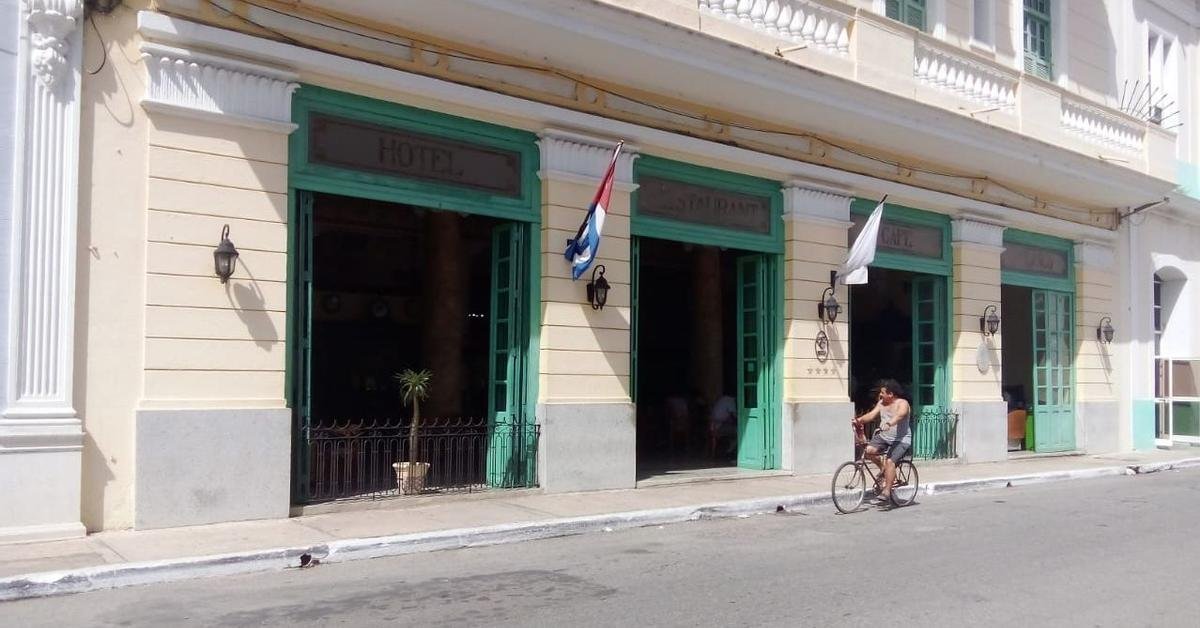
Matanzas/The man who today enters the Velasco Hotel as an ordinary visitor spent ten years behind the carved wooden desk at the reception, answering the phone and serving guests. He did not leave that chair of his own free will. A downsizing shattered his degree in Tourism and the experience previously accumulated in hotel facilities in Varadero.
“After having served almost two decades in the sector, they fired me with the offer that I go to work at the Watkins Zoo cleaning the animals’ cages. Tell me if that isn’t disrespectful,” laments David, with his name changed to avoid retaliation.
Walk across the granite floor of the lobbyimpeccable and almost empty. There are no foreigners unloading suitcases from a Transtur bus or travelers queuing to register. Above the reception, four gold stars remind us of the establishment’s category and three clocks seem intent on marking the hours for guests who do not arrive.

/ 14ymedio
El Velasco, in front of the Plaza de la Libertad, is part of the sentimental landscape of Matanzas. The property was acquired by Luis Velasco Zorrilla in 1902 and six years later it opened as a hotel. In its best times, its cafe, restaurant and rooms made the property one of the emblematic accommodations in the city center.
Now his stillness sums up a national problem. In June, only 28,100 international travelers arrived in Cuba, even lower than the 35,795 registered in June 2021, in the midst of the pandemic. In the first semester, 699,878 arrived, 48.7% of the 1,364,400 counted in the same period of 2025. Almost half of those who arrived in June were Cubans residing abroad.
In July there was a slight riseup to 32,272 travelers, but the figure was 71% lower than that of the same month in 2025 and 92% lower than that of July 2018.
The debacle now reaches those who for decades belonged to a very particular labor aristocracy. Getting a place in Tourism meant getting closer to tips, foreign currency and products that were practically unattainable for a teacher, a doctor or a Communal worker.
/ 14ymedio
It was also a specially controlled sector. Until the entry into force this September Decree-Law 128foreign companies could not hire their Cuban employees directly and had to do so through state employing entities. The new norm, included among the 176 economic and social transformations approved in June, eliminates this mandatory intermediation for mixed companies and companies with totally foreign capital.
For years, selection criteria included not only job requirements, but evaluations of work and social behavior, a mechanism that favored the presence of personnel considered politically reliable.
Under the same lamp that David avoided lighting during his night shifts to save electricity, he was given the notice that he was “interrupted,” the official euphemism for “unemployed.” “I presented a complaint to the union. I also wrote to Gran Caribe, with a copy to Mintur, the Government and the Party. What did they do with my career? Crumple it up like a napkin and throw it in the basket.”
Mailé was not spared either. Linked to room service, she was sent home in April and, after the first month, she was left without a salary guarantee. “Thanks to the tips of some guests I was able to buy the pampers to my mother, who is bedridden. “I ended up with swollen feet from standing for so many hours, but I saw the result of my sacrifice.”
/ 14ymedio
To the right of the lobby, the bar looks stocked with bottles, but there is a lack of customers and even coffee. A bartender speaks in a low voice while preparing a cocktail with the essentials. “When they take you out of the game, you instantly cease to exist.”
He assures that he will not accept a position in Comunales. “It’s a decent job, but I didn’t study to end up as a sweeper on Medio Street.” His colleagues joke about the possibility of preparing drinks from home, ironically alluding to the official push for remote work.
“If the tourists are still lost, half a shift will be enough to serve the entire hotel. This looks like the Sahara Desert,” he concludes, pointing to the empty tables.
David looks towards the reception one last time. The diplomas and certifications that once made you proud now seem like they belong to another life.
“Tourists can arrive tomorrow if they want,” he says. “The one who doesn’t come back is me.”