Even before the history begins inside, it becomes clear outside that the Museum of the Communist Party of China wants to be more than a collection of old documents and objects. On the enormous square in front of the building there are monumental groups of statues of workers, farmers, soldiers and revolutionaries. The red party flag is a dominant symbol. Everything is large, sleek and carefully organized.
Text and image Ivan Cairo
The Museum of the Communist Party of China is located on Beichen East Road in Chaoyang District, near the Olympic Park and on the northern extension of Beijing’s central axis. The building, which was completed in 2021, is shaped like the Chinese character 工 (gong), which means labor or worker. There are 28 columns on the east and west sides, a reference to the 28 years between the founding of the Communist Party in 1921 and the founding of the People’s Republic of China in 1949.
“The museum not only tells what happened according to the official history, but uses the design to give the visitor the feeling that the past flows directly into today’s China”
Inside, the scale changes, but hardly the monumentality. Wide staircases, high ceilings, polished floors and enormous halls guide the visitor through more than a century of recent Chinese history. Red and gold continually return. Photos, paintings, documents, weapons, uniforms, utensils, flags, images and meters of timelines alternate with films, digital screens and life-size reconstructions.
From humiliation to revolution
The permanent exhibition covers the first three floors and contains more than 2,500 photos and more than 4,500 objects and collections. The total exhibition route is approximately 3.5 kilometers long. If you want to look at everything carefully, a quick museum visit is of little use. You will have to spend hours or come for several days.
The story is largely told chronologically. First, pre-revolution China appears: foreign interference, war, poverty and political disruption. This was followed by the rise of the revolutionary movement and the founding of the Communist Party in 1921.
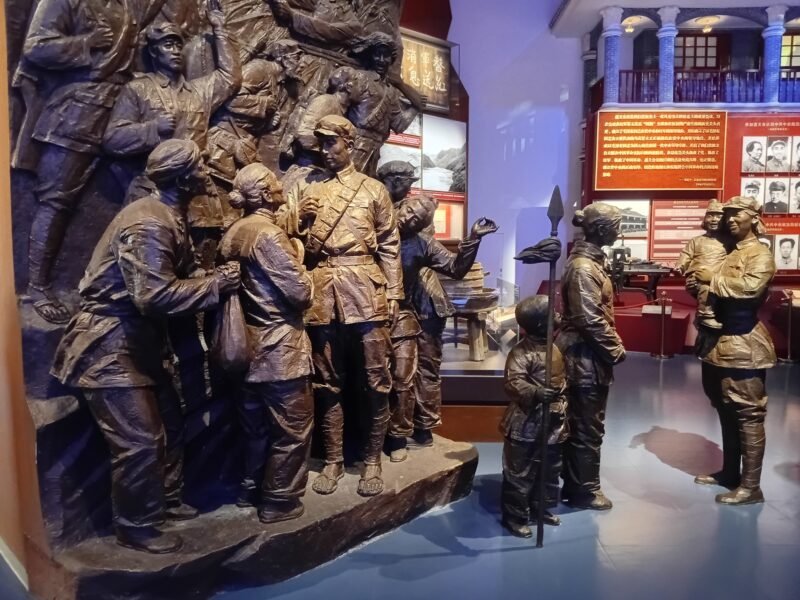
From that moment on, the museum becomes more and more theatrical. History is not just behind glass. Complete scenes have been recreated. Visitors face revolutionaries who appear to emerge from rocky landscapes as life-size figures.

The Long March is brought to life with images, sound and digital techniques. A special cinema uses panoramic LED screens to place visitors right in the middle of that journey, as it were.
Among these large scenes are small objects that sometimes attract more attention: yellowed documents, personal belongings, weapons and old newspapers. Historical objects include pistols used by Zhu De during the Nanchang Uprising, ballot boxes from the Seventh Party Congress and the first five-star red flag raised during the founding of the People’s Republic.
For a foreign visitor, it is at the same time a museum, a history lesson and an insight into the way China tells its modern national story. The common thread is clear: from a period of foreign domination, division and poverty, China developed through revolution, the founding of the People’s Republic and economic development into the world power of today.
Suddenly standing at attention
At least as interesting as the showcases are the people in front of them, the visitors. Groups of students move through the halls. Sometimes they follow neatly behind a supervisor, a little later they crowd around a screen or model. Phones come out. Photos are taken of paintings, statues and of each other.
During some interactive parts, the solemnity disappears for a moment and curiosity wins out. Children point, discuss and try to be the first to see what awaits around the next corner.
It is no coincidence that young Chinese are emphatically part of the audience. In addition to its historical function, the museum has an explicit educational mission. Shortly after its opening, Chinese authorities described it as a place where new generations should be introduced to the party’s history.
A few rooms further on, the pace changes. Older visitors take more time. Some stand tall in front of black-and-white photos from the first decades of the People’s Republic. While students move quickly from one screen to another, older men and women continue to read.
Sometimes someone else is grabbed by the arm and pointed to a photo. For them, part of what is presented here as history is closer to their own lives. They were still toddlers or already teenagers then.
It is precisely this mixing of generations that makes a museum visit special. Grandparents walk with grandchildren, school groups pass retirees. One person learns about a China he only knows from books; the other looks at images from a country in which he himself was young.
“It is no coincidence that young Chinese are explicitly part of the public. In addition to its historical function, the museum has an express educational mission.”
In some places the visit takes on an almost ceremonial character. This becomes strikingly visible when groups of police or soldiers, often still in training, pass through the exhibition. In front of important images and sculptures of the founders of the revolution, their body language changes. Conversations fall silent. Backs straighten. Feet go next to each other. They jump to attention or salute.
Sometimes it only lasts a short time, but it is immediately noticeable among the visitors passing by. Where tourists hold up their phones and children curiously approach, the uniformed visitors stand motionless. It is a gesture of respect for those who, within the official Chinese historical narrative, are considered the founders of the revolution and modern China. They are the heroes.
There the museum takes on a meaning that goes beyond history alone. For many visitors, what lies behind the glass is not a distant past. The revolution, the war against Japan, the civil war, the founding of the People’s Republic in 1949 and the subsequent development of the country are parts of a collective national story.
Mao and the New China
Inevitably, Mao Zedong takes a prominent place in this. Photos, film footage, paintings and documents follow his role in the revolutionary struggle and ultimately the moment when the People’s Republic of China is proclaimed.
After that, the museum landscape also changes. Revolutionary struggle gives way to state building. Factories, agriculture, infrastructure, science and technology come more into focus.
The exhibition ultimately moves to the China of high-speed trains, space travel, modern cities, poverty alleviation and technological development. The shape also changes. Old, black and white photos and yellowed documents are gradually making way for color, large video screens, digital presentations and modern interactive techniques.
The museum therefore not only tells what happened according to the official history, but uses the design to give the visitor the feeling that the past flows directly into today’s China. That also makes a visit journalistically interesting. If you look only at the objects, you will see the history that China wants to show.
Anyone who looks at the visitors in the meantime sees something different: how that history is experienced today. A student enthusiastically pointing to a revolutionary scene. An old woman standing in front of a photo for several minutes. A grandfather explaining something to his grandchild. Soldiers and police officers who change their attitude without prompting as soon as they stand in front of an important revolutionary monument.
Perhaps that last image tells the most about this place. Outside, Beijing rages on: with electric cars, skyscrapers, smartphones, high-speed trains and an economy that is now one of the largest in the world. Inside, the visitor is always taken back to 1921, to revolution, war and 1949.
The museum tries to draw one long historical line between these two worlds. And at the end of the kilometer-long route it is clear that this building does not only store objects. It wants to organize memories, make history tangible and, above all, pass on to a new generation the story China tells about its own path to the present.