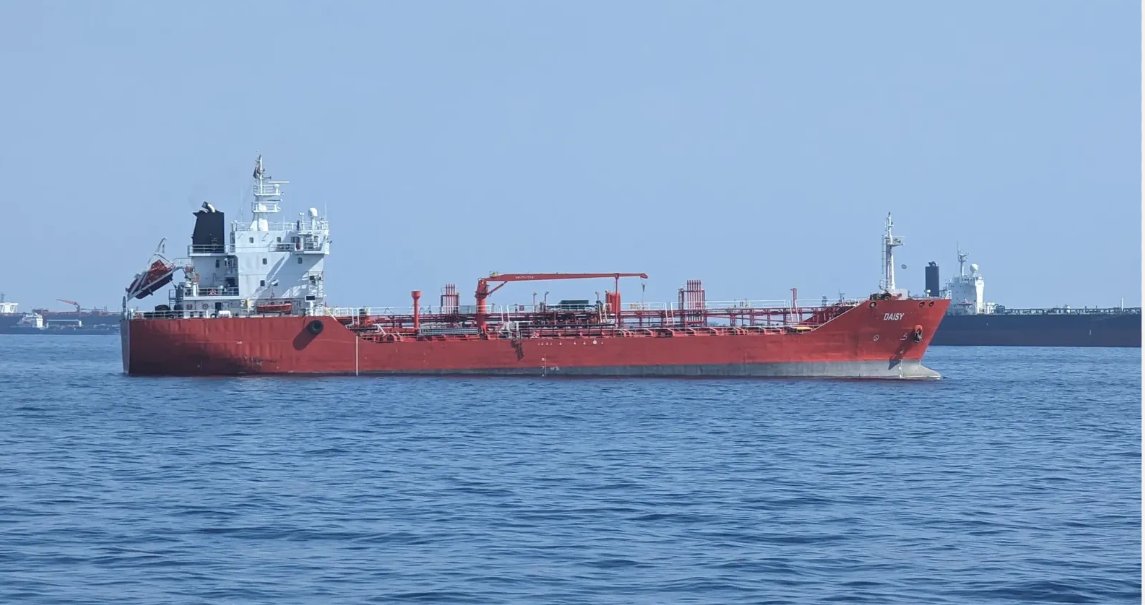

A vessel flying the flag of the Commonwealth of Dominica has become caught in the widening conflict in the Middle East after Yemen’s Houthi movement claimed responsibility for an attack on the oil tanker Daisy in the Gulf of Aden.
The incident has raised concerns about the safety of Dominican-flagged ships and civilian seafarers operating in one of the world’s most dangerous maritime corridors.
It occurred on August 5, 2026, when the Daisy was sailing westward in the Gulf of Aden. The Houthis claimed that they had struck the tanker with a ballistic missile and forced it to turn back.
But accounts from maritime authorities provide a more cautious picture.
At about 5:30 PM local time on August 5, the Daisy’s master reported a loud explosion close to the vessel. The United Kingdom Maritime Trade Operations (UKMTO) said the explosion’s shockwave caused minor damage, while the crew remained safe. Maritime security sources placed the incident approximately 95 nautical miles southeast of Aden, Yemen.
The maritime security company Vanguard Tech reported that the explosion occurred approximately 40 metres from the ship’s port side. The Houthi claim that a ballistic missile actually struck the tanker and forced it to reverse course has not been independently corroborated.
For Dominica, however, the significance is immediate: a ship registered under the Dominican flag was caught in an increasingly dangerous conflict far from the Caribbean island.
The Daisy incident illustrates how the consequences of conflicts in the Middle East can reach beyond the countries directly involved.
Dominica is thousands of miles from Yemen, Saudi Arabia, and the Red Sea. Yet the country’s maritime flag places vessels registered under its jurisdiction on international shipping routes, including the strategically important waters surrounding the Arabian Peninsula.
The Gulf of Aden is a critical gateway linking the Indian Ocean with the Red Sea and the Bab el-Mandeb Strait, through which enormous volumes of international trade pass.
An attack or attempted attack on a Dominican-flagged commercial vessel therefore has implications beyond the immediate safety of the ship and its crew. It highlights the risks faced by vessels associated with Dominica as geopolitical tensions increasingly spill into international shipping lanes.
The Daisy was able to continue its voyage toward Djibouti, and there were no reported crew injuries.
But the fact that a commercial ship carrying civilians came within such close proximity to an explosion has placed Dominica’s maritime interests in the spotlight.
The incident has taken on an even more serious dimension following a new assessment by Human Rights Watch (HRW) published on September 15, 2026.
HRW said recent Houthi attacks on commercial vessels in the Red Sea and Gulf of Aden most likely amount to war crimes in at least three cases, including attacks involving the Daisy.
The organisation said evidence indicated that the Houthis knew, or should have known, that the Daisy and other targeted vessels were commercial ships carrying civilians.
HRW said it could not confirm the cargoes aboard the Daisy, Encelia, and Amzan, but noted that the Houthis had not produced evidence demonstrating that these ships contained military targets.
Human Rights Watch researcher Niku Jafarnia said attacks against civilian crews carried out deliberately or recklessly can constitute war crimes.
The organisation’s assessment is significant, but it is important to distinguish a human-rights organisation’s legal assessment from a judicial determination. No court has convicted the Houthis of a war crime in relation to the Daisy incident.
Under international humanitarian law, however, civilian vessels and their crews are generally protected from deliberate or reckless attacks unless they constitute legitimate military objectives.
For Dominica, the Daisy incident is a reminder that the country’s international maritime presence can expose vessels flying its flag to risks arising from conflicts thousands of miles away.
The incident also comes at a time when Houthi attacks on commercial shipping have expanded beyond their earlier focus on the Red Sea.
The Houthis announced on July 20, 2026, that they would impose what they described as a maritime embargo on Saudi Arabia. According to Human Rights Watch, the group subsequently claimed attacks on at least nine vessels between July 20 and August 24.
Authorities, shipping companies, or shipmasters confirmed attacks involving four of them — Encelia, Daisy, Tihamah, and Amzan.
That escalation has increased the danger for civilian sailors whose jobs require them to pass through the region.
And for Dominica, it means that the country’s flag has now become part of the story of a conflict that has increasingly threatened international commerce.
The Daisy incident also raises a broader question for Caribbean countries with vessels operating under their flags: how can ships registered in small island states be protected when they sail through major international conflict zones?
A commercial tanker does not need to be connected to the conflict to become vulnerable. A vessel can be hundreds or thousands of miles from the country whose flag it carries and still find itself directly exposed to missiles, drones, mines, or other forms of attack.
That is precisely what makes the Daisy incident so significant for Dominica.
There were no reported deaths or injuries aboard the tanker. The explosion did not result in a confirmed direct missile impact, and the ship continued its voyage.
But the incident demonstrated just how close civilian shipping can come to becoming a casualty of war.
The August 5 incident ultimately ended without the loss of life aboard the Daisy. Yet the episode has now become part of a growing international debate over the protection of civilian shipping.
Human Rights Watch has called on the Houthis to immediately and unconditionally end unlawful attacks on civilian ships in the Red Sea and Gulf of Aden.
For Dominica, the incident carries a particularly powerful message.
The conflict may be thousands of miles away, but the Dominican flag was there — attached to a civilian vessel caught in the crossfire.
The Daisy survived the encounter. Its crew escaped unharmed. But the August 5 attack is a stark reminder that in today’s increasingly interconnected world, even a small Caribbean nation can find its flag at the centre of an international conflict.