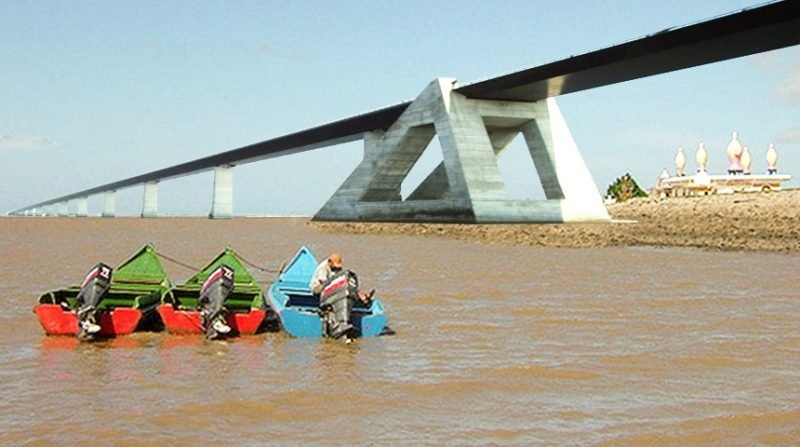
The seemingly eternal bickering with Guyana over the construction of a bridge over the Corantijn has so far brought little good and especially no river connection. Moreover, the government’s new and surprising move to now want to build the bridge itself does not make any progress. On the contrary, the long-standing dream seems further away than ever.
Text Armand Snijders
Image OW
The idea for a permanent river crossing is decades old, but the initiative took concrete shape again in 2020 when the Santokhi government concluded an agreement with Guyanese President Irfaan Ali. The bridge would become the showpiece of regional integration and definitively merge the economies of Suriname and Guyana. The population of both emerging oil countries would also benefit from this.
“The Surinamese decision to finance the Corantijn Bridge itself shows a healthy dose of patriotism, but lacks any form of financial transparency and diplomatic tact”
With great display and a sense of friendship and brotherhood, the presidents of the two countries signed a declaration of intent. The formula that was devised sounded like music to our ears: Public-Private Partnership (PPP). Through the so-called Design-Build-Finance-Operate-Maintainmodel, which was enthusiastically promoted by then Minister Riad Nurmohamed of Public Works, private investors would build and operate the bridge, so that the Surinamese state did not have to cough up a single cent.
It was like a fairytale that would come true. Ali nodded in agreement at the idea of his country co-owning – and having a say in – a bridge that is not even geographically on Guyanese soil. After all, the Corantijn belongs to Suriname. So that was pure profit for the neighbors.
A persistent myth
However, the PPP method turned out to be a persistent myth; it may have worked for a few public toilets on the Waterkant, but those were in fact just donations from companies that would otherwise have come. The really big international investors, on the other hand, turned out not to be crazy; Building a bridge in a region where the infrastructural hinterland still largely consists of dirt roads, between two countries that are regularly at each other’s throats, entails major risks. There was no belief that this money could be recouped based on future tolls.
When the tenders from large consortia, including the Dutch Ballast Nedam and China Road and Bridge Corporation, were finally received, it became painfully clear that the governments themselves would have to provide significant guarantees and capital. The PPP balloon had burst with a loud bang. Moreover, there was a lot of uncertainty and bickering about how much the countries should each contribute and what rights one could derive from this. And so the bridge remained a dream for the entirety of Santokhi’s reign (2020-2025).
There are no concrete figures
In the most recent chapter in this farce, the Surinamese government has suddenly announced that it will pay for the bridge entirely out of its own pocket and that it will also become its entire property. The reason is clear from a Surinamese point of view: the Corentijn River is completely Surinamese territory up to the Guyanese bank, so it must also become a Surinamese bridge. However, from a financial and strategic point of view, this is mainly a leap into the deep without anyone knowing whether there is even water in the pool.
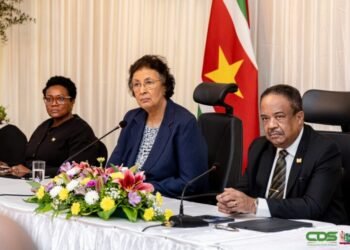
Because where will Suriname get the money from? Minister Stephen Tsang of Public Works and Spatial Planning recently presented “different financing models” in the National Assembly and would consult with the Ministry of Finance and Planning about this. But concrete figures and substantiation thereof are completely lacking. Will loans be taken out again for which future oil revenues are already reserved in advance for repayments? It appears that an air bridge will be financed with money that is not yet available, as has been done before.
Meanwhile, people on the other side of the Corantijn are shaking their heads. The Guyanese president responded via the media with great surprise to the Surinamese solo flight. Georgetown claims that no amended proposal or formal request has ever been submitted from Paramaribo through official channels, but this is denied by the Surinamese government. Guyana is adhering to previous agreements and says it has already reserved approximately 24 million US dollars as a contribution to the joint project. It is unclear what this amount is based on and whether there are agreements that more money would be pumped into the bridge.
Guyanese territory
Apart from that, the bitter reality is that a bridge to a neighboring country cannot be built alone, even if the river is yours. The physical structure may float above Surinamese water, but the ramp, customs posts, logistics hubs and connecting infrastructure will be on Guyanese territory. If Georgetown digs in its heels because it feels passed over, the Surinamese bridge will soon end before the first pile can be driven.
Moreover, there is a good chance that the entire international tender procedure, which cost millions and took years to complete, can now be definitively thrown in the trash. Tsang already admitted that a completely new tender will probably be necessary as soon as a new financing structure is in place. This means back to square one, resulting in years of additional delays.
“The bitter reality is that a bridge to a neighboring country cannot be built alone, even if the river is yours”
So what once started under Santokhi as a kind of ‘visionary project’ to transform the Guyana Shield Region economically, is in danger of being completely destroyed in a political and diplomatic power struggle, in which the agendas are clearly at odds. The Surinamese decision to finance the Corantijn Bridge itself shows a healthy dose of patriotism, but lacks any form of financial transparency and diplomatic tact.
As long as Paramaribo and Georgetown are not able to sit around the table as adult partners without constantly surprising each other through the media, the river crossing will remain exactly what it has been in recent decades: an air bridge that Surinamese and Guyanese citizens can only laugh at. And it certainly won’t happen for a while.