
Listen to this article
Estimated 3 minutes
The audio version of this article is generated by AI-based technology. Mispronunciations can occur. We are working with our partners to continually review and improve the results.
An Alberta First Nation says it aims to defy Premier Danielle Smith’s government by establishing a safe haven for gender-affirming medical care.
Saddle Lake Cree Nation says access to health care is a treaty right and falls under its inherent jurisdiction.
Late last year, Smith’s United Conservative Party government used the Charter’s notwithstanding clause to shield its legislation from court challenges.
The law prohibits doctors from prescribing puberty blockers or hormone therapy to transgender and gender diverse children under 16.
The premier has said it’s about protecting children and their fertility. But doctors and national medical associations have pushed back, noting puberty blockers don’t render a person infertile.
Chief Dale Steinhauer said the law is one of many that are dehumanizing.
“No longer will our children and families have their rights taken away,” she announced in Fort Pitt, Sask., on Wednesday.
“When one group’s rights are removed, we are all affected.”
The nation, located northeast of Edmonton, said it’s working to attract clinicians to provide care on its reserve land.
It has also started fundraising to develop its health law and defend it against potential legal challenges.
Steinhauer said clinicians who provide gender-affirming care on reserve land would be exempted from sanctioning by regulatory bodies.
“To the medical profession and regulatory bodies like the College of Physicians and Surgeons of Alberta: when will you stop this violence?” she said.
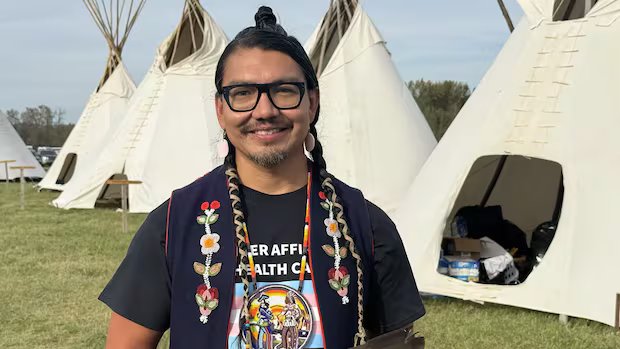
Dr. James Makokis, a two-spirit family physician from Saddle Lake Cree Nation, became emotional at the announcement while speaking about the impact of violence against two-spirit and transgender people, including self-harm.
“That is a public health emergency that has to stop,” said Makokis.
“When there’s a threat to the buffalo calves in the herd, all of the adult buffalo form a circle around those young ones, because they’re the next generation.”
Steinhauer cited the medicine chest clause of Treaty 6, signed 150 years ago, which says the Crown will keep a medicine chest in the home of each federal government agent working on or near a reserve.
It’s widely understood by First Nations to be a commitment to provide comprehensive health care, and Indigenous leaders have criticized the Crown for failing to live up to the promise.
Steinhauer asked how the Alberta government could stop First Nations doctors from practising, or accessing the medicine chest.
“Have the colonial governments not learned enough from their own history?”
Alberta’s health-care law is one of three from the UCP government impacting transgender people across the province.
Another requires parental consent for students under 16 to change their names or pronouns at school. The third bans transgender athletes 12 and older from participating in amateur competitive female sports.
Heather Jenkins, a spokesperson for Justice Minister Mickey Amery, repeated in a statement Wednesday that the laws are about preserving choice for children and youth, strengthening the role of parents, and ensuring fairness and safety in amateur competitive sports.
“Alberta’s United Conservative government will be unapologetic in our commitment to these principles,” she said.