Slovakia has acquired a modern tool that changes the way we perceive coexistence with our biggest beast. The State Nature Protection of the Slovak Republic has officially launched a new web platform pozoromedved.sk, the dominant feature of which is an interactive map mapping the occurrence of brown bears in real time.
This digital assistant does not only serve to satisfy curiosity, but represents a key element in the effort to increase the safety of residents and tourists. The data on the map is based directly on public input, which makes it possible to monitor operationally where individual animals move to and where their activity is most pronounced in 2026.
Where to be most careful and which regions are safe
Looking at the current data and comparing them with the year 2025, it is clear that the center of gravity of occurrence remains in the heart of Slovakia. The riskiest clashes and the densest concentration of reports were concentrated in the districts of Liptovský Mikuláš, Poprad, Martin, Prievidza and Zvolen.
These areas have long been considered hot zones, where caution when moving in nature should be an absolute priority. At the moment, the regions of Žilina and Brezna show a medium risk, where the movement of animals is regular, but less intense. On the contrary, residents of eastern Slovakia, especially in the Prešov region, face only a low risk. The situation remains completely peaceful in the vicinity of Košice, Michaloviec and in the entire south-western belt from Bratislava through Trnava to Komárno, where the bear occurs only exceptionally or not at all.
enlarge
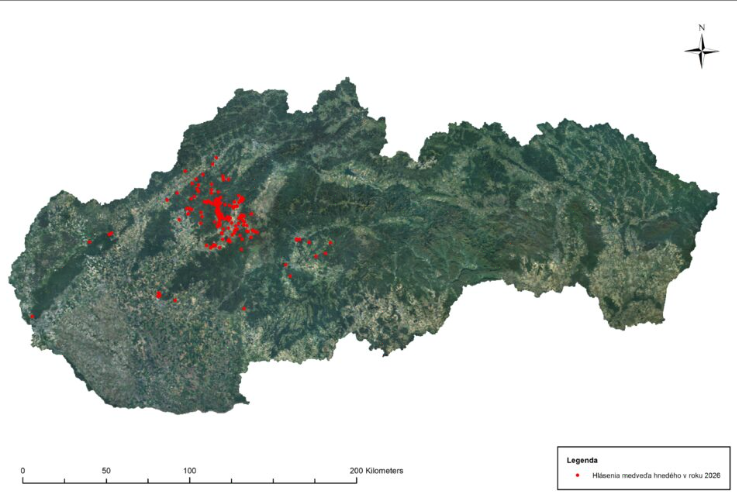 Photo: pozomermedved.sk
Screenshot 2026-04-23 095205 A web map that tells you exactly where bears are located in Slovakia and warns you in time thanks to data from the field.
A platform that connects science with field practice
General Director of ŠOP SR Roman Fajth emphasizes that the aim of the platform Attention bear is not just passive monitoring, but above all active prevention and better coordination of intervention teams. The website offers a comprehensive view of the issue, while reports from people serve experts to quickly evaluate risky situations.

Thanks to the systematic collection of data, conservationists can more effectively take measures directly in the field and inform municipalities about the development of the situation. It is a strategic step to ensure that information about the danger is not spread only in the form of rumors, but is supported by real numbers and locations.
How to make your garden an uninteresting place for a bear
However, prevention does not end with following the map, it begins right at our homes. State conservationists point out that the bear is a naturally shy animal that is primarily attracted to people by easily available food. The basic rule for owners of houses and cottages is to consistently secure waste in lockable containers and regularly collect fallen fruit, which acts as a strong magnet for animals.
It is equally important not to leave food scraps in yards, to provide composting sites and to store pet food exclusively indoors. If a bear does not find anything to eat near villages, it loses its reason to approach people and retains its natural instincts.
Public space under the supervision of technologies
In addition to individual responsibility, technical measures in municipalities also play a key role. Emergency teams are increasingly using electric fences, odor repellents, but also acoustic and light scarers in places with frequent occurrences. An important step towards safety is also the modification of the environment itself, for example the regular removal of invasive trees and dense vegetation in which the beast could hide unnoticed.
Strengthened public lighting on the outskirts of municipalities and monitoring of critical points using camera traps or camera systems helps not only to protect property, but above all people’s lives. Correctly set prevention significantly reduces the need for radical interventions in the bear population and builds trust between the public and experts.