In 1977, the U.S. buried 120,000 tons of radioactive waste inside a concrete dome in the Pacific, and rising seas are now threatening to expose it
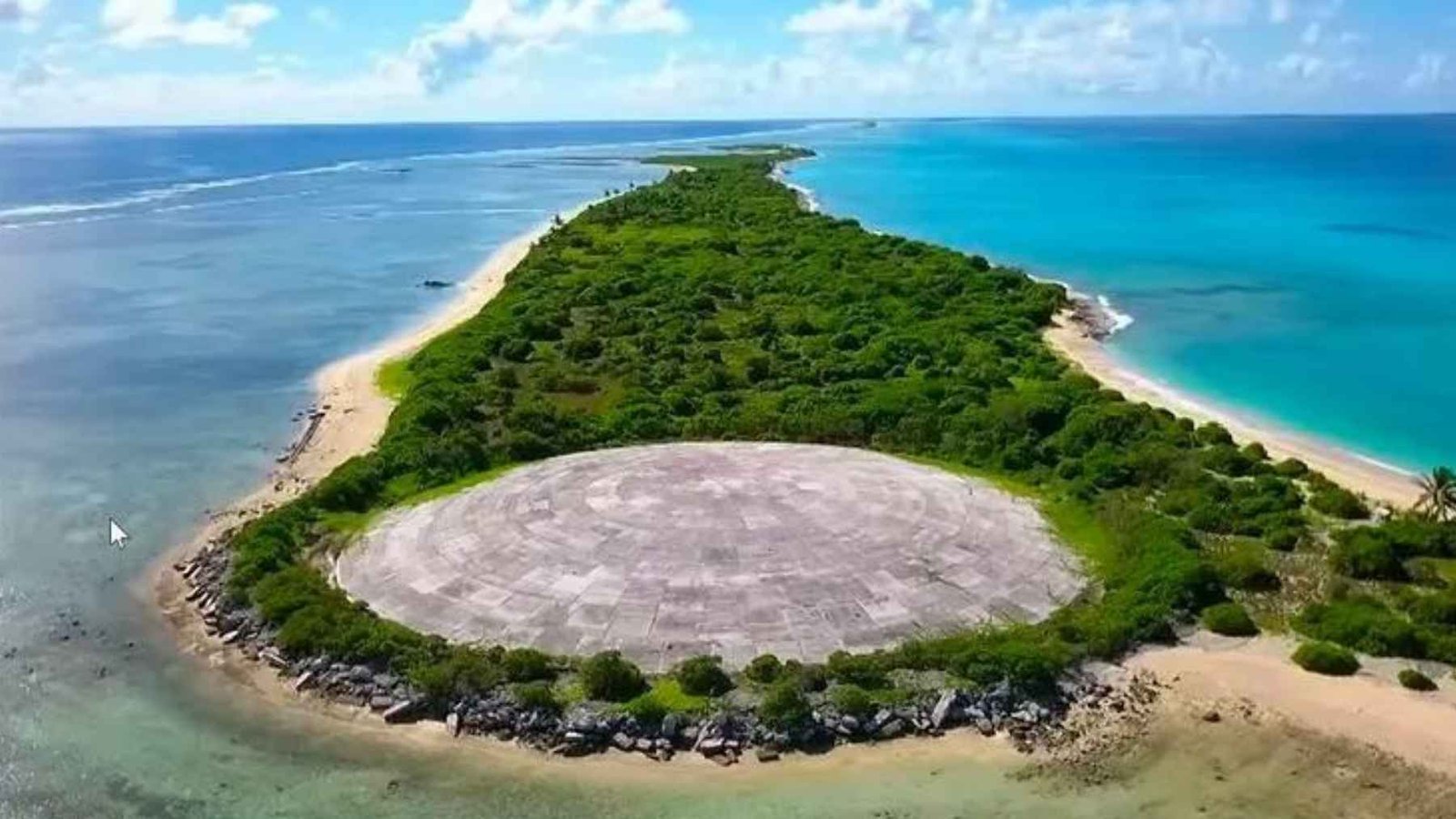
From the air, Runit Dome looks like a pale concrete coin dropped on a narrow strip of green land in the Marshall Islands. The 374-foot-wide cap covers radioactive soil and debris placed in an unlined nuclear test crater during a U.S. cleanup that began in 1977 and ended in 1980.
Nearly half a century later, visible cracking, moving groundwater, and rising seas have turned it into a symbol of a Cold War problem that never went away.
The latest detailed federal findings available publicly do not support an imminent-collapse scenario, and U.S. modeling estimates small added radiation doses to inhabited islands even under a hypothetical failure. But that finding comes with a harder truth because
Enewetak Lagoon already holds roughly 100 times more transuranic radioactivity than the dome, while Marshallese officials say U.S. agencies have downplayed the broader risk and failed to earn public trust.
A blast crater became a dump
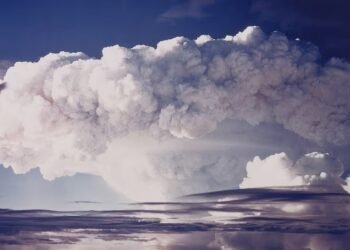
The United States conducted 67 atmospheric nuclear tests across the Marshall Islands from 1946 to 1958, including 43 at Enewetak Atoll, contaminating the land and lagoon and leaving Runit Island indefinitely off-limits. When cleanup began, workers scraped contaminated soil and debris from six northern islands and hauled it to Cactus Crater, left by a 1958 nuclear test.
Inside went about 100,000 cubic yards of contaminated soil mixed with cement, plus around 6,000 cubic yards of debris. Above it, crews formed 357 trapezoidal concrete segments and a top section, each designed to be about 18 inches thick. The structure functions more like an erosion cap than a fully lined vault.
The bottom was never sealed
The crater has no impermeable liner. Monitoring indicates that groundwater under the cap and lagoon water are in hydraulic communication, and the Department of Energy says fallout contamination may be leaching into the aquifer beneath the structure. That sounds alarming because it is, but it does not automatically mean a large plume is reaching people.
In one monitoring well, strontium-90 was about 20 times and gross beta activity almost 10 times the Environmental Protection Agency’s drinking-water limits, although the groundwater is not a drinking source.
DOE concluded that any outflow was unlikely to create a significant human or ecological risk because it is diluted and difficult to distinguish from the much larger contamination already in lagoon sediments. For families who depend on fish, however, “already contaminated” is hardly a comforting answer.
Cracks do not tell the whole story
Recent reporting in March 2026 again showed cracks across the outer shell. Earlier DOE surveys in 2013 and 2018 documented cracks and spalled seams, yet engineering tests found that the defects were not structural and that the cap remained strong enough to serve its erosion-control purpose.
More than 1,000 linear feet of cracks and 34 spalls identified in 2013 were later repaired, according to Lawrence Livermore National Laboratory.
DOE’s 2020 report said the dome was “not in any immediate danger of collapse or failure.” So the structure is neither pristine nor proven to be on the verge of collapse. The more credible long-term concern is the compound pressure of groundwater, storm surge, and sea-level rise on a low-lying site.
What the latest models found
In 2024, the Pacific Northwest National Laboratory modeled nine scenarios based on severe historical storms, current conditions, a 2090 climate, and a worst-case failure that released the dome’s entire inventory.
When the dome remained intact, the estimated increase in dose was below 0.1 millirem per year on every island. Under the hypothetical failure, added doses on inhabited islands remained below 0.2 millirem per year, compared with about 310 millirem a year from natural sources in the United States.
A peer-reviewed Scientific Reports paper published in 2025 reached a more nuanced result. Its model found that storms can sharply raise radionuclide concentrations for brief periods, and a postulated dome collapse produced a maximum 28.4-fold relative increase in plutonium-239 at some locations. The authors stressed that those concentration spikes do not by themselves establish human-health risk and that the model relied on old inventory data with limited site validation.
That distinction matters. A concentration can jump from a very low baseline and still produce a small dose, while repeated exposure through seafood or local activity requires a separate assessment. In other words, the science does not support panic, but it does support better sampling and long-term monitoring.

The lagoon is the bigger source
The most surprising number sits outside the dome. GAO reported DOE estimates of about 15 curies of transuranic activity in Runit Dome and roughly 1,830 curies in Enewetak Lagoon, around 100 times more. A broken cap would therefore not introduce radioactivity into a clean ecosystem, but disturb one part of a much larger contaminated landscape.
DOE uses that comparison to argue that leakage from the dome is not a major added source of exposure. Marshallese officials see the same setting differently, warning that higher seas could move contamination through groundwater and fishing grounds while the public carries the consequences. Both statements can be true at once, and that is why a single “safe” or “unsafe” label misses the point.
The argument is now about trust
Washington’s official position is that responsibility for controlling affected areas shifted to the Marshall Islands under the Compact of Free Association, although U.S. law still requires DOE to inspect the dome and analyze surrounding groundwater at least every four years.
The Marshallese government has challenged that position and continues to press the United States over responsibility for the nuclear legacy. The power and resource imbalance is central to the dispute.
GAO found that DOE considers the health risk low, while Marshallese officials believe the department has downplayed it. The watchdog recommended a communication strategy that is “sustained, understandable, and transparent,” and its latest public update says that recommendation remains open after DOE reported in August 2025 that a draft plan was still under review.
When the subject is radiation in fishing grounds and food, trust is not a public-relations extra but part of the safety system.
Runit Dome may not be days away from failure, but its unlined design leaves a long-term stewardship problem on a low-lying island. The harder task is making sure the people who inherited this nuclear legacy are not left to inherit the uncertainty as well.
The findings appeared in the journal Scientific Reports.