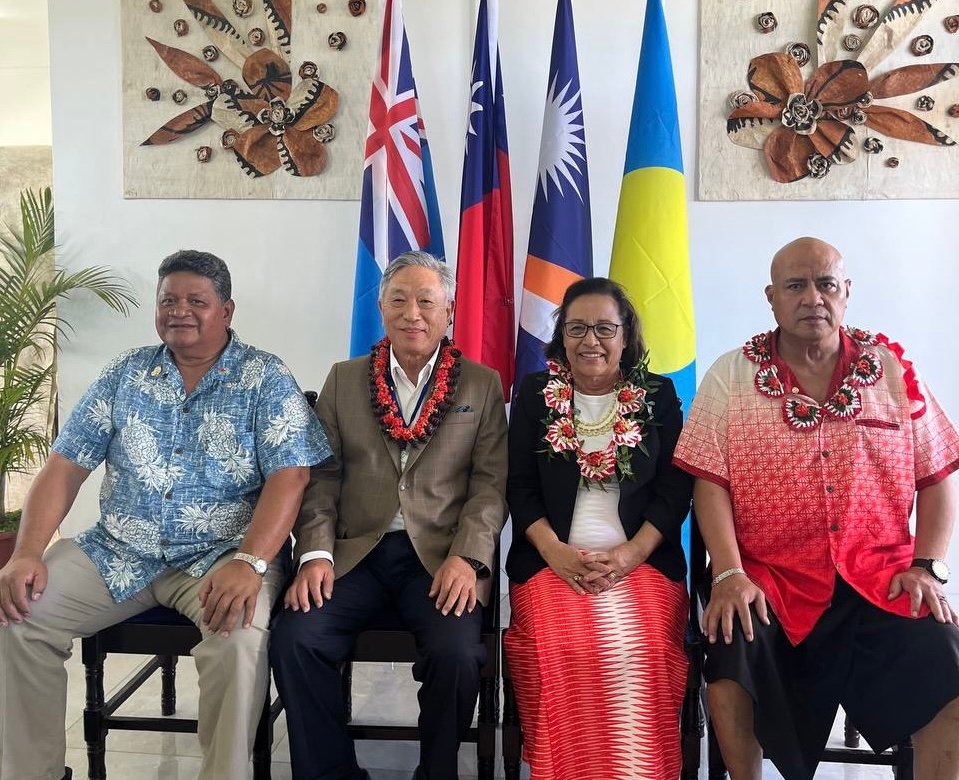
David Cheng-Wei Wu, Representative, Taipei Trade Office in Fiji
As Pacific leaders prepare to gather for this year’s Pacific Islands Forum (PIF), they will once again address the defining challenges facing the region—from climate change and economic resilience to ocean governance and sustainable development. Yet another question deserves equal attention: how can the Forum continue to safeguard its independence in an era of intensifying geopolitical competition?
For more than half a century, the answer has been found in the Pacific Way.
The Pacific Way is more than a diplomatic tradition. It is the belief that dialogue is preferable to confrontation, consensus
is stronger than coercion, and respect for one another is the foundation of lasting regional cooperation. It has enabled
countries of different sizes, histories and political systems to work together while ensuring that Pacific priorities remain
determined by Pacific peoples.
That tradition has made the Pacific Islands Forum one of the world’s most respected regional organisations.
Today, however, that tradition faces increasing pressure.
As major powers devote greater strategic attention to the Pacific, regional institutions inevitably attract greater geopolitical interest. International engagement is welcome when it supports Pacific priorities. It becomes far more problematic when external political competition begins to influence the Forum’s long-established practices or distracts it from the issues that matter most to Pacific communities.
The Pacific Islands Forum was never intended to become another arena for strategic rivalry. Its purpose is to strengthen
regional cooperation and advance the collective interests of the Blue Pacific.
Protecting that purpose requires confidence in the Forum’s own decisions, respect for its institutional continuity and trust
in the consensus built by Pacific leaders over many decades.
This principle is particularly relevant when considering Taiwan’s longstanding relationship with the Forum.
For more than thirty years, Taiwan has participated in Forum-related activities as a Development Partner under arrangements established by the 1992 PIF Leaders’ Communiqué. Since 1993, Taiwan has engaged constructively with Forum members while respecting the Forum’s procedures, traditions and consensus-based approach to regional cooperation.
Over those three decades, Taiwan has sought to demonstrate that genuine partnership is measured by contributions rather
than political rhetoric.
Across the Pacific, Taiwan has built its reputation not through grand announcements but through long-term engagement. Taiwanese Technical Missions have worked alongside governments and local communities in Palau, the Marshall Islands, Tuvalu, Fiji and Papua New Guinea, supporting agricultural development, fisheries management, vocational education, public health, medical cooperation and community capacity-building. For many Pacific islanders, Taiwan is known not through diplomatic statements but through agricultural experts, medical professionals, engineers and technical advisers who have worked in their
communities for many years.
Taiwan has also recognised that strong regional institutions are essential to Pacific cooperation. For many years, it has
provided approximately US$1 million annually in financial support for the operations and programmes of the PIF Secretariat and the Council of Regional Organisations of the Pacific (CROP) agencies. In addition, Taiwan has offered scholarships, professional exchanges and technical cooperation programmes that strengthen local institutions and develop the skills needed for sustainable development.
Its commitment has continued to evolve alongside Pacific priorities. In 2025, Taiwan pledged US$3 million in support
of the Pacific Resilience Facility (PRF), a Pacific-owned financing mechanism established to help communities strengthen their resilience against climate change and natural disasters. The pledge reflected Taiwan’s confidence that the most effective solutions are those designed and led by Pacific countries themselves.
These are not acts of charity. They are investments in partnerships built on mutual respect, shared responsibility and long-term commitment.
This is why Taiwan’s relationship with the Forum should not be viewed solely through the lens of geopolitics.
The more important question is whether development partners contribute constructively to Pacific priorities, honour their commitments and respect the institutions that Pacific leaders have built together.
For more than three decades, Taiwan has consistently sought to do exactly that.
Conversely, efforts by outside powers to redefine longstanding Forum arrangements through political pressure risk weakening the very principles that have made the Pacific Islands Forum successful. When consensus gives way to coercion, and established practice becomes subject to geopolitical contest, regional institutions inevitably become less able to focus on the challenges Pacific communities identify as their highest priorities.
The Pacific Way offers a better path.
It reminds all partners that the Forum belongs first and foremost to the peoples of the Pacific. Its future should be determined through the Forum’s own processes, according to the collective judgement of its members, and free from
external political pressure.
As leaders meet this year, the central question is therefore not whether Taiwan benefits from participating in the Pacific Islands Forum.
The more important question is whether the Forum benefits from continuing to welcome partners that have demonstrated,
over decades, respect for Pacific leadership, a willingness to deliver on commitments and a genuine commitment to the region’s long-term development.
For more than thirty years, Taiwan has sought to be such a partner.
By remaining faithful to the Pacific Way and by judging development partners on the basis of their contributions rather than geopolitical rivalry, the Pacific Islands Forum can continue to do what it has always done best: remain an institution shaped by Pacific voices, serving Pacific interests, and working for a peaceful, resilient and prosperous Blue Pacific.