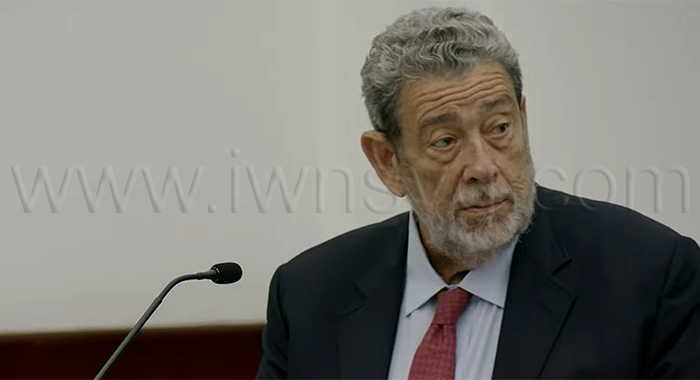
Opposition Leader Ralph Gonsalves has opposed in Parliament the motion presented by government senator, Chelsea Alexander, which calls for the establishment of a national development bank in St. Vincent and the Grenadines.
The former prime minister, who was voted out of office in November, after 25 years in office, called for a “rethink”, arguing that current entities perform the roles the proposed bank is to fill.
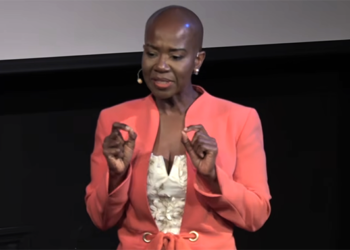
In presenting the motion, Alexander said the New Democratic Party (NDP) government intends to be “proactive, intentional, and focused” in reshaping national institutions so that they are “purposefully designed” to remove longstanding barriers to economic growth.
She said many young people engaged in new emerging industries often struggle to access financing, adding that a national development bank would “bridge that gap” by providing funding and support to start-ups and innovators who “often fall outside the scope of traditional lending criteria…
“In this way… the establishment of the National Development Bank is an invitation, especially to young people, to think beyond convention, to embrace innovation, entrepreneurship and the reimagining of traditional industries,” Alexander said.

However, Gonsalves said that once the history of development finance in SVG and the current institutional landscape are properly considered, the proposal, in its present form, should be reconsidered.
“I want to suggest that when I’m finished with my presentation, that there be an appropriate rethink of this proposal,” said Gonsalves, who was minister of finance from 2001 to 2017, under the Unity Labour Party (ULP) government, which was voted out of office in November.
He said that once lawmakers examined “the history and the current circumstances” of financing in agriculture, housing, education, information technology, culture, the arts, and small, medium-sized and own‑account operators and compared them with experiences in other OECS countries, “you would see a case for a rethink”.
Gonsalves traced the history of development banking in SVG from the Development Corporation, founded in the 1960s under the Labour Party administration.
Under the NDP administration — 1984 and 2000 — a decision was taken in 2000 to set up a development bank, and all loans — “good and bad” — from the Development Corporation were transferred into the new institution with EC$5 million in capital, he said.
“The problem… the Development Bank was stillborn,” Gonsalves said. “The bad loans exceeded the good loans by far, indeed exceeded the $5 million in equity which was put in. So, the bank was stillborn. It was insolvent ab initio, from the very beginning.”
Gonsalves further said that when his administration took office in 2001, the state-owned National Commercial Bank (NCB) was “in a terrible condition” and “insolvent”.
The ULP responded by transferring the “good” loans from the development bank to the NBC and by creating a special-purpose vehicle to manage the non‑performing portfolio.
He said a micro and small enterprise loan programme was then established at NBC but when his government sold the majority of NCB shares to the Bank of Saint Lucia, the new shareholders no longer wanted that component of the business.
Gonsalves argued that instead of a single national development bank, successive policies implemented by his government produced a “fit-for-purpose” array of targeted institutions.
He mentioned the Student Loan Company, which has a delinquency rate of “a number close to 25%”, the Farmer Support Company, founded in 2014 with EC$5 million in initial capitalisation, and PRYME (Promoting Youth Micro‑Enterprises), which gives grants of up to EC$40,000.
The opposition leader spoke about his then-government’s housing mortgage initiatives, mainly the 100% mortgage for public servants.
“Without establishing a national development bank, a number of fit-for-purpose institutions and public policies were created to take the advancement of the particular goals, including all of the [Sustainable Development] Goals,” he said.
The opposition leader responded to government lawmakers’ references to the focus of development banks in other countries across the region.
He argued that existing banks in SVG are constantly seeking “bankable projects” across the sectors identified in Alexander’s motion.
“We have a set of institutions … which do not have the level of expense which you will have with the national development bank,” Gonsalves said, adding that creating a new institution without secure, low‑cost funding might come at the expense of existing ones.
“What I suspect would want to be done is to close down the Student Loan Company, close down the Farmer Support Company, close down PRYME, close down all of those entities which have brought so much good to this country,” Gonsalves said.
Gonsalves also focused on the source of funding for the proposed national development bank and questioned how the government would obtain funds cheaply enough to lend at concessional rates while covering administrative costs and non‑performing loans.
The opposition leader said Alexander appeared to be aware of the central question of capitalisation.
“A bank without money is an oxymoron,” he said. “So you have to find money, and you have to find money… either as grant, or you have to get it as loan, sufficiently cheaply and on such excellent terms that you can lend in a preferential manner.”
Gonsalves also questioned the assertion in the motion that the new bank was necessary to catalyse small and medium‑sized enterprises (SMEs) across the country.
In presenting the motion, Alexander had noted that in the campaign for the 2025 general election, the NDP had promised the reintroduction of a national development bank.
Gonsalves countered:
“It is often said that people campaign in poetry, but you have to govern in prose, and you may find that some of your more poetic utterances on the campaign trail, you may find them very difficult to address in the real world.”
The opposition leader said that while he supported the broad development objectives, he could not endorse the motion as presented.
“There are aspects of it which are, as they say, motherhood and apple pie, which anybody can agree with,” Gonsalves said. “But insofar as giving the national development bank the support here as what is presented, I regret that I’m unable to do so for the reasons that I have just outlined.”
“I think that I’ve given this Honourable House, and I’ve given the country the benefit of my knowledge and my experience and my judgement as to how we should proceed with this matter,” he said.
The debate on the motion will continue at a later date, as it was not completed by 5 p.m., when debate on private members’ motions must end.