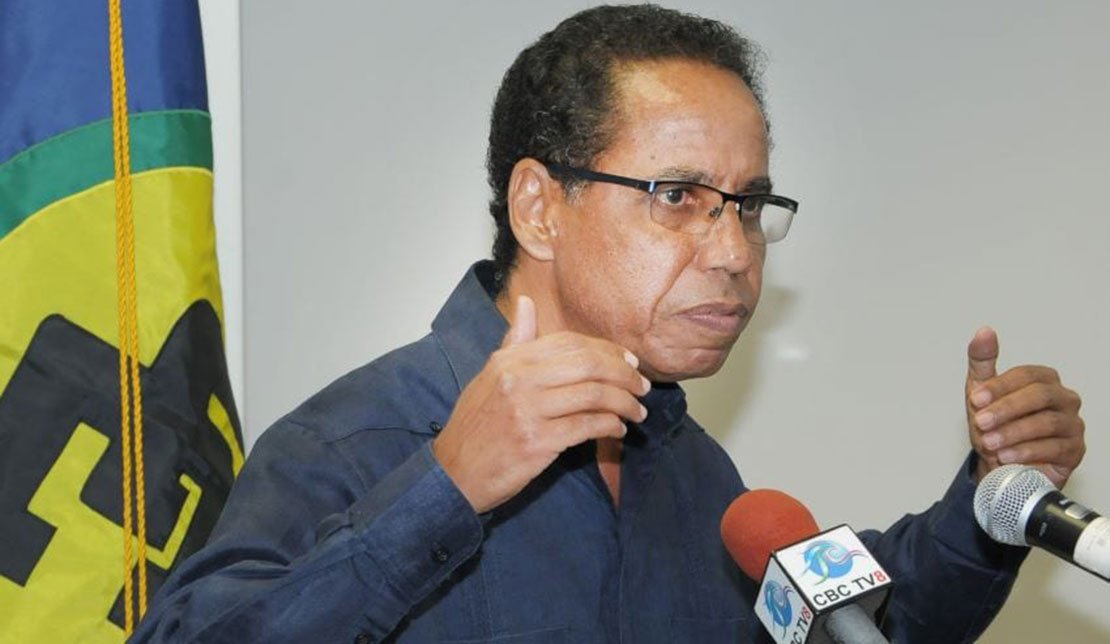

Barbados Ambassador to CARICOM HE David Comissiong
Disclaimer: All views and claims expressed in this article belong solely to the author.
Recently, the Caribbean Court of Justice (CCJ) has been dominating news headlines across our Caribbean region – for all the wrong reasons.
But the unfortunate reality is that most of our people do not really know much about the CCJ, and therefore may easily be misled into drawing false and negative conclusions about this critical CARICOM institution.
So, let us try – in this article – to help correct that deficiency.
First of all, it is important that we fully grasp the fact that the CCJ is OUR organization !
The Caribbean Court of Justice (CCJ) was established between the years 2001 and 2005 by the fifteen member nations of our Caribbean Community (CARICOM) and is therefore an “institution” of CARICOM.
Indeed, the CCJ is one of the seventeen institutions of CARICOM – a group of institutions that includes the Caribbean Disaster Emergency Management Agency (CDEMA), the Caribbean Agricultural Research and Development Institute (CARDI), and the Caribbean Examinations Council (CXC) among others.
The CCJ was established as a regional Court that would supply the following two services to the member states of CARICOM:-
*It would be the Court that presides over and adjudicates all disputes pertaining to the functioning of our Revised Treaty of Chaguaramas; and
*It would be available to function as the highest national Court of Appeal for any CARICOM country
Now, many of our CARICOM institutions are truly outstanding organizations, but if I was challenged to select THE very best and most excellent CARICOM institution of them all, I would have to go with the Caribbean Court of Justice (CCJ)!
And let me now list the many reasons why – in my opinion – the CCJ stands head and shoulders above not only every other CARICOM institution, but also way above the British Privy Council:-
(1) FINANCES OF THE CCJ
First of all, the finances of the CCJ are as secure as the proverbial “Fort Knox”!
You see, the CCJ is financed out of the income generated by a permanent US$100 Million Trust Fund that is administered by a highly professional Board of Trustees drawn from or including the Heads of the Insurance Associations of the Caribbean, the Caribbean Institute of Chartered Accountants, the Association of Indigenous Banks of the Caribbean, the Organisation of Commonwealth Caribbean Bar Associations, the Caribbean Congress of Labour, the Caribbean Association of Industry and Commerce, the University of the West Indies and the CARICOM Secretariat.
This excellent state of affairs is a tribute to the collective foresight of the CARICOM Secretariat, then Barbados Attorney-General, Mia Amor Mottley, and former St. Lucia Prime Minister, Dr. Kenny Anthony, who undertook responsibility for setting up the Trust Fund at the time of the establishment of the CCJ.
(2) FIRST CLASS FACILITIES AND SERVICE
This fulsome and secure funding explains why the CCJ has been able to establish and maintain a first class, modern, state-of-the-art headquarters and Court in Port-of-Spain, Trinidad & Tobago and – unlike the Privy Council – to also institute the modus operandi of an itinerant Court, travelling and taking its services to Caribbean citizens in Barbados, Jamaica, Belize, Guyana and other CARICOM nations.
(3) EXPERIENCED JUDGES OF HIGH REPUTATION
The CCJ also employs and maintains a panel of absolutely first class, experienced, and highly professional judges who – to date – have been drawn from the nations of Trinidad & Tobago, St. Kitts & Nevis, Jamaica, St. Vincent & the Grenadines, the United Kingdom, Barbados, the Netherland Antilles, Guyana, Belize, Canada, and Nigeria.
Indeed the first three Presidents of the Court have been such outstanding legal luminaries as Hon. Michael de la Bastide of Trinidad & Tobago, Sir Dennis Byron of St. Kitts & Nevis, and Hon. Adrian Saunders of St. Vincent & the Grenadines.
(4) INDEPENDENT ADMINISTRATION OF THE CCJ
The CCJ judges are all appointed by a broad-based non-political “Regional Judicial and Legal Services Commission” (RJLSC), comprised of selectees or representatives of such entities as :-
*the Council of Legal Education,
*the University of the West Indies Law Faculty,
*University of Guyana Law Faculty,
*the private sector Bar Associations of the CARICOM nations,
*the OECS Bar Association,
*the Organization of Commonwealth Caribbean Bar Associations,
*one CARICOM Public Service Commission,
*one CARICOM Judicial Services Commission, and
*the Secretaries General of CARICOM and the OECS.
You really cannot get more broad-based and politically independent that this!
And it is this broad-based and manifestly independent Commission that has stepped forward and assured us that the current controversy will be investigated and dealt with appropriately through the Court’s internal disciplinary mechanisms.
(5) AN ACCESSIBLE CARIBBEAN PEOPLE’S COURT
The CCJ – unlike the British Privy Council – is a final Court of Appeal for all types of civil and criminal cases – from the smallest civil claim of the average working-class Caribbean citizen to the high finance cases of the corporate elite.
The British Privy Council, on the other hand, basically functions as an Appeal Court either for the murder appeals of persons on death row or for big civil cases. The Privy Council is not – in effect – a court that deals with the typical legal matters of ordinary Caribbean citizens!
(6) REASONABLE AND AFFORDABLE JUSTICE
One of the reasons why the British Privy Council – unlike the CCJ – is not really a Court for the masses of Caribbean people, has to do with costs.
In order for a Caribbean citizen to take a case before the Privy Council in London, England, he or she not only has to get permission to do so, but he/she also has to pay expensive filing costs; retain expensive UK based lawyers; and undertake the expensive venture of travelling to the United Kingdom.
Indeed, legal experts estimate that a Caribbean citizen has to look for somewhere between US$57,000 and US$87,000 in order to pay for a civil appeal before the Privy Council!
With the CCJ there is no such prohibitive cost. Furthermore, rather than the Caribbean citizen having to travel to the CCJ in Trinidad, the CCJ will often come to the citizen in his or her home territory, or permit the appeal to be heard via video conferencing!
(7) A COMMITMENT TO IMPROVING THE ENTIRE SYSTEM
Unlike the British Privy Council, the CCJ makes it a point of duty to “get on the case” of inefficient or dysfunctional national Courts of Law in our individual CARICOM member states – constantly subjecting them to constructive criticism, advice, and even training, in order to get them to improve their standards. So, in addition to its strict and narrow function as a court, the CCJ also serves as a Caribbean developmental institution, involved in raising standards right across our justice system.
(8) A 21 YEAR RECORD TO STAND UPON
And finally, the CCJ has now been in existence for some twenty-one years, and has created a self-evident record of achievement that speaks for itself !
Indeed, far from there being any evidence of outside political or governmental interference in the functioning of the Court over that extensive twenty-one year period, the CCJ has actually ruled against CARICOM governments on multiple occasions !
CONCLUSION
Clearly, the CCJ is one of the greatest accomplishments of our regional integration Movement!
Moreover, it is an achievement that we collectively accomplished through the application of our own initiative and native intellect, and that our citizens and taxpayers have independently underwritten and financially supported.
Just look at all the Caribbean entities that are involved in and therefore that are part and parcel of the CCJ ! Look at the long list of important national and regional organizations ! The conclusion is clear : the CCJ is a veritable microcosm of our Caribbean Community. For us not to have confidence in the CCJ, would therefore be tantamount to us not having confidence in ourselves.
It therefore goes without saying that we should all feel very proud about this outstanding Caribbean success story.
And we should feel that sense of pride in spite of the current controversy that is swirling around the CCJ, for indeed, there is no institution made by man that will not be subject to some controversy or challenge from time to time !
At present, the CCJ serves 14 CARICOM member states as a Court of original jurisdiction with responsibility for interpreting and applying the Revised Treaty of Chaguaramas, but it only serves five (5) CARICOM states as a final national Court of Appeal – Barbados, Guyana, Belize, Dominica, and St Lucia.
Surely it is time for all of us in the Caribbean Community (CARICOM) to make full use of this first class Caribbean institution!