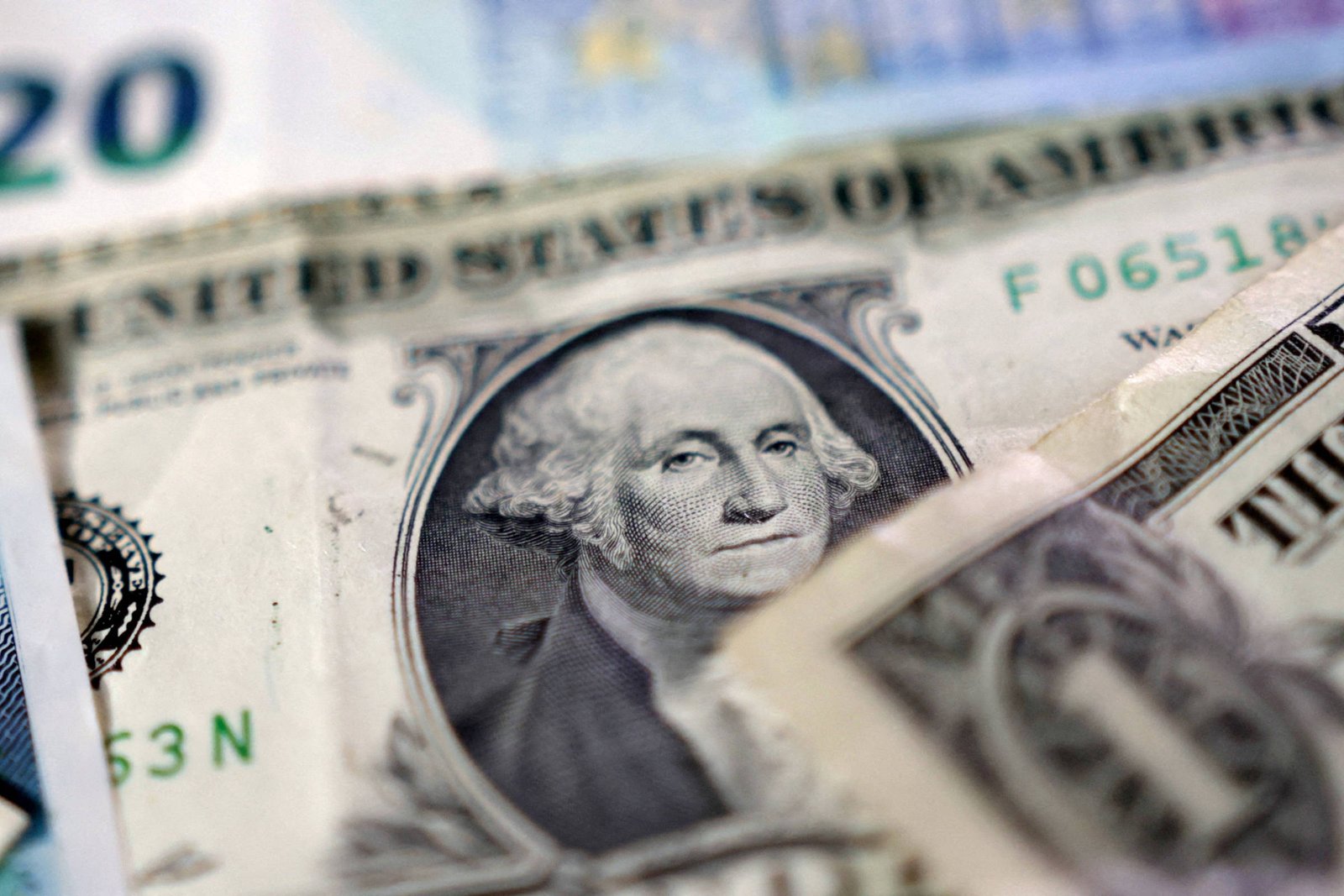
THE dollar closed again above R$5 this Thursday (23), ending the day with an increase of 0.59%, at R$5.003, as tensions between the USA and Iran deepened investors’ caution.
The last time the US currency closed above this level was on April 10almost two weeks ago.
This Thursday’s trading session was volatile, with the rise in oil prices strengthening the real for much of the day. This movement took the dollar to a low of R$4,940, down 0.67%. During the afternoon, however, there was a reversal of optimism, with an increase in tensions in the Middle East boosting the search for security assets, such as the dollar.
Impacted by the scenario of greater risk aversion, the Brazilian Stock Exchange fell 0.78%, to 191,378 points.
This Thursday, tensions between the US and Iran increased again. The president of United StatesDonald Trump said he felt no pressure to end the war with Iran, but warned that “the clock is ticking” for Tehran.
Trump also said he ordered the U.S. Navy to “shoot and kill” any Iranian boat laying mines in the Strait of Hormuz. “We have complete control of Hormuz,” he said.
On the part of Tehran, Iranian media reported on Thursday that explosions were heard in the Iranian capital. The state news agency IRNA stated that “anti-aircraft defense shots were heard” in the west of Tehran. The Mehr agency indicated that the systems were activated against “hostile targets.”
An Israeli source, however, told AFP that his country’s army was not responsible for the alleged offensives.
Tehran and Washington have blocked maritime traffic from Hormuz, through which 20% of the world’s oil and LNG (liquefied natural gas) production passes. On Wednesday (22), Iran’s Revolutionary Guard, a division of Tehran’s Armed Forces, announced that detained two oil tankers who attempted to cross the strait without his authorization.
This Thursday, the US stopped and boarded a ship with Iranian oil in the Indian Ocean. Until the day before, the Pentagon had said it had prevented the transit of 31 ships since the beginning of the embargo, the second day before last (13).
The tensions were reflected in greater risk aversion in global markets. Oil closed this Thursday on a high. The Brent barrel, a global reference, jumped 4.02%, to US$ 106.01. At its highest, a barrel reached US$107.37 — the highest price since April 7th.
Stock markets fell abroad. In the US, the S&P 500, Nasdaq and Dow Jones indexes fell 0.53%, 0.89% and 0.36%, respectively. In Europe, the Euro Stoxx 50 index, the continent’s reference, closed down 0.19%.
In Brazil, the announcement of the temporary ceasefire caused the Stock market approaches the level of 200 thousand points. The lack of major advances in the geopolitical scenario over the last few weeks, however, caused the Brazilian stock market to retreat — a movement that was intensified with this afternoon’s tensions.
For Itaú BBA, the recent lows are justified by the realization of profits on the Ibovespa, that is, investors taking advantage of the recent highs to sell shares and pocket gains. According to the bank, the prospects for progress in an agreement between the United States and Iran remain surrounded by uncertainty.
“This indicates that there is still a lack of additional momentum for the market, as a whole, to feel more comfortable in sustaining new highs”, he states in the chartist’s diary this Thursday.
Ágora Investimentos also highlights a correction process. “Despite the more intense adjustment, the reading still fits as a correction within an uptrend.”
The perception is that, despite Trump having announced the extension of the ceasefire, negotiation channels between the US and Iran remain blocked.
The Republican announced on Tuesday (21) the extension of the truce between the countries. The North American did not set a new deadline as a limit, stating only that the truce will be extended until Iran presents a proposal.
However, the second round of negotiations between Iran and the US in Islamabad, the capital of Pakistan, remains on hold, after Iranian authorities did not confirm participation. The US delegation is led by US Vice President JD Vance — who participated in talks between the countries in early April, that ended without an agreement.
Iran refuses to participate in negotiations while the US maintain the blockade on the transit of Iranian ships in the Strait of Hormuz —Tehran considers the measure a violation of the ceasefire.
As an oil exporter, Brazil benefits from the rise in oil prices, both through the flow of foreigners and the trade balance. The global search for protection, however, tends to put pressure on domestic assets.
“The predominant tone was one of caution, as the general perception is that the impasse in the Middle East remains far from a definitive resolution. The reading of the day is clear: as long as there is no concrete sign of detente between the US and Iran and normalization of the flow in Hormuz, the market tends to continue alternating between relief and protection”, says Marcos Praça, director of analysis at Zero Markets Brasil.
Cristiane Quartaroli, chief economist at Ouribank, says he sees a reversal in the advance of the real against the dollar related to the uncertainties of the war. “It is not yet clear whether the ceasefire will hold, whether negotiations will continue or whether we can see a closer resolution of the conflict.”