It is not known if, or how much, Prime Minister Dr Andrew Holness knew beforehand of Bruce Golding’s several recent stinging criticisms of US foreign policy, or if the Jamaican leader shared Mr Golding’s concerns.
Nonetheless, Mr Golding’s interventions have been important in at least three respects. First, whatever may be Dr Holness’ view, as Mr Golding noted in his January rebuke of Donald Trump’s boast of taking control of Venezuela after America’s renditioning of President Nicolás Maduro, as a former head of government, without the care of office, he had the freedom to articulate what Caribbean leaders may have thought but couldn’t verbalise for fear of US retribution.
At the same time, by highlighting the limited space small countries like Jamaica have to manoeuvre, and the potential consequences from Washington for pushing back, Mr Golding has provided domestic political cover to his successor as leader of the Jamaica Labour Party (JLP). Prime Minister Holness could remain relatively quiet in the face of Mr Trump’s policy provocations, while the public assumed that a proxy was articulating much of what he believed, thus giving credence to Dr Holness’ statement that his job was to “keep Jamaica safe” rather than engage in fights.
Further, Mr Golding’s remarks have the additional value of underlining the logic of arguments of the kind presented in Kingston this week by Ghana’s president, John Mahama, for greater collaboration between Africa and the Caribbean – and other regions of the Global South – in seeking a new global architecture that is fairer to developing countries. Prime Minister Holness, in that sense, has been spared the need to engage in a geopolitical discourse that might draw the wrath of the United States.
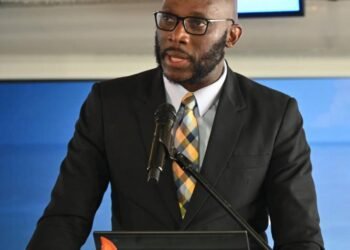
Bruce Golding was Jamaica’s prime minister between 2007 and 2011 before his administration imploded over his handling of the Christopher ‘Dudus’ Coke extradition issue. Since then, Mr Golding has emerged as a grandee on Caribbean affairs and a vocal critic of the Trump administration, especially its treatment of supposed regional partners and friends, including Jamaica.
NOT ACTIONS OF FRIENDSHIP
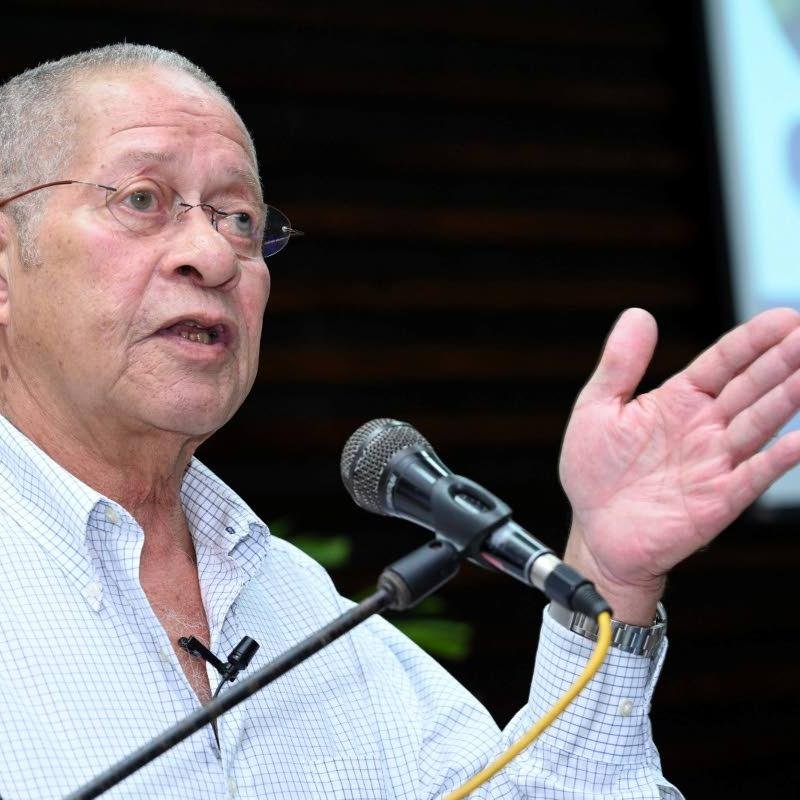
In his latest searing critique a week ago of America’s behaviour in Philadelphia, Mr Golding argued that Washington’s behaviour towards Jamaica and other Caribbean countries by arbitrarily imposing tariffs on their exports; putting pressure on them to downgrade relations with China, their primary source of development financing; and in insisting that they host deportees from third countries; were not actions of friendship.
“True friends don’t abuse your friendship; they don’t make unreasonable demands of you; they should be there to help you,” Mr Golding said.
“Holding a gun to your head and insisting that we must be ‘reasonable’ and do things your way is not friendship,” he said. “The United States has put us under severe stress – that’s not what friends are for.”
He accused the United States of “bullying” Jamaica.
Mr Golding is right that national interests place restraints on what leaders can say. In that regard, his promises to “voice my concerns as to how America’s dictates affect Jamaica and impair the hopes and aspirations of our people”, is welcome.
His statements, without the baggage of the partisan hustings, are stark pictures of the political moment that confronts Jamaica. Hopefully, they can help to create the basis for consensus on some critical issues, including red lines for engaging the United States in the era of Donald Trump. In that regard, the long-dormant Vale Royal Talks between the Government and the Opposition, to agree on matters to be removed from the partisan agenda, should be relaunched.
NOT THE BOARD’S VIEW
The Gleaner’s Editorial Board agrees with Mr Golding that, in the Caribbean, “our sovereignty and regional leverage are under siege”. However, while we appreciate its severe limitations, it is not the board’s view that “Caribbean unity is of no avail” with “every man for himself”.
Clearly, the idea of regional conglomeration via the Caribbean Community (CARICOM) is being tested by Donald Trump’s hegemonic agenda in the Western Hemisphere. But CARICOM’s greater strength in the existing circumstances lies in the platform it provides for cooperation with like-minded regions in demanding a space at the table in negotiating a new world order to replace the one that is disintegrating. Which is the essence of President Mahama’s proposal for integrating CARICOM into the African Continental Free Trade Area (AfCFTA) and in talks for a reset of a new international architecture.
“We must coordinate our positions on issues that will define humanity,” including the creation of a “balanced international order in which developing countries participate as equal partners in shaping global solutions”, Mr Mahama told a joint sitting of Jamaica’s Parliament.
President Mahama’s proposal can’t be dependent on the passage of Donald Trump and the hoped-for death of Trumpism. Even in the face of resistance it has to be worked at – even if sometimes quietly.