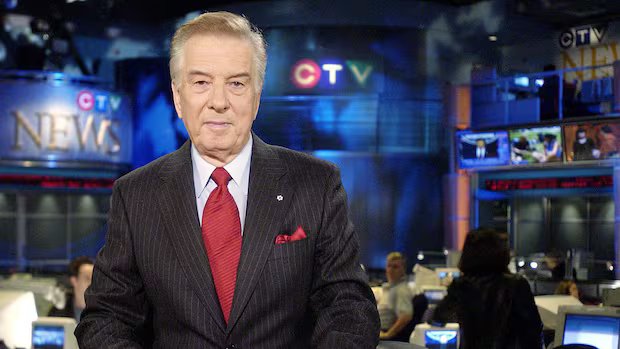
Lloyd Robertson, who delivered the news to Canadians in an authoritative and unflappable manner for more than 40 years as anchor for the flagship news programs of CTV and CBC, has died. He was 92.
His death was first reported by CTV and was confirmed by a family member to CBC News.
Robertson stepped away as CTV National News anchor in 2011 after 35 years, having joined the network in a move from CBC that reshaped Canadian broadcast news. He had been anchor of CBC’s The National for six years.
“Someone came along with this … on my terms, in my life at precisely the right moment, and it was irresistible. I couldn’t turn it down,” he told CBC’s Take 30 in 1976, days after accepting the offer.
At CTV, Robertson helped lead coverage of 11 federal elections, three Canadian-hosted Olympic Games and two Quebec referendums, as well as tragedies like the 1985 Air India bombing, 1989 Montreal massacre and the Sept. 11 attacks. He also helped share inspiring stories such as Terry Fox’s Marathon of Hope.

CTV anchor stepping down after decades-long career, including 22 years at CBC
Robertson frequently spoke of enjoying being at the centre of attention for events shaping Canada and the world, but his on-air style was once accurately described as “self-effacing and lacking in the watch-me swagger of most news anchors,” by Globe and Mail television critic John Doyle.
Robertson was “the guy with the smallest ego I’ve ever seen in the television business, when he has a right to the largest one,” Henry Kowalski, former CTV news chief, told the same newspaper in 2001.
“He was not just a fine journalist but a fine person,” said Peter Mansbridge, former chief correspondent for CBC News, describing Robertson as a “friend and colleague of mine for more than 50 years.
“His audience believed him, and they trusted him. He set the bar for those who anchored newscasts across the country, and he will always be remembered for that.”
In addition to a number of industry awards during his career, he was inducted as an officer into the Order of Canada in 1997 and into the Canadian News Hall of Fame for the Canadian Journalism Foundation in 2016.
“If you find something that you love to do, and you’re able to do it, that’s about as good as it gets in life,” Robertson said in a 2012 CTV documentary And That’s the Life I Led.

The teenage president of the Ontario branch of the National Sidewalk Surfers of Canada explains her organization’s reason for being.
Robertson was born in Stratford, Ont., on Jan. 19, 1934, to parents George and Lilly, the youngest of their two children by nine years. He also had eight older half-siblings from the first marriage of his father, whose ancestors emigrated from Scotland in the mid-19th century.
He hung on the advice and political musings of his father, a Canadian National Railway machinist, and the pair enjoyed radio comedies together.
But it was often a “dreary home life,” he wrote in his 2012 memoir The Kind of Life It’s Been, owing to his British mother’s struggles with mental illness. Prone to bouts of paranoia and obsessive-compulsive behaviour, she would be lobotomized when he was 14, quelling her mind to a degree but dulling her emotional connection with her son.
“I couldn’t have kids to the house, I couldn’t tell them about her,” he told CBC’s George Stroumboulopoulos Tonight in 2012.
WATCH | Mansbridge surprises Robertson on Strombo:
High school classmates, in the 2012 CTV documentary that accompanied his memoir, remembered a friend who gave little sign of turmoil. Robertson was popular, participating in debate and a barbershop quartet at Stratford Central Secondary School.
22-year run at CBC
Already gifted with a smooth voice, he’d been intrigued by radio after standing near reporters covering a post-war parade in his hometown in 1946.
“I just remember being fascinated by the voices of the two commentators as they painted vivid pictures of the marchers and the joyous crowds,” he wrote in his memoir.
At just 17, he persuaded Stratford radio station CJCS to give him an opportunity, overcoming an early on-air bungled pronunciation of the city name as “Strat-herd.”
He didn’t consider going beyond high school, learning the craft of radio at private stations in Stratford and Guelph, before beginning a 22-year run with the public broadcaster in 1954 in Windsor.

Lloyd Robertson was an anchor at the CBC before he became the face of CTV News.
For Robertson, 1956 was a momentous year — his elderly father died just months after he landed at CBC Winnipeg for his first foray into television.
That year he also married Nancy Barrett, a high school sweetheart with whom he had remained in touch. The couple would welcome four daughters born in Winnipeg, Ottawa and Toronto, reflecting Robertson’s peripatetic, upward climb.
In his memoir, he remembered his four-plus years in Winnipeg as “among my happiest and most productive,” and he even donned Western garb to host the country-flavoured Saddle Songs. He then honed political chops with a two-year stint with CBC Ottawa — though it wasn’t all Parliament Hill business, as he hosted a show about the CFL’s Ottawa Rough Riders.

In 1962 came an offer from the corporation the couple couldn’t refuse, and another move. Robertson would remember being at the “bottom of the pile” of 30 announcers, all male, at CBC Toronto.
Robertson would separate himself over time, displaying adaptability by hosting a kid’s show, the athletics program Kaleidosport, and a host of news and magazine programs. Many Canadian radio listeners first heard of John F. Kennedy’s assassination in 1963 from Robertson, and he would score high-profile network assignments for the 1964 Tokyo Olympics and Expo ’67 in Montreal.
Robertson was cool and collected on air, but admitted years later that co-anchoring the 1969 moon shot by U.S. astronauts gave him pause.

“I had to pinch myself to be sure I was really living through this momentous time,” he wrote.
Robertson would be rewarded with the network’s plum assignment of anchoring The National in late 1970. It was a baptism by fire, as within days the Front de libération du Québec would plunge the province and country into crisis, kidnapping British diplomat James Cross and ultimately killing provincial minister Pierre Laporte.
CBC’s news and current affairs roster was deep in the first years of that decade — future Canadian news anchors Peter Kent, Peter Trueman, Peter Mansbridge and Jan Tennant, along with budding stars like Adrienne Clarkson, Barbara Frum and Alex Trebek.
But there were also increasingly outdated union strictures involving studio and field work. Robertson once shared his workplace frustrations with Walter Cronkite on a trip to U.S. He recounted that the CBS news titan was incredulous that CBC anchors couldn’t write their own copy, and were limited in reporting outside of the studio.
Move to CTV
In a time where NBC and ABC were employing multi-anchor formats in the U.S., Robertson was promised more freedom upon joining CTV National News in 1976, even as Harvey Kirck remained on the desk.
“Life with Harvey was sometimes tumultuous, occasionally precarious, but never dull,” he wrote in his memoir of a co-anchor he described as loyal, but who caused the news division headaches with impaired driving citations.
Robertson adjusted to private-sector reality — more commercials, and local affiliates with clout — but he was welcomed by colleagues.

The CBC’s Larry Stout learns why money wasn’t the only thing that motivated Lloyd Robertson to leave CBC for CTV. Aired on CBC’s The National on June 21, 1976.
“What Lloyd did is [he] gave us instant credibility, and our numbers began to climb, and we’ve never retreated, really,” said Craig Oliver, a top CTV political reporter and off-air friend, in 2012.
Kirck’s departure in 1984 established Robertson’s pre-eminence. Around the same time, coincidentally, he was approached by the Conservative Party to run as an MP. He wrote years the prospect held “some appeal,” but he rebuffed that entreaty, and one by the Liberal Party in the early 2000s to serve as a senator.
By the 1990s, Roberton was ending the newscast with what would become a trademark: “And that’s the kind of day it’s been.” He was firmly established as an éminence grise in the industry, winning three Geminis that decade for best host, anchor or interviewer.
Robertson initiated a plan to step back from anchoring in 1996 and give way to CTV reporter Keith Morrison, but, he wrote years later, it imploded due to a combination of corporate resistance and misunderstandings. He expressed regret that the personal relationship with Morrison was ruptured beyond repair.
Robertson would still be in the anchor chair in the next decade and beyond, pulling a 14-hour shift on Sept. 11, 2001, the day of the terrorist attacks on U.S. soil by Islamist militants.
“The magnitude of this crisis is truly breathtaking,” he told viewers. He admitted to The Canadian Press that days later his voice “may have been trembling a little bit,” describing the scene as tens of thousands who had gathered on Parliament Hill for several minutes of silence in honour of what would be nearly 3,000 innocent victims, including 24 Canadians.
Robertson tributes flowed in 2010, and the year after, as he gave a year’s notice of his intention to leave the anchor post.
“I’ve never seen Lloyd angry,” Kent, then a federal politician, marvelled at the time. “Lloyd is a gentleman and a paragon of integrity.”
Robertson remained with the network for several more years, contributing to investigative program W5, and he continued charitable work that included raising awareness of mental illness.
He was able to spend more time with his children and grandchildren, who were used to that sometimes-booming baritone.
“There’s a line that we use: ‘Dad, I’m in the room,'” daughter Susan Robertson told CTV in 2012. “But that’s his trademark, that’s his voice.”
While straight-laced on air, Robertson wasn’t overly fussy with his image, appearing in comedic skits with the Royal Canadian Air Farce, and with Drake in a taped segment for the Juno Awards. As to SCTV‘s newscaster “Floyd Robertson,” he told CBC he thought the portrayal by Joe Flaherty was “marvelous.”