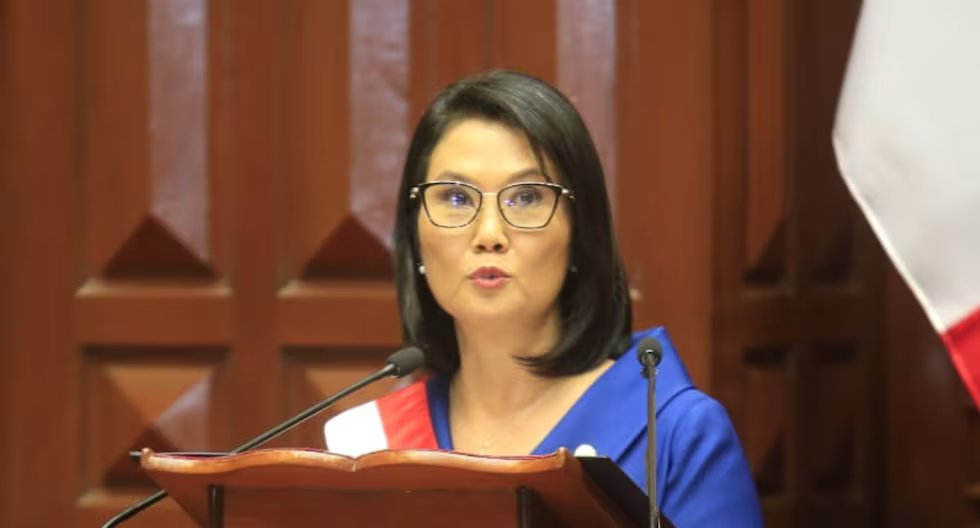

Keiko Fujimori Higuchi’s first message to the nation, delivered yesterday before Congress after being sworn in as President of the Republic, fulfilled what her entourage had anticipated in the previous days: a speech focused on citizen security, economic reactivation and measures against the threat of the El Niño phenomenon. There were, therefore, no surprises on the agenda, but rather the orderly development of the priorities that the president herself had hinted at since she received her credentials as president-elect. This fulfillment of what was announced is, in itself, good news: it has been a long time since the country has heard a head of state speak with the discipline of someone who seems to have a road map and not just a collection of good intentions.
Another feature that distinguished this message was its numerical precision. The president did not limit herself to common places; He anchored his diagnosis and his announcements in concrete figures – from the State’s losses due to inefficiency estimated by the comptroller’s office at more than 24 billion soles during 2023, to the increase in the minimum wage from S/1,130 to S/1,300 or the doubling of Pensión 65, from S/350 to S/700 every two months. Furthermore, it is data that withstands scrutiny: none of the central figures in the speech deserve the label of false or misleading, something that is no less important when it comes to a presidential message in Peru, in which statistical exaggeration is usually commonplace.
A particularly salutary moment in the speech was the one in which, after taking the oath of office, Fujimori Higuchi ratified before the country and the international community present his “firm commitment to absolute respect for the independence of powers and individual freedoms, particularly freedom of expression and freedom of the press,” which he rightly described as “the basis of any rule of law in a democratic country.” In a region in which several newly inaugurated leaders prefer to test the institutional limits before committing to them, this explicit declaration deserves to be taken seriously and, above all, demanded in practice during the next five years.
Also to be welcomed is the announcement to create a digital national authority and a digital identity for each citizen, with the support of artificial intelligence, within the framework of a deregulation process that promises to free the citizen and the investor from bureaucratic burdens. Modernizing the State is not a technocratic whim, but a condition for the fight against inefficiency and corruption to be sustained. What is worrying is the disproportion between ambition and detail: the announced infrastructure plan – which includes the completion of line 2 of the Lima metro, new metro lines in Arequipa, Piura and Trujillo, commuter trains and a dozen national highways – is of considerable magnitude, but the speech did not clearly explain where the resources will come from to finance everything, beyond the generic promise of greater efficiency in spending.
That same question mark hovers over the announcement of the increase in the minimum wage. It is striking that, just one day before the message, the current Minister of Economy and Finance, Elmer Cuba, maintained that this measure “is always under evaluation” and that he did not want to “make any announcement” yet.
Finally, what happened minutes before the president began her speech cannot go unnoticed: the 32 deputies and 14 senators of Together for Peru, along with a part of the deputies and senators of Ahora Nación, left the chamber shouting slogans, just when Fujimori Higuchi was already on the podium, about to speak. Questioning and monitoring is a legitimate right of the opposition; retreating and shouting before the president utters a single word – and asking, in the process, for the release of the person who attempted a coup d’état – is not. This gesture does not help democratic oversight: it weakens it, and exposes the dubious democratic convictions of those who prefer the symbolic sit-in to the debate of ideas that the Constitution itself mandates them to exercise.
In short, Keiko Fujimori’s first message to the nation is a healthy start. But a speech, no matter how organized and verifiable, is not enough. The true test of this five-year period will not occur in the chamber, but in the execution. Peru has heard solemn promises on every July 28; What corresponds now is to demand, with the same precision with which the figures were announced, that they be fulfilled.