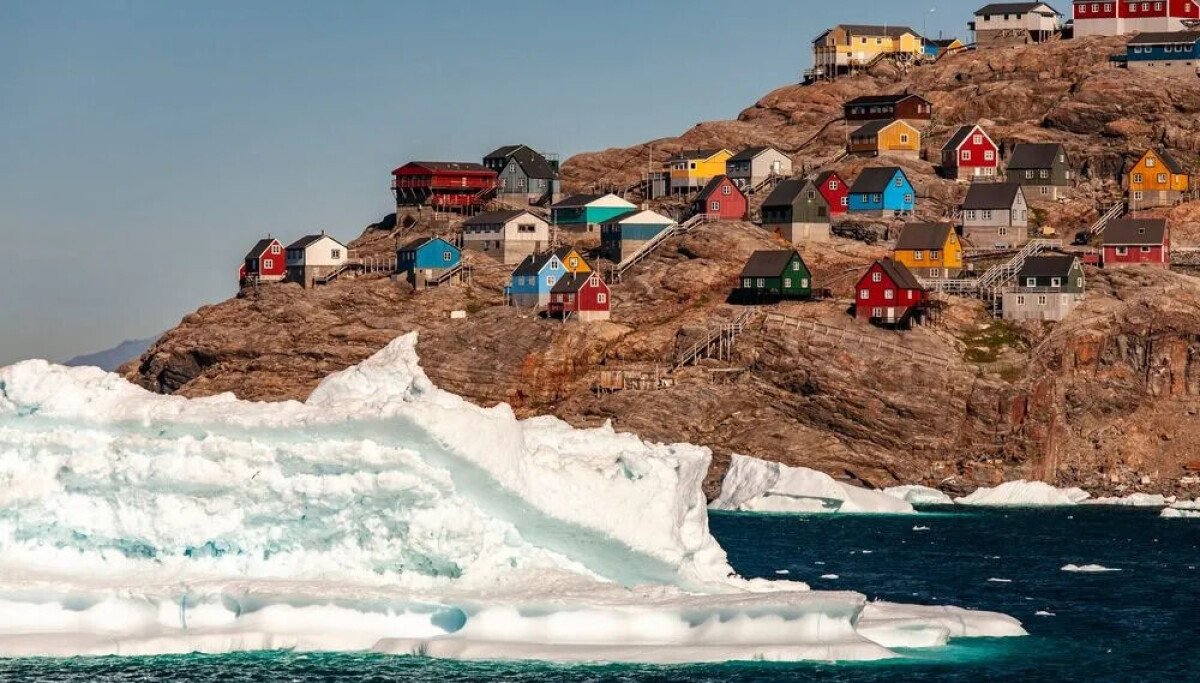
In the city of Uummannaq, 460 km north of the Arctic Circle, there are no roads to the neighboring town. Like all other communities in Greenland, the town is isolated and can only be reached by boat or plane in the summer.
So when an employee at the waterworks mistakenly poured lubricating oil into the drinking water in 2019 instead of chlorine, a minor human error quickly turned into a crisis.
For over two months, the town was without water, and more than a hundred people had to collect water in cans, which were transported in large tanks from a nearby settlement.
The episode shows how vulnerable the water supply is in Greenland.
And as the climate changes, it creates further pressure on the already scarce drinking water.
This is precisely what I am investigating in my PhD project. In this article, I’ll reveal what we’ve found so far – and maybe you’ll also be a little happier with your tap water the next time you go out and turn on the tap.
Surface water is exposed
Let me first take you on a tour of the Greenlandic water supply.
When you think of Greenland and water, your thoughts will probably quickly land on ice. It is also true that the world’s largest fresh water reserve is hidden in the 1.7 million km2 ice sheet.
But this does not mean that the drinking water comes in unimaginable quantities everywhere in Greenland.
The inland ice is far away from the towns and villages, and transporting ice will therefore be both expensive and difficult – especially because there are no roads connecting them.
Drinking groundwater like here in Denmark is not an option either. In Greenland, the ground is permanently frozen in many places. This is what is called permafrost. This means that rain and meltwater cannot seep down and form groundwater reservoirs.
Therefore, cities and settlements must find other ways to obtain drinking water.
The frozen ground in Greenland means that it is both expensive and difficult to lay pipes, so that drinking water must come from local sources.
In most places, the drinking water therefore comes from lakes and rivers close to the city. This means that the water source lies directly in the open landscape and can therefore also be affected by activity from both animals and people.
In winter, the area around the lakes is often used for transport. Snowmobiles and dog sleds cross the ice on the lake as people move between the city and nature.
When the snow melts in the spring, both dog feces and oil spills can end up in the water. Therefore, the waterworks work extra during the melting season to ensure that the drinking water is still clean enough to drink.
In many places they lack water
Water shortage is also a big problem in Greenland. When the towns and settlements were founded, drinking water was not always thought of.
In some places they can let the water flow out of the taps, while in other places you live with a great risk of running out of water.
This applies, for example, in the city of Kangaatsiaq. Here, the fish factory had to close down in 2020 to ensure that there was enough clean drinking water, and citizens were encouraged to conserve water.
But there are also places where water shortages are even more pronounced. Some settlements and cities simply do not have fresh water available. Instead, they have to resort to desalination of seawater, and in the northernmost town in Greenland, Qaanaaq, they have to in the winter pick up sea ice to ensure enough water for the city.
These processes are very expensive and can cost several thousand kroner per cubic meter. In comparison, the same amount of water costs just over DKK 40 in Copenhagen.
Climate change will worsen the situation
In addition to the challenges Greenland already faces in relation to getting clean water in the taps, climate change, as mentioned, also creates problems.
In the Arctic, the temperature is rising almost four times faster than in the rest of the world.
Climate change is also leading to changes in precipitation, where snow will fall as rain, and certain areas risk longer periods of drought.
In my PhD project, I specifically examine the consequences this has for the drinking water in Greenland.
We do not know what is hidden in the permafrost
The ground in Greenland has been permanently frozen for several thousand years. With the rising temperatures, we are looking into a future where more of the permafrost will thaw.
We do not yet know what is hidden in the permafrost. But the hypothesis is that man-made pollution has bound itself to the earth over time.
It could be, for example, pesticides and PFASs, which have been transported with the winds from the south.
When the soil dries, the substances may be transported to nearby lakes and rivers.
There is also a naturally high content of heavy metals in the soil in Greenland. But we lack information on whether it will be transported into the water when the permafrost dries.
In my research, I therefore look for an increase in the pollution at the bottom of the lake.
We have taken cores with sediment from the bottom of several lakes in Greenland. The sediment acts as a time machine where we can look for the development of heavy metals and man-made pollution over the years.
Drinking water with a touch of trout
Climate change may also affect the drinking water in Greenland in other areas.
With rising temperatures, there is a risk that we will see a greater bloom of algae, which can both produce toxins and smell and taste foul.
This phenomenon has been observed in many places in the world, including in the Arctic and in Denmark.
It is not entirely unknown that the drinking water in Nuuk sometimes tastes of fish, which is why we have also taken samples from the lake, which we analyze for algae DNA.
In our samples we see clear traces of algae, but it is still unclear whether this is the cause of the fishy taste.
This does not mean that the water is poisonous. But of course not all citizens are fond of their drinking water tasting of trout.
The consequences are already clear
In addition to the bad taste from the drinking water, which several cities and settlements experience, climate change also has physical consequences for the drinking water.
For example, my colleagues and I have visited Kangaatsiaq, a town where the drinking water lake has started to leak into the sea.
This is possibly because the permafrost has started to thaw. And it was precisely the frozen ground that used to keep the water in the lake.
In Kangaatsiaq, they do not already have much clean water available. It was the same town where the fish factory had to close due to a lack of water. And if a source of drinking water runs out or becomes contaminated, it is a long way to the next one.
When we visited the city in 2025, there was an active boil order, which meant that citizens were encouraged to boil their water before use. It was due to bacteria somewhere in the wiring.
But the biggest problem is often not the bacteria, but that it is difficult to get a clean sample analyzed in time.
From the city, it is an hour’s sailing to the nearest airport, where the sample can be transported to Nuuk and from there on to Denmark.
In case of bad weather, delays quickly occur, and the sample must be analyzed within two days to be usable.
The challenges with abundant and clean water in Kangaatsiaq are therefore due to a combination of permafrost thaw, weather challenges and isolation.
Challenges hit crookedly
It is therefore clear that the problems that arise with climate change are lopsided and must be seen in the context of the isolated societies. Greenland therefore faces a future with increased inequality and vulnerability.
After the episode in Uummannaq, Greenland has developed small water purification systems that can be flown by helicopter to any town or settlement in Greenland. In this way, they have future-proofed themselves against short-term failures.
However, it is not a long-term solution to lakes that dry up or become permanently polluted.
I hope that with my research I can contribute to preparing Greenlandic society for the challenges that will arise under a constantly changing climate.
We cannot predict the future, but we can make cautious suggestions that can hopefully help the Greenlandic utility target treatment technologies and risk planning.
My Ph.D. is part of the EU-funded project ILLUQwhich examines the consequences of permafrost thaw. We look at the environment, people and nature as a coherent concept called One Health. The project takes place both in Greenland, Canada and on Svalbard.