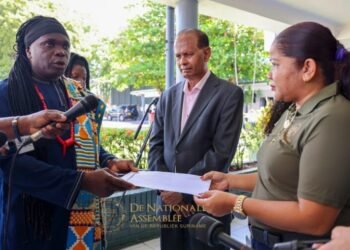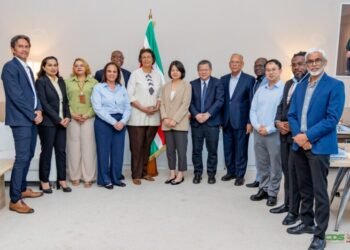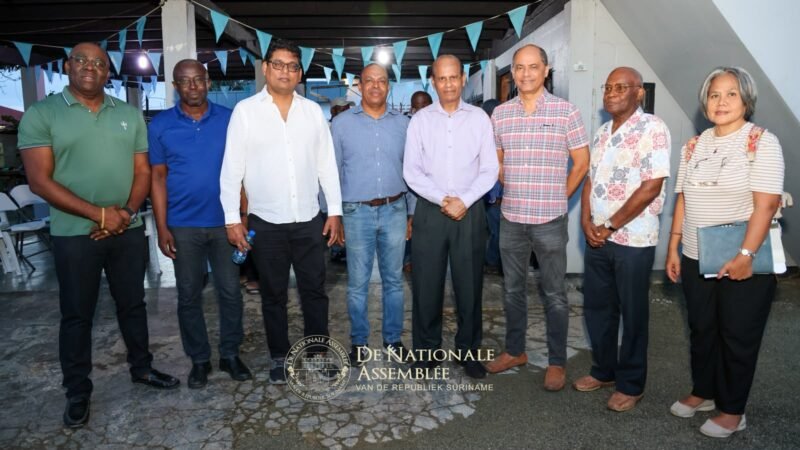
In the run-up to the continuation of the discussion of the law regarding the regulation of the border between Suriname and French Guiana, some members of Parliament held consultations on Saturday with Granman Bono Velanti of the Aukaners and representatives of the traditional authority. The meeting took place at the granman’s residence in Paramaribo.
The outgoing French ambassador to Suriname, Nicolas de Lacoste, spoke on July 9 a press conference expressed his frustrations over this issue. Since taking office, he has committed himself to various objectives, the most important of which, he believes, have not been achieved. The ambassador was unable to persuade Suriname to have the border protocol, which was signed in France in February 2021, approved by the National Assembly. “It was on DNA’s agenda once, but then it turned out to be a big problem to get it back on the agenda,” De Lacoste said.
“We don’t want restrictions on the river when we have to use it to reach our habitats”
Granman Bono Velantie
During the consultation on Saturday, Granman indicated that the traditional authority supports the continuation of the treatment of the protocol. He emphasized that it is important that the official document or final transfer is inspected before formal adoption. According to him, the traditional authority must be able to study the exact content of the agreements, so that the communities involved remain well informed about the further process.
Rabin Parmessar (NDP), chairman of the committee preparing the law, indicated that after previous objections from the traditional authority, additional discussions have been held with various stakeholders and communities in the border area. He explained that the consultation was intended to gain insight into the vision and points of interest of the traditional authority, prior to further consideration of the protocol.
According to Parmessar, a clear border arrangement not only contributes to legal certainty, but can also provide opportunities for further cooperation and development on both sides of the river. He referred to experiences with other border areas, where agreements on cross-border cooperation have contributed to the development of the communities involved.
During the consultation, Granman Velanti emphasized the importance of preserving the traditional rights of residents along the Marowijne River. According to him, free passage and freedom of movement for the communities along the river must be guaranteed. “We don’t want any restrictions on the river when we have to use it to reach our habitats.” In addition, the grand chief emphasized that the traditional authority must remain closely involved in decision-making that has consequences for the Maroon communities.
VHP faction leader Asiskumar Gajadien noted that parliament is dealing with an agreement that has already been negotiated and the contents of which have been determined. According to him, attention should therefore mainly be focused on careful implementation of the agreements already made. He pointed out that residents along the river will be represented within the River Council, which will oversee the implementation of the agreement.
“With this protocol, we could more effectively combat illegal gold mining, which pollutes the traditional habitats of these communities, together with Suriname.”
Outgoing French Ambassador De Lacoste
According to NPS faction leader, Jerrel Pawiroredjo, the interests, lifestyle and rights of the communities that have lived along the border rivers for generations must be taken into account. According to him, Suriname has a long history and these communities have been established in the area for quite some time.
“Nobody wants the Surinamese population to be restricted in their freedom of movement. What matters is that we look together for solutions that take into account the concerns and interests of the communities involved,” said Stanley Betterson of the ABOP faction.
“This is a matter of national importance. It is important that the rights of the residents along the river are guaranteed and that the conversation with the traditional authority continues. The government must provide sufficient guarantees to protect the interests of the communities involved,” said A-20 faction leader Steven Reyme.
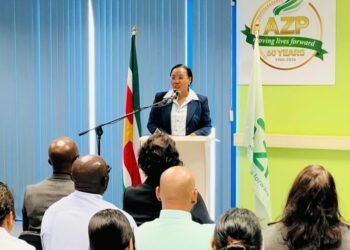
Johan Kolader, chairman of the Border Commission from the Ministry of Foreign Affairs, International Trade and Cooperation (BIS), then explained the content of the protocol and its development. He emphasized that a definitive border arrangement is necessary, but that the interests of the residents along the Marowijne River have been taken into account. According to Kolader, the agreements made guarantee free movement on the river and the protection of acquired rights of residents.
According to De Lacoste, the border commission led by Kolader had already held consultations with traditional authorities around 2019. But this parliamentary committee had also been accompanied by Kolader in November last year already visited Granman Velantie.
“I would not know why Suriname does not want to approve or deal with this protocol. We see that the protocol works well at the border with Brazil. There we work intensively together in the fight against cross-border crime. There is a border map, there is access to free healthcare and other practical agreements have been made. For example, we recently abolished the visa requirement for Brazilians traveling to French Guiana. With this protocol we would, together with Suriname, stop illegal gold mining, which pollutes the traditional habitats of these communities. more effectively. The people who live there want this. Their water and living environment are polluted by mercury,” said the outgoing ambassador.