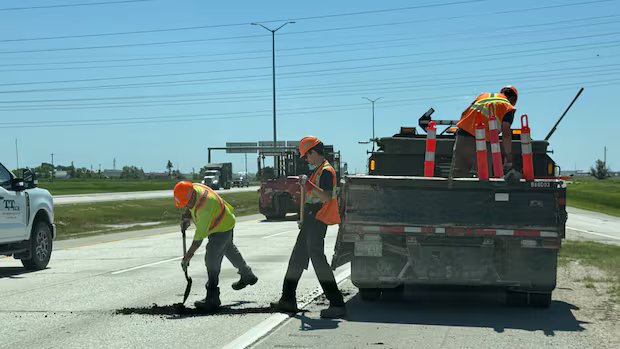
Manitoba’s extreme heat has played havoc with highways and city roads, causing some to break, buckle and heave.
A western part of the Perimeter Highway was closed to traffic between Saskatchewan Avenue and the Trans-Canada Highway on Sunday.
Garth Thomson was driving his 2011 Mustang convertible north just past Assiniboia Downs near CentrePort Canada Way shortly after 4 p.m. when the car ahead of him moved, revealing a big hole in the road.
“So, I swerved to miss the most of it. I heard a large ‘bang, bang,’ and thought I better pull over and have a look,” he said.
Thomson saw several other vehicles pulled over with people looking them over, many with flat tires. He called the fire department after noticing gas pouring out from under his car.
“They came, and they got the road blocked off after that,” Thomson said.
“Then I waited a couple hours for a tow truck in the heat, which wasn’t much fun.”

Thomson believes he hit loose pieces of concrete that had broken away and that the chunks punctured his gas tank.
The damage also left an oil patch on the ground from his engine.
“So, good thing I stopped and didn’t do any more damage,” he said. “It took a beating.”
The west Perimeter was among several highways affected by blowups and buckling on Sunday, including highways 7, 8, 30, 59 South and 75, along with the Trans-Canada, a Manitoba government spokesperson said in an emailed statement.
They said all highway and road closures due to buckling have since been resolved.
Highways and roads “are designed to accommodate the expansion and contraction of the road surface at the joint locations. However, when air temperatures significantly rise, concrete pavement can expand beyond the available space at the joints,” the spokesperson said.
Although buckling is not common, the province cautioned drivers to be aware of them during extreme heat, as Manitoba Transportation and Infrastructure works to fix them as soon as possible.
The City of Winnipeg has also been dealing with buckling roads and sidewalks, so much so that “emergency maintenance crews could not keep with the demand,” said Julie Horbal Dooley, a city public works spokesperson. “They continue to respond.”
The city doesn’t track buckling or heaving roads, but “we’ll definitely get out there immediately and barricade it,” said Michelle Stainton, the city’s project management engineer with the department of public works.
Concrete expands when it’s hot, and although buckling on roads is rare, it can be dangerous and violent, Stainton added.

“It’s an emergency repair, so it would be … repaired within a couple of days.”
Concrete roads, and especially sidewalks, are more susceptible to buckling from heat compared with asphalt ones.
Given the increased intensity and length of heat waves, Stainton says the city is looking to mitigate its impacts on infrastructure and public safety.
“We’re definitely paying attention to this. It’s not new.”
Check tires, pack emergency kits: CAA
At least 10 cars at West Kildonan Auto Service have needed cooling system repairs since the heat wave started.
Usually, the shop only sees a handful of such repairs in a few days, owner Richard Porco said.
“You get stuck on the side of the road if you get a failure. I mean, it’s 37 degrees [Celsius]. The interior of your car is probably gonna be 40, 50 degrees,” he said.
“It gets hot, and you don’t want to be stuck on the side of the road in a hot vehicle.”
Porco advised drivers to check their coolant levels, make sure car radiators are clear of debris and ensure tires are properly inflated.
CAA Manitoba says it has experienced about a 10 per cent increase in calls during Manitoba’s latest heat wave, mostly for battery calls, breakdowns and tire issues.

Sections of several Manitoba highways, including part of the Trans-Canada, buckled after temperatures soared to the mid-30s on Sunday. The dangerously hot temperatures also forced some outdoor activities and events to move indoors or cancel.
As of Monday afternoon, its roadside assistance service had responded to at least 892 calls across the province, said Kaitlynn Furse, CAA Manitoba’s communications director.
“The pressure of tires actually increases in the summer when it’s hot, just like it decreases in the winter when it’s cold, and so it’s really important to check that tire pressure.”
Furse encouraged drivers to pack an emergency kit that includes additional food and water.
It’s also key to make sure cellphones are charged and that gas tanks are at least half full, “in case you run into anything unexpected,” she said.