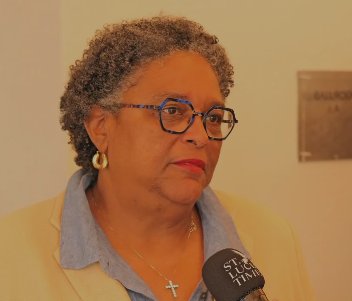
Fewer than 1 000 people have taken advantage of CARICOM’s enhanced free movement regime involving Barbados and three other member states since its introduction, with most choosing Barbados, Prime Minister Mia Mottley said late Wednesday, pushing back against earlier fears that the policy would trigger “open floodgates” of cross-border migration.
As CARICOM leaders wrapped up their 51st summit in Saint Lucia, Mottley said the early uptake had been modest and reflected Barbados’ need to address persistent labour and skills shortages. She also indicated that two more member states are likely to join the initiative.
“It has been a good experience so far,” she said. “The numbers show that there are less than 1 000 people who have used it so far, and that’s why we said this is not going to open floodgates.
“The majority have come to Barbados, and as I’ve said over and over, Barbados has a skills deficit and therefore, to that extent, one of the reasons why we signed on to the Revised Treaty of Chaguaramas in the first place was to facilitate the movement of people to bridge the fact that inherently our population numbers are low and by extension our skills levels are low.”
Barbados was among the first four CARICOM countries, along with Belize, Dominica and St Vincent and the Grenadines, to implement enhanced free movement arrangements from October 1 last year, allowing their nationals to live and work indefinitely in participating states without the need for work permits.
The initiative was introduced under the Enhanced Cooperation Protocol of the Revised Treaty of Chaguaramas, as part of efforts to deepen regional integration. It has been one of the more closely watched integration measures, with supporters arguing that it helps address labour shortages and promotes economic growth, while critics have voiced concerns about the potential impact on jobs, housing and public services.
Mottley has consistently rejected suggestions that the initiative would lead to large-scale migration, maintaining that Barbados requires additional workers across several industries to sustain growth.
The regime was continuing to gather momentum, she said, with additional member states now preparing to join.
“Grenada has submitted its letter now to come and join, and Saint Lucia has signalled an intention to start the process and to reflect how they too will come,” Mottley said.
She likened the gradual expansion of the arrangement to CARICOM’s own development over the past five decades.
“So I expect that this will, just like CARICOM started in 1974 with four countries, then another six or seven joined, and then another one and another two. So these things happen in waves, but we’re happy with it.”
The regional economic and cooperation bloc was formed on July 4, 1973, as a successor to the Caribbean Free Trade Area (CARIFTA) with Barbados, Guyana, Trinidad and Tobago and Jamaica as initial members. It has since expanded to a 15-member grouping as Eastern Caribbean states became independent, later including Haiti and Suriname.
The Bahamas has remained a member solely of CARICOM’s functional cooperation arrangement and has never joined the common market or its successor, the CARICOM Single Market and Economy (CSME).
(SM)