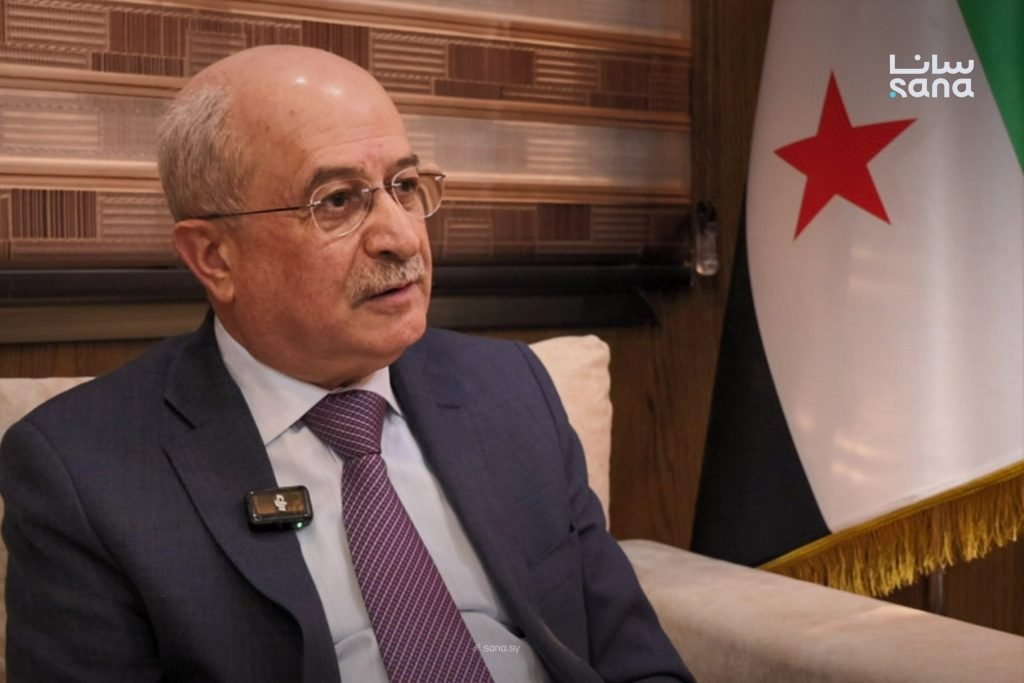
Damascus, June 29 (SANA) The rehabilitation of the M45 international highway is one of the most strategic projects being implemented by Syria’s Ministry of Transport, given its pivotal role in developing the road network and reinforcing Syria’s position as a key transit corridor for regional trade, the ministry said.
Transport Minister Yarub Badr told SANA on Monday that the designation “M45” comes from the classification adopted under the Arab Mashreq International Road Network Agreement, prepared by the UN Economic and Social Commission for Western Asia (ESCWA), to which Syria is a signatory.
Badr said the M45 corridor begins at the Bab al-Hawa border crossing on the Syrian-Turkish border, heading south through Aleppo, Homs and Damascus to the Naseeb border crossing on the Syrian-Jordanian border, then continues through Jordan and Saudi Arabia to the city of Taiz in Yemen. It is one of the most important international land corridors linking Türkiye to the Gulf states and Yemen.
The minister said the route holds strategic importance as a main artery for regional transport and trade exchange, handling high traffic volumes, particularly transit trucks between Türkiye, Jordan and the Gulf states. Its rehabilitation will enhance the flow of transport and trade and support Syria’s role as a key transit corridor.
The project is expected to boost transit traffic, reduce transport costs and journey times, and improve supply chain efficiency, positively impacting regional trade, Badr added.
Tenders announced for three sectors
The minister said the Public Establishment for Road Communication has issued domestic and international tenders for rehabilitation work across three sectors; the Naseeb–Damascus sector (approximately 100 km, 400-day implementation period), the Damascus–Homs sector (168 km, 500 days), and the Homs–Aleppo sector with the Saraqib–Idlib link (195 km, 500 days).
The project includes rehabilitation of the existing four-lane road to the highest technical and engineering specifications to improve efficiency and road safety.
An international tender will also be issued to select a consultancy firm to supervise rehabilitation work across the entire corridor, with late July set as the final deadline for submissions. The ministry completed preparatory surveys and engineering studies for the Naseeb–Damascus and Damascus–Aleppo sectors, providing a technical foundation for implementation.
ESCWA—one of five UN regional commissions, established in 1973, and with Syria as one of its member countries—serves 20 Arab member states in Western Asia. It provides a framework for formulating and harmonizing development policies and acts as a platform for coordination and the exchange of knowledge and information.
The M45 highway rehabilitation is part of a broader plan to modernize Syria’s road network, including a second branch from Damascus to Deir Ezzor via Palmyra to link northeastern regions to the capital, with a target to reduce travel time between governorates by up to 40%.
KhA