(ATTN: ADDS details throughout)
By Kang Yoon-seung
SEJONG, July 2 (Yonhap) — South Korea’s growing dependence on semiconductor exports may make the country more vulnerable to external shocks and cyclical volatility, despite serving as a major “growth driver,” the Organization for Economic Cooperation and Development (OECD) said Thursday.
The Paris-based organization made the assessment in a report titled “OECD Economic Surveys: Korea 2026,” which came around a month after it raised South Korea’s economic growth outlook for this year to 2.6 percent from 1.7 percent three months earlier, citing the artificial intelligence (AI) boom.
“Semiconductor exports have been an important growth driver, with the growth contribution of exports and investments accelerating in early 2026,” the report said.

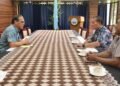
Finance Minister Koo Yun-cheol speaks with Douglas Sutherland, head of division at the OECD Economics Department, in Seoul on July 2, 2026, in this photo released by the Ministry of Finance and Economy. (PHOTO NOT FOR SALE)(Yonhap)
During a press conference on the report held in the central city of Sejong, Douglas Sutherland, head of division at the OECD Economics Department, said such performances have helped shield the economy from the effects of the Middle East conflict.
“With a combination of government support measures, a resilient labor market, and a pickup in domestic demand, this will continue to support growth in the country,” Sutherland said.
Government data released the previous day showed South Korea’s monthly exports hit a fresh high by surpassing the US$100 billion mark for the first time in June, amid a record-breaking chip performance.
Exports of semiconductors nearly tripled to reach $44.82 billion, with monthly exports surpassing $40 billion for the first time on the back of surging demand for memory chips.

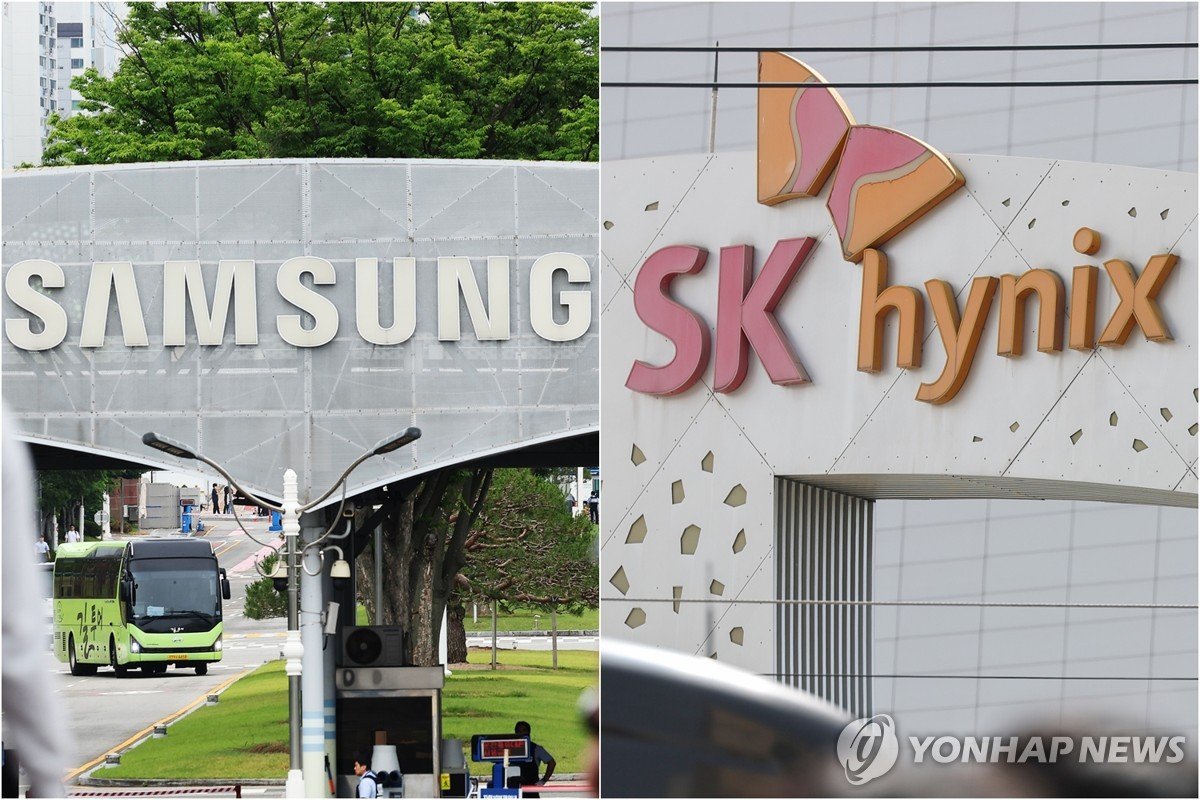
This photo shows the logo of Samsung Electronics Co. and SK hynix Inc. (Yonhap)
The OECD, however, said such dependence also “generates volatility in output and tax revenues and strategic vulnerabilities.”
“The increasing dependence on semiconductor exports boosts growth and tax revenues but may also increase exposure to external shocks and cyclical volatility,” it added.
Responding to the remark, Sutherland said South Korea should closely monitor the chip cycle while bracing for possible volatility.
“In that sense, we suggest a little bit of caution just to make sure that the cycle is ongoing and you have that extra revenue,” he said.
To this end, Sutherland said the “excess revenue” should be spent on addressing pending challenges and securing future growth engines.
“We support using these types of excess revenues to support growth or to bring down the debt,” Sutherland said.
Sutherland added other possible expenditures would include supporting education or training people with new skills.
“The ability to build up funds to support future investments that make sense would be an appropriate use of these revenues,” he added.
Jon Pareliussen, head of the Korean Desk at the OECD, echoed the view, noting it is nevertheless too early to draw the conclusion that the semiconductor cycle is over.
“When the exports become more concentrated, it also increases the consequences if things turn,” Pareliussen said. “But of course, the most important takeaway is that Korea is doing really, really well,” he added.
Nevertheless, the OECD also stressed the need to “use fiscal policy to support domestic demand but consolidate in the medium term,” in order to improve fiscal health amid rapidly rising spending pressures from challenges such as an aging population.
“Due to extremely low birth rates and increasing life expectancy, the age structure of the population has inverted, and the labour force is set to contract in a few years after decades of expansion,” the report said.
Despite recent signs of a rebound, with the number of newborns being on an upward trend since July 2024, South Korea’s total fertility rate, the average number of children a woman is expected to have in her lifetime, came to just 0.93 in April.
The rate remains well below the 2.1 births per woman needed to maintain a stable population without immigration.
With the demographic challenge set to weigh on South Korea’s fiscal soundness, the OECD advised South Korea to create a “broad political consensus on a strengthened fiscal framework, including medium-term fiscal objectives and mandatory spending restructuring consistent with long-term sustainability.”
The OECD also advised South Korea to raise the pension eligibility age further than the current 63 by 2035.
The OECD additionally called for efforts to address the labor market dualism “by relaxing employment protection for regular workers, while expanding social insurance enrolment.”
Touching on the property market, the OECD suggested that the country should move to seek a comprehensive tax reform, especially in the property market.
“Korea’s property tax revenue structure relies more heavily on transaction taxes and less on the more efficient recurrent taxes than the OECD average,” the report said.
“A revenue-neutral shift, once current housing market tensions have abated, towards recurrent taxes and tenure neutrality would support residential mobility, improve labour market efficiency and mitigate housing market frictions,” it added.
The OECD noted that more than one-third of wage earners in the country do not pay any personal income tax, noting a reform of the exemption policy could lead to additional tax revenue, as the country needs to secure new sources of income to address pending challenges, such as the aging population.
The organization said South Korea should also brace for continued energy price volatility, although inflationary pressures from domestic demand remain “subdued.”
The OECD added that South Korea should “look through inflationary pressures from the energy price shock, while standing ready to tighten to keep long-term inflation expectations anchored.”

This file image provided by the Organization for Economic Cooperation and Development (OECD) shows its logo. (PHOTO NOT FOR SALE) (Yonhap)
colin@yna.co.kr
(END)