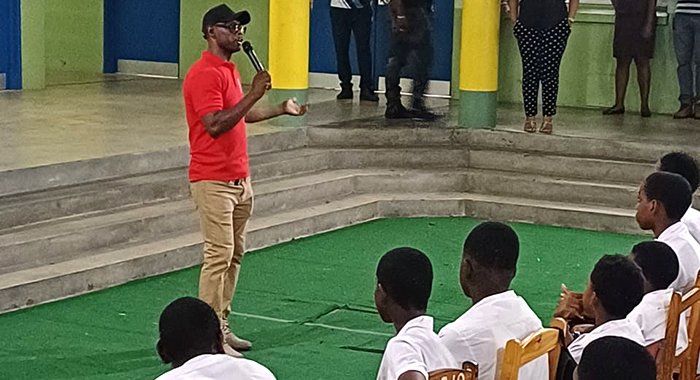
The political directorate and police force in St. Vincent and the Grenadines have endorsed “soft power” as a first step to counter youth violence in the country but have made it clear that they are prepared to use hard power to ensure that the situation does not get out of hand.
There have been several instances of youth violence in public in the country, and in at least one secondary school – West St. George Secondary School (WSGSS) — students have openly associated themselves with either of two rival gangs — Sixx and 7even – police have said.
Principal of WSGSS, Afi Marti, told a consultation on school violence organised by the Ministry of National Security and the Police Force on March 10 that problems at the 21-year-old school include the sale and smoking of marijuana, gangs and violence, bullying, lack of respect for authority and sex tapes.
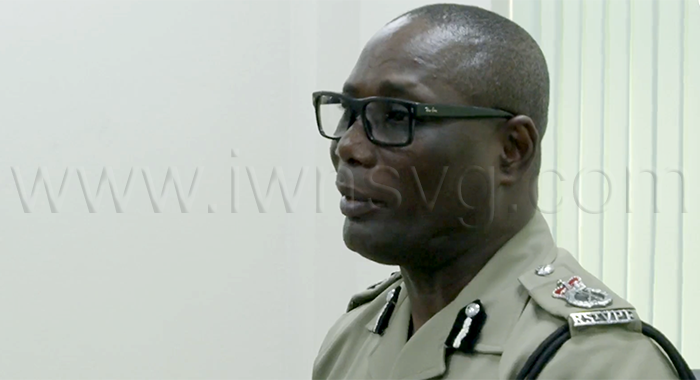
At a press conference in Kingstown on Wednesday, Williams was asked whether he had any update on the situation at the school.
The police chief said the police conducted searches at the school and removed a lot of scissors and other items, similar to what were taken away from students attending the inter-secondary school sports meet.

“So, a number of … similar items came out of West St. George.”
Williams said he was “not picking on” WSGSS, adding, “… I think it is not unique just to West St. George to have young boys and young girls going to school with weapons, scissors.
“And for the most part, the scissors are to cut up marijuana. We can’t hide, put our heads inside and say it isn’t happening.”
He said he would work through the ministers of national security and education to address school security.
“I don’t want us to come to the place where we become so intrusive that we’re going to search bags, but we want to appeal to parents to search the bags of your students, ensure that your boys and girls don’t remove your scissors and a knife from their homes to take to the school,” he said.
“I don’t want us minister to come to the situation where police have to be placed in the schools like Trinidad… It is counterproductive for what we’re trying to achieve in our small state to capture our young people before we lose them.
“But if it continues, we’ll have to come up with some more –” Williams said, adding that he agrees with the national security to use soft power.
“… and I want us to use the softer powers,” Williams said and appealed to parents, adding that lately there have been media reports of school violence.
“I saw a video where there was a fight at Barrouallie Secondary School with two children. That is after the death of the young lady,” he said, referring to Alia McDowall, a 17-year-old student athlete, who died on March 1, 16 months after she was stabbed in the throat outside her school in Peters Hope.
“You saw videos of fights,” he said of the recent altercation that took place after Mc Dowall’s death.
“I know there’s an instance prior to that where a parent was arrested coming from the same school because she engaged in fighting with children,” Williams said, and appealed to parents to become “pacifiers, to become peacemakers”.
“The police station, the law is there, and the school system is there if somebody offend your child or your children to seek redress through that means, and stop encouraging your boys and the girls ‘to hit them back’, and don’t give them weapons to walk to school with to ‘do them back’, because if we don’t stop the cycle of violence will continue.”
Williams also appealed to onlookers who videotape and laugh at these altercations rather than trying to stop them.
“Let us stop glorifying violence,” he said, noting the video of the “gruesome” chopping death of Munt-I in Barrouallie on March 23 was circulated widely via social media.
“We have to stop sharing these things because people are looking for likes; they want to see how many likes and how much shares they have, and when you share the violence, then they are copycat persons who want to copy it because they themselves want a like and a share,” Williams said.
He said that sharing such videos is against the Cybercrime Act.
“So let me appeal to us, our sense of right and our sense of fairness, our sense of being Vincentian, because hitherto were neighbourly, and we used to say what wrong is wrong; just go back to that place where, as parents, we really taught our children from engaging in acts of criminality. And I think we have a better society.”
Meanwhile, responding to a question, Leacock noted the composition of the RSS and the various ways in which it assists member countries.
“And they are here under my chairmanship that if matters that are not now under sufficiency of control require extra assistance, in my own deliberate judgement, I can make that call for that assistance,” Leacock said.
“One of those areas in which we’ll keep our keen eye on is the rise in crime and violence among our young people. And I said my first preference, my first port of call, is an application of soft power.”
He noted the efforts of the National Broadcasting Corporation, which is running a campaign to turn young people away from violence.
“But let’s hope not that we don’t have to go there …” Leacock said, referring to seeking RSS assistance to counter violence among young Vincentians.
He said that attorneys general at the RSS meeting discussed harmonising legislation to address gangs, guns and criminal elements in schools.
“Trinidad and Tobago right now, for example, is wrestling with it. It’s a big debate as to whether the police should be in the schools,” Leacock said.
“Our police force is dealing with that very carefully. They don’t want that to be the first order of the day. They will hope that moral persuasion and the responsibilities of family…
“The family is the basic unit of society. A lot of what we have as a consequence of the breakdown of families,” Leacock said.
“So, they (RSS) are at our disposal. And if this is the answer you want, we will not hesitate to call on the regional security for assistance if we feel matters here so require. We pray God that we don’t have to.”