“Data centers are developing from a marginal size to a structural driver of electricity demand in many regions,” said Allianz climate economist Patrick Hoffmann.

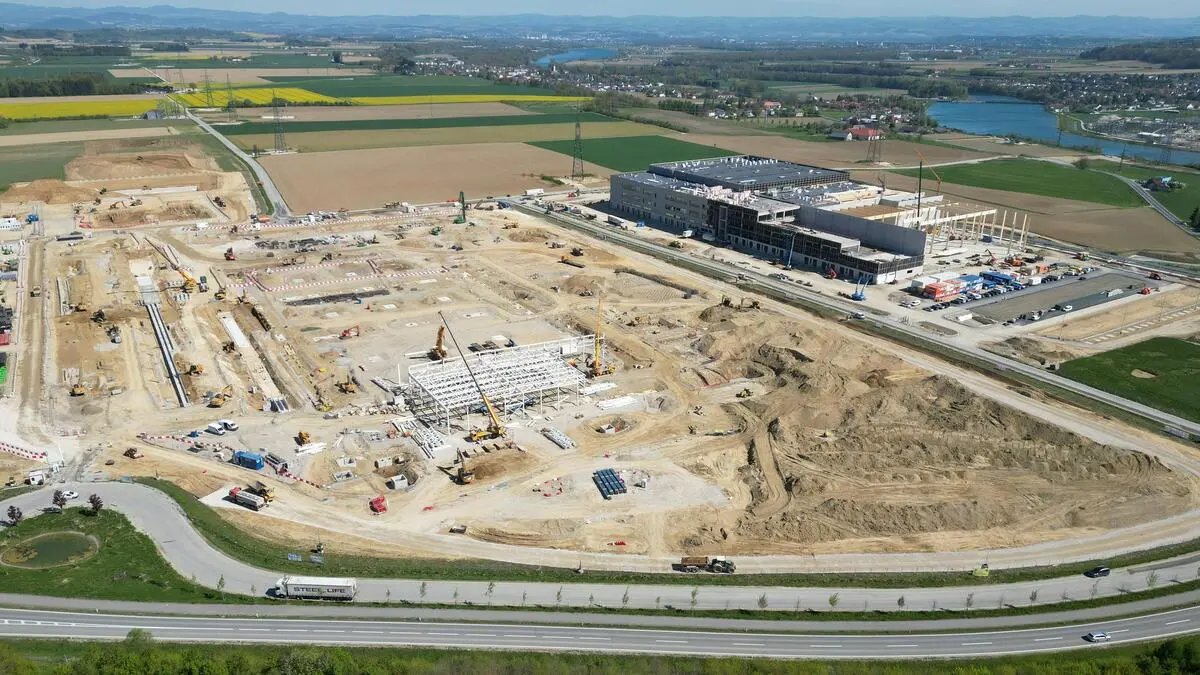
Symbolic image: The construction site of the Google data center in Kronstorf on April 23, 2026 (aerial view). APA/HELMUT FOHRINGER
Add the Press on Google as your preferred news source.
According to a study, the global expansion of data centers is accelerating significantly through the use of artificial intelligence (AI). By 2030, the share of AI applications in data center electricity consumption could rise to around 40 percent, according to the analysis published on Tuesday by the world’s largest credit insurer AllianzTrade. Currently it is already 15 to 20 percent.
“Data centers are developing from a marginal size to a structural driver of electricity demand in many regions,” said Allianz climate economist Patrick Hoffmann. According to the information, global investments totaled 580 billion dollars (508.5 billion euros) last year. Installed capacity is expected to double by the end of the decade. How damaging this development is to the climate depends largely on the location. “Identical computing power can cause many times more emissions, depending on the electricity mix,” said Hoffmann. In countries like India, Indonesia or Malaysia, more than 600 grams of carbon dioxide per kilowatt hour (kWh) would be emitted. In Norway and Sweden the values are less than 30 grams. There is also an advantage compared to the USA (384 g) and China (526 g).
“Europe’s comparatively clean electricity mix gives the region a structurally good starting position for climate-friendly AI growth,” said Hoffmann. “However, Germany tends to be one of the bottom performers in Europe.” The emissions from the German electricity mix are 329 grams of CO2 per kilowatt hour. This is below the level of the USA and China, but significantly higher than in Scandinavia, for example. The reason is the continued high proportion of coal-fired power generation (20.6 percent) and biomass use (ten percent).
In fact, emissions are likely to be significantly higher than previously assumed. For 2025, the study puts it at 286 million tons of CO2, which is around 57 percent more than previous estimates. A good 70 percent comes from electricity consumption, while around a quarter comes from hardware and infrastructure. AI itself is already causing 43 to 60 million tons of CO2 today. At the same time, another bottleneck is growing: data centers consumed around 814 billion liters of water worldwide in 2025 – by 2030 it could be up to 1.8 trillion liters.
In the long term, however, AI could contribute to reducing emissions. “AI has the potential to have a net emissions-reducing effect – provided its efficiency gains scale faster than the expansion of infrastructure,” said Hoffmann. The decisive factor here is the transformation of the energy systems: the key lies in clean electricity. Europe has clear advantages here – but without consistent expansion of renewable energies, this advantage risks being lost. “The course for climate-friendly AI infrastructure must be set now,” said Hoffmann. (APA/Reuters)