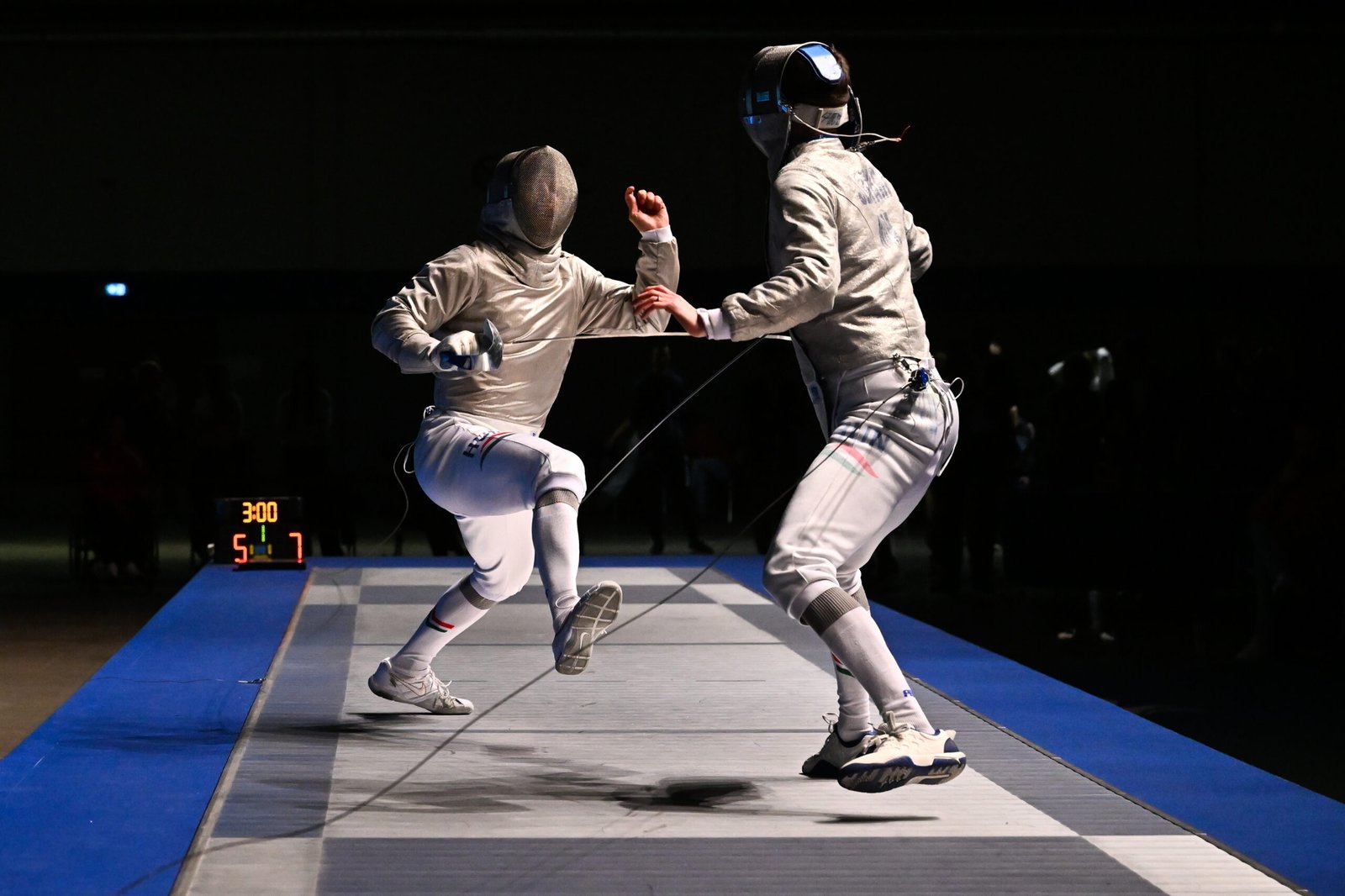

With a tally of one gold, one silver, and two bronze medals, the Hungarian national team concluded the European Fencing Championships in Antony, France. In the overall medal standings, Hungary finished in third place.
The Hungarian men’s saber team, consisting of Áron Szilágyi, András Szatmári, Krisztián Rabb, and Benedek Dallos, were crowned European champions in Antony. The team not only successfully defended their title from last year but also made history. It was the third consecutive European Championship title for Hungary’s saber fencers.
According to the Hungarian Fencing Federation,
such a hat trick of European titles is unprecedented in Hungarian history at the European Championships.
The road to gold led through a strong field of competitors. On their way to the final, the quartet defeated Sweden, Spain, and the reigning world champions from Italy. In the final, the Hungarians also left Romania with no chance.
Head coach Zsolt Nemcsik emphasized the team’s unity after the triumph: “It was a genuine team effort, and I am incredibly proud of every single member. Our preparation went excellently, and we are on the right path. We maintained our composure throughout, and in the final round of the championship match everyone won their bout—a tremendous achievement.”
For three-time Olympic champion Áron Szilágyi, it was already the sixth European Championship gold medal of his career (the fifth with the team).
He stressed that the team had invested a great deal into achieving this success, but that their focus was already on the future. After the celebrations, preparations will begin for the World Championships in Hong Kong, which will take place in one month.
The Hungarian saber team thus continues a years-long streak of success. Following European Championship gold in 2022 (Antalya), the World Championship title in 2023 (Milan), and Olympic silver in 2024 (Paris), the team remains the benchmark in the sport.
The Hungarian women’s épée team also shone on the tournament’s final day.
Comprising Eszter Muhari, Lili Büki, Blanka Nagy, and Emma Borsody, the team fought their way to the final with victories over Spain, Russia, and Italy.
There, the Hungarians faced the heavily favored French world champion team on home soil. After an intense exchange and a score of 31–35, Hungary’s final fencer found herself under pressure. The Frenchwoman Auriane Mallo-Breton tactically exploited the openings that appeared and eventually extended the lead to six touches.
Despite the loss in the final, the young Hungarian team celebrated the silver medal—a repeat of their success from two years earlier in Basel.
In addition to the team successes, the Hungarian delegation also won two bronze medals in the individual competitions.
Olympic bronze medalist Eszter Muhari secured bronze in the women’s individual épée event. After convincing victories over Dana Raposo (Spain) and Gala Hess Sancho (Germany), as well as a razor-thin win in the round of 16 against France’s Diane von Kerssenbrock, she defeated local favorite Alexandra Louis Marie 15–12 in the quarterfinals.
However, in the semifinals, the exceptional Estonian fencer Katrina Lehis (Olympic team champion in Tokyo) proved too strong on the day. The 31-year-old Estonian made perfect use of her experience. Although the 23-year-old Hungarian landed several spectacular touches, she ultimately lost 10–15.
Nevertheless, the bronze medal is historic. It is Hungary’s first individual European Championship medal in women’s épée since 2017, when Emese Szász also won bronze.
The men’s individual saber event brought another medal for Hungary. The 2017 individual world champion András Szatmári advanced to the semifinals with victories over Scjapan Koval (Belarus), Peter Krajnc (Slovenia), Aleksandre Tavartkiladze (Georgia), and Kamil Ibragimov (Russia).
Awaiting him there was France’s Maxime Pianfetti. In a tactically driven bout, Szatmári spent much of the match trailing, with the deficit reaching its largest at 7–12.
Although the Hungarian later managed to pressure his opponent in the center of the piste and narrow the gap to 12–14, Pianfetti responded ruthlessly to the final attacking attempt and scored the decisive touch for a 15–12 victory.
András Szatmári had to settle for the bronze medal.
Via MTI, hunfencing.hu; Featured image: MTI/Illyés Tibor