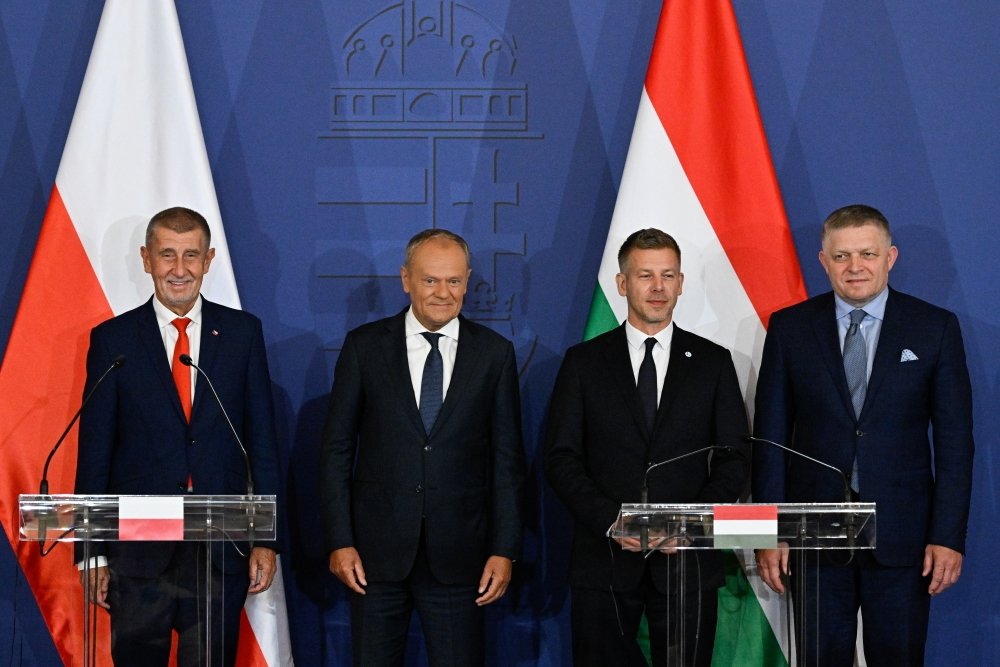

Czech Prime Minister Andrej Babiš, Polish Prime Minister Donald Tusk, Hungarian Prime Minister Péter Magyar, and Slovak Prime Minister Robert Fico (from left to right) at the press conference following the meeting of the heads of government of the Visegrád Group
After years of stagnation, the heads of state and government of the Visegrád Group (V4) announced the revitalization of their cooperation at a summit in the Hungarian city of Gödöllő. While the participants held out the prospect of economic and infrastructural successes, the political backdrop points to a profound change of course for the alliance. Rather than dismantling existing structures, the new Hungarian leadership is using the V4 as a framework to fill it with EU-compliant, post-sovereigntist content.
At the meeting in Grassalkovich Castle, the prime ministers of Hungary (Péter Magyar), Poland (Donald Tusk), the Czech Republic (Andrej Babiš), and Slovakia (Robert Fico) emphasized the region’s economic importance. With a total of 65 million citizens, the V4 represents one of the most dynamic economic regions in the European Union—as illustrated by the fact that the trade volume between the V4 states and Germany exceeds that between Germany and France.
V4 is back!
It was an honour to host the Prime Ministers of Poland, Czechia, and Slovakia in Gödöllő at Grassalkovich Castle.
The Visegrád Group is stronger than ever! pic.twitter.com/Ai6fWvpEN1
— Magyar Péter (Ne féljetek) (@magyarpeterMP) June 23, 2026
To further tap into this potential, the heads of government agreed on key priorities for the coming years. For the upcoming EU multiannual financial framework (2028–2034), the Visegrád countries are unanimously calling for the preservation of the Cohesion Policy and the Common Agricultural Policy to promote regional growth.
Hungarian Prime Minister Péter Magyar presented his partners with plans for a trans-European high-speed rail link connecting the capitals of Warsaw, Prague, Bratislava, and Budapest.
The project is to be further developed under the upcoming Slovak V4 presidency and co-financed with additional EU funds.
In light of high energy prices—which have been identified as the main obstacle to European competitiveness—the alliance is calling for affordable electricity prices and announced closer cooperation in the areas of digitalization, artificial intelligence (AI), cybersecurity, and research and development. In addition, they plan to jointly advocate for a revision of the EU Emissions Trading System (ETS) and involve Austria and Germany in this lobbying effort.

Czech Prime Minister Andrej Babiš, Polish Prime Minister Donald Tusk, Hungarian Prime Minister Péter Magyar, and Slovak Prime Minister Robert Fico (from left to right) at the press conference following the meeting of the heads of government of the Visegrád Group (Photo: MTI/Illyés Tibor)
The four heads of government also expressed unity on foreign policy: They support the EU integration of the Western Balkan states (Serbia, Montenegro, Albania), provided they meet the accession criteria.
To restore the alliance’s influence within the Brussels power structure, the politicians decided to return to a tried-and-true practice.
In the future, positions will be coordinated before every EU summit in order to present a strong, united front in Europe. Polish Prime Minister Donald Tusk explicitly thanked his Hungarian counterpart for having “restored hope” to the group that, despite existing differences of opinion, could once again act as “one fist.”
Donald Tusk lengyel miniszterelnök fogadása Gödöllőn, a V4-találkozónhttps://t.co/bYw5XreUkp
— Magyar Péter (Ne féljetek) (@magyarpeterMP) June 23, 2026
Behind the harmonious images from Gödöllő and the formal declaration that “the V4 is back,” however, lies a fundamental transformation of the alliance. This fresh start was made possible only by the assumption of office by Magyar and Tusk, after the Budapest-Warsaw axis had been shattered in previous years by the alleged “pro-Russian course” of the former Hungarian leadership and the admission of political refugees from Poland.
The new era of cooperation appears to demand a clear ideological price. Instead of dismantling existing structures, the new Hungarian leadership is using the V4 as a shell to fill it with EU-compliant, post-sovereigntist content.
Magyar can thus cast himself as the savior of a paralyzed alliance, while Prague and Warsaw are willing partners in this “modernization.”
For this realignment, Slovak Prime Minister Robert Fico is not a true ally, but rather an obstacle. The Hungarian side’s deliberate focus on historically contentious issues such as the Beneš Decrees is presumably intended to politically weaken the national right in Slovakia and pave the way for liberal forces such as Progressive Slovakia in upcoming elections.
A revival of the V4 as a sovereigntist defensive bloc—as it was during the 2015 migration crisis—is virtually out of the question under this new leadership. In order to go with the flow of the Brussels “mainstream,” the alliance is sacrificing the very issues that once defined its identity: the uncompromising right to self-determination for small nations, the protection of homogeneous societies, and resistance to multiculturalism and progressive gender ideologies.
The Visegrád Cooperation, in its historical form, has lost its mission and its spirit.
The new alliance “Patriots for Europe” has long since taken up the torch of genuine national-sovereign resistance in Europe. The “new V4” is in the process of transforming itself from a historically regional community of interests into a purely pragmatic, pro-European community of values—more functional for the EU, but stripped of its original ideals.

Via MTI; Featured image: MTI/Hegedüs Róbert