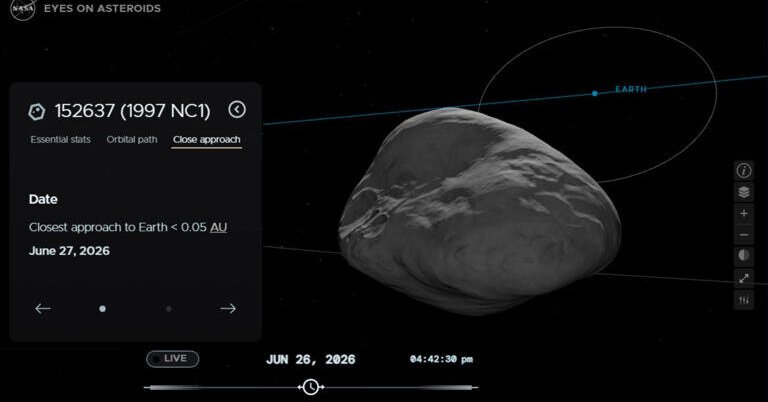
An asteroid nearly 1 km in size will pass by the Earth on June 27. This is the first time in four years that an asteroid of this size will come close to our planet. The asteroid is named 1997 NC1 and was discovered at the Haleakala Observatory in Hawaii. It moves at 32,000 km/h. speed
The last time an object of similar size came close to Earth was in January 2022, when asteroid 1994 PC1, nearly the same size as 1997 NC1, flew by 1.98 million miles away. km away.
At its closest point, 1997 NC1 will be 2.4 million miles from Earth. km It belongs to the Aten-type asteroids whose orbits cross the Earth’s orbit.
In 2013, a meteor that was 50-60 times smaller than asteroid 1997 NC1 exploded over Russia. It is known as the Chelyabinsk meteor. The explosion created a powerful shock wave in the atmosphere. Its force was so great that windows broke in six Russian cities. A number of people were also injured, mostly from flying glass shards.
While NASA and other space agencies monitor potentially dangerous meteors and comets, they overlooked the Chelyabinsk meteor because it was approaching from the Sun.
How to see asteroid 1997 NC1?
If you want to see asteroid 1997 NC1, you will need a telescope with a lens or mirror diameter of at least 15 cm.
It won’t look like a bright star flying across the sky, though. Through a telescope it will be seen only as a faint point of light.
The asteroid will be best observed on June 26, 27 and 28.
What if asteroid 1997 NC1 hit Earth?
The Chelyabinsk meteor was relatively small, but still caused significant damage. It exploded at an altitude of about 29 km in the Earth’s atmosphere.
However, if a 1 km asteroid such as 1997 NC1 were to hit Earth, it would pass through the atmosphere completely intact.
Flying at 32,000 km/h. speed, it would form a crater 10-15 km wide and up to 1.6 km deep.
Upon impact, both the asteroid itself and the impact site would instantly vaporize. Buildings around the impact zone would be swept off the ground, and the landscape for hundreds of kilometers would be destroyed.
Rocks and dust rising into the atmosphere could block sunlight for months.