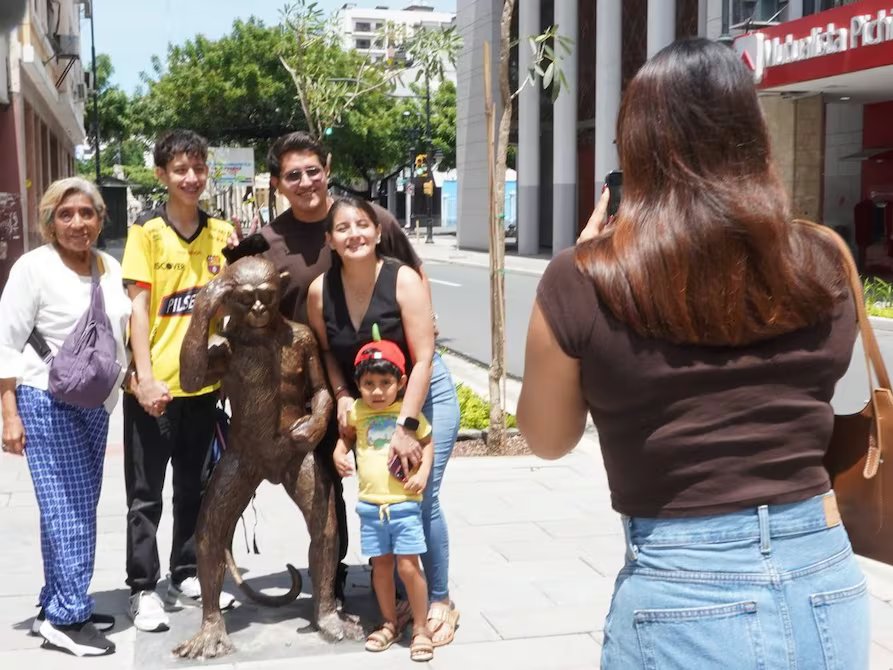
On the corner of Pichincha and Illingworth, the pace of people does not stop, but it does change by the second when someone fixes their gaze on the street. bronze monkey placed on one side of the sidewalk, where due to its size, shorter than an adult person, it is at hand height and allows direct contact, without barriers or distance.
Families pass through the area and give him a glance from time to time, some continue on by, others go back a few steps, approach him, touch him on the head, run their hand on his arm or settle down for a quick photography before continuing, while the rest look askance or comment among themselves upon recognizing the figure in the middle of the usual route.

Encounters with the bronze monkey
This reaction is repeated throughout the day with people who first look from afar and then get closer, as happened with Jimena Estrellawho arrived from Ambato.
As he settled next to the sculpture and noted that it was the first time he had seen it, he added that, as a visitor, it seemed like a place to stop and take a photo.
A few meters ahead, Estefano Avila He observed it before continuing on his way and explained that the figure connects with the fauna of Guayaquil and what those who live on the Coast are sometimes called because of their happy and extroverted character.
“It is something that colloquially represents us, the monkey, the heat, the coast, everything that one always says,” he said, while remaining in front of the sculpture for a few seconds before continuing his tour of the area.

In the midst of constant movement, there are those who are surprised to see it for the first time, such as Larisa Retowho recalled that before in that section there were other representations linked to trades.
“It’s the first time I’ve seen it, because before there were typical jobs, but not animals. It’s very beautiful and it’s important to recognize our culture and keep it in mind as well,” he commented after stopping for a few seconds in front of the figure, looking at the details before continuing on his way.
The cultural significance of sculpture
For those who work nearby, the figure is already part of the daily route, as indicated Diego Montielwho frequently passes by the place and has noticed the changes in the area.
“The square is very beautiful, the arrangement they have made in the panama streetall that helps. This represents what Guayaquil is, fun and work, also because of all the people who walk here,” he expressed, referring to both the sculpture and the constant movement of people in the sector.
Later, María Asunción and Adrián Chávez They stopped after a walk and associated the figure with a broader representation of the country and its species.
“It represents our flora and fauna“What we have in the country, which is often not taken care of as it should be,” said Chávez, while both looked at the sculpture for a few seconds before continuing.
The monkey is part of a set of figures that will be incorporated in this section of the panama street until end of augustin a space where people continue passing by, but every now and then someone stops, touches it or takes a photo before continuing.
Another figure that will be installed will show a monkey along with an iguana and a parrot, sitting on a bench; and one more will be an iguana sitting in front of a chess table.
The urban renewal on Panamá and Pichincha streets, in the section between Aguirre and Roca, contemplates an investment of $1.1 million.
The Municipality of Guayaquil indicated that it seeks to extend the urban concept applied in the northern section to these blocks to strengthen the commercial, tourist and cultural activity of the center.
In the block between Aguirre and Illingworth you can already see the new wide sidewalk, as well as gardens that are beginning to change the image of the sector. The work maintains the two lanes of vehicular circulation and incorporates new street furniture, lighting, improvements in traffic lights, road signage, ramps at the corners and the planting of around one hundred trees. (YO)