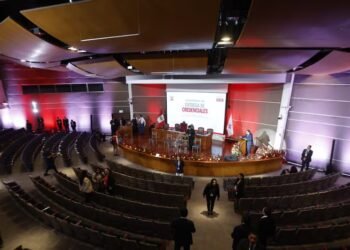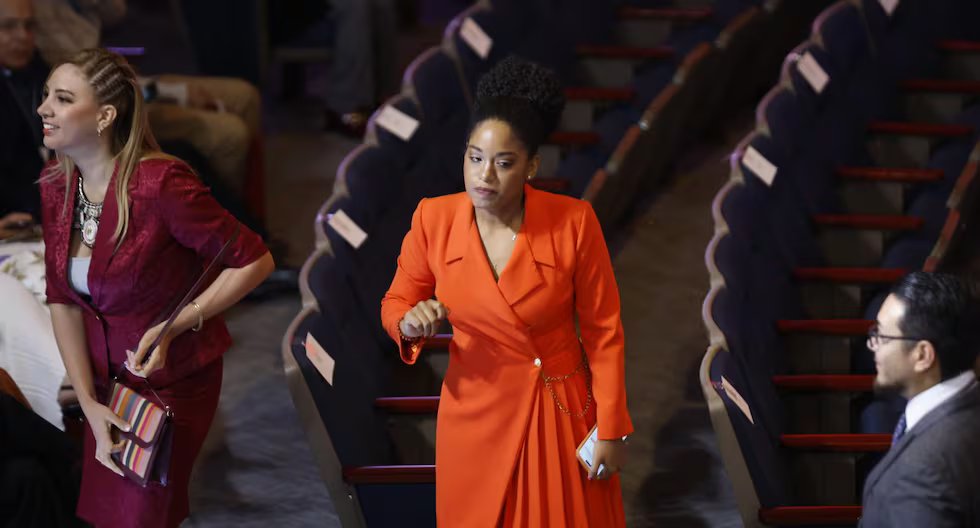
The auditorium of the Medical College of Peru (Miraflores) resembled the plenary session of Congress for a few hours. There were approaches, forced gestures and dialogues sealed with laughter. Although this time there were no debates or votes, the 130 elected members of the Chamber of Deputies of the bicameral Parliament received the credentials that formalized their status as authorities for the period 2026-2031.
The meeting was attended by, among other authorities, the head of the National Registry of Identification and Civil Status (Reniec), Carmen Velarde, and the Ombudsman, Josué Gutiérrez. There was also a large presence of the media and future members of the Lower House, although four of them were absent from the ceremony.

Electoral authorities deliver the official credentials to the deputies elected in the 2026 General Elections, during a ceremony organized by the National Elections Jury (JNE) at the Medical College of Peru, in the Miraflores district. Photos: Mario Zapata N. / @photo.gec

Electoral authorities deliver the official credentials to the deputies elected in the 2026 General Elections, during a ceremony organized by the National Elections Jury (JNE) at the Medical College of Peru, in the Miraflores district. Photos: Mario Zapata N. / @photo.gec

Electoral authorities deliver the official credentials to the deputies elected in the 2026 General Elections, during a ceremony organized by the National Elections Jury (JNE) at the Medical College of Peru, in the Miraflores district. Photos: Mario Zapata N. / @photo.gec
The event began at 11:09 in the morning, when Roberto Burneo—followed by the television cameras—moved in the middle of the auditorium and took a seat in the center of the podium next to the full National Election Jury, made up of judges Martha Maisch, Gunther Gonzales, Rubén Torres and Aarón Oyarce.
A loud ringing of the bell began the plenary session. Seconds later, everything was immersed in a minute of silence in memory of the victims of the earthquake that shook Venezuela the day before and left hundreds dead and thousands injured. The room was standing.
In his first words, Burneo highlighted that the recent event culminated the stage of proclamation of the new authorities that returned to a bicameral Parliament after almost 36 years, since the last proclamation of a Congress with a double chamber was dated July 11, 1990.
He emphasized the importance of the balance of powers and respect for the autonomy of State institutions and agencies, especially the National Elections Jury, the highest electoral authority (JNE).
He did not hesitate to highlight the transparent electoral process by which each of the deputies from different political parties was elected. And he greeted the international observers who helped guarantee the elections.
“The Chamber of Deputies is called to be the space where those voices (of the country) find representation,” he highlighted at another time.
—The new deputies—
The 130 members of the Chamber of Deputies did not attend the event. Missing were Ana Patiño Urco and former congressmen Cecilia Chacón, Diethell Columbus and César Revilla, all from the ranks of Fuerza Popular.
At the time of going to press, the reason for his absence was not specified; However, after consulting the JNE, it was indicated that they must go to the highest electoral authority to request their respective credentials.
In his presentation, Burneo highlighted that the Chamber of Deputies is a space where unheard voices find representation and that the credentials they receive do not only constitute an official recognition of the electoral results, but the legal expression of the sovereign will.
“This trust of millions of citizens must be honored with integrity, responsibility, permanent closeness to the population and an unwavering commitment to the rule of law,” he stated.
He thanked all the actors who contributed to the holding of the first electoral round, such as international organizations and the Peruvian Armed Forces, among other institutions.
“But our greatest recognition, however, corresponds to the citizens. Millions of Peruvians went to the voting centers as polling station members and to the polls convinced that the vote continues to be the most legitimate instrument to build the future of the country. From each region, province, district and population center, as well as from abroad, each vote had the same value and received the same respect,” he said.
He assured that the event consists of the beginning of the work of representation of the 130 deputies, elected by a vote “freely expressed by Peruvians” and that it will now be legitimate political representation.
“The Chamber of Deputies is called to be the space where these voices find representation, where differences can be transformed into dialogue and where citizens’ demands become, through democratic debate, laws,” he highlighted.
—Details of the ceremony—
The first to receive the credential was Royser Castro Grandez (Fuerza Popular), elected by the Amazonas region with 4,624 votes. Liz Mendoza Bernedo, from the same party, was the last to receive the document.
During the ceremony, well-known faces were seen among the future deputies such as Yenifer Paredes (JP), the sister-in-law of former president Pedro Castillo; the former head of the Diviac Harvey Colchado (Now Nación); the general secretary of JP, Ernesto Zunini; Analí Márquez, candidate for the first vice presidency for Together for Peru; and César Tito Rojas, former member of the Movement for Amnesty and Fundamental Rights (Movadef).
Legislators Mery Infantes and Ana Morgan, from Fuerza Popular, were also there; Diego Bazán, from Popular Renewal; and former parliamentarians Marvin Palma, Karina Beteta, Milagros Takayama and Gilmer Trujillo.

Electoral authorities deliver the official credentials to the deputies elected in the 2026 General Elections, during a ceremony organized by the National Elections Jury (JNE) at the Medical College of Peru, in the Miraflores district. Photos: Mario Zapata N. / @photo.gec

Electoral authorities deliver the official credentials to the deputies elected in the 2026 General Elections, during a ceremony organized by the National Elections Jury (JNE) at the Medical College of Peru, in the Miraflores district. Photos: Mario Zapata N. / @photo.gec

Electoral authorities deliver the official credentials to the deputies elected in the 2026 General Elections, during a ceremony organized by the National Elections Jury (JNE) at the Medical College of Peru, in the Miraflores district. Photos: Mario Zapata N. / @photo.gec

Electoral authorities deliver the official credentials to the deputies elected in the 2026 General Elections, during a ceremony organized by the National Elections Jury (JNE) at the Medical College of Peru, in the Miraflores district. Photos: Mario Zapata N. / @photo.gec

Electoral authorities deliver the official credentials to the deputies elected in the 2026 General Elections, during a ceremony organized by the National Elections Jury (JNE) at the Medical College of Peru, in the Miraflores district. Photos: Mario Zapata N. / @photo.gec

Electoral authorities deliver the official credentials to the deputies elected in the 2026 General Elections, during a ceremony organized by the National Elections Jury (JNE) at the Medical College of Peru, in the Miraflores district. Photos: Mario Zapata N. / @photo.gec
Congresswoman Norma Yarrow, from Renovación Popular, avoided taking the official photo with Burneo, unlike the rest of her colleagues. She posed alone before the cameras, saluted briefly and left the stand.
The Chamber of Deputies of the next Parliament will be made up of 41 deputies from Fuerza Popular, 32 from Together for Peru, 18 from the Good Government Party, 15 from Renovación Popular, 14 from the Civic Obras Party, and 10 from Ahora Nación.
—Important announcements—
Minutes before beginning the ceremony to officially accredit the 130 elected deputies, Roberto Burneo made an important announcement: the winning presidential ticket will receive their credentials on July 15 at noon at the Gran Teatro Nacional, in San Borja.
“We will hold an official credentialing ceremony that is scheduled for July 15 at noon at the National Theater,” he told the digital program JNE Media.
From the headquarters of the Medical College of Peru, in Miraflores, the electoral authority also confirmed that the official proclamation of the results of the presidential election is scheduled, at the latest, for Friday, July 3.
It should be noted that in the absence of some 100 pending minutes in the special electoral juries, Keiko Fujimori (Fuerza Popular) is the virtual winner of the presidential elections. He surpasses Roberto Sánchez (Together for Peru) by more than 40 thousand votes, so his advantage is now irreversible.