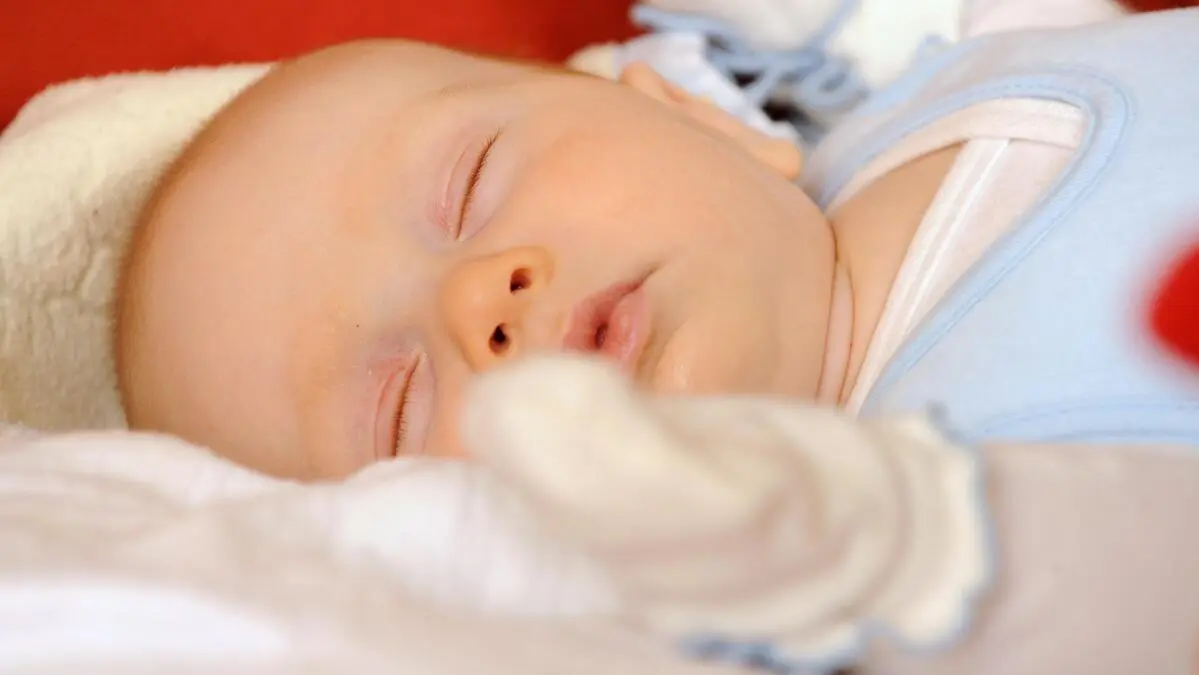
Newborns respond to sound patterns that are important for language acquisition.

Even sleeping newborns (0-4 days old) have the cocktail party effect active in the brain: repetitive sounds are perceived separately from the background noise. Clemens Fabry
Add the Press on Google as your preferred news source.

“What did you say?!” In noisy surroundings it is difficult to understand the person you are talking to. People and animals are usually surrounded by noises that sound at the same time: people in crowded rooms, with traffic noise or background music; Animals in the diversity of nature. The ability to recognize sound sequences from a mixture is extremely important. This is called auditory signal separation or the cocktail party effect. The brain filters out exactly the sounds that “belong together” from the tangle of simultaneous noises and separates them from everything else.
Research teams from Hungary, France, Italy and Austria wanted to know: At what age does our brain learn this trick? Can newborns – a few days old, in deep sleep – filter out tonally coherent patterns from random background noise? In Frontiers in Human Neuroscience They show that a measurably different reaction takes place in the brains of newborns than in the case of pure background noise.
To do this, 33 healthy newborns between the ages of zero and four days were played sound sequences during natural sleep: sound mixtures in which a regular pattern (repeating frequencies) was hidden in a background of randomly changing tones. Using high-resolution EEG recordings (measuring brain activity via 64 electrodes on the scalp), reaction patterns were visible, similar to the reaction in adults: but somewhat slower and not yet as specialized. Petra Kovács from the Vienna Institute for Sound Research at the ÖAW explains: “The ability to distinguish regular from irregular sounds is a fundamental prerequisite for language acquisition.” (verse)