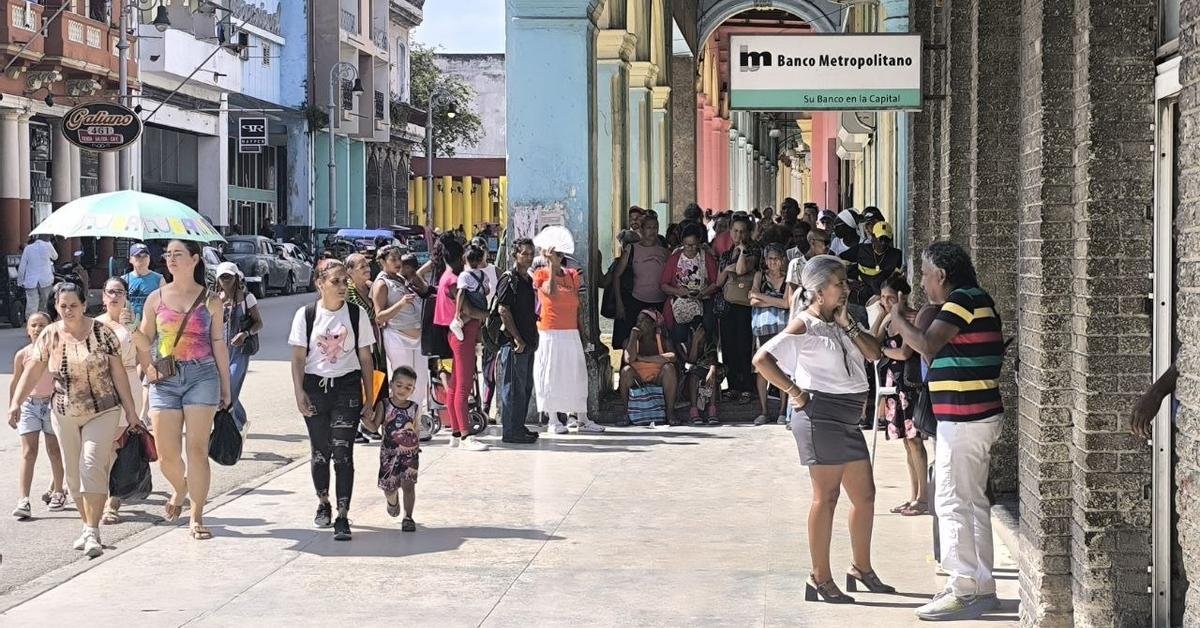
Madrid/The informal currency trading market is going through turbulent times. Just three days ago, the dollar reached 700, crossing a new psychological barrier and leading to an immediate increase in the prices of products in national currency. The joy of the currency sellers was short-lived, since a few hours later a sharp decline was recorded, followed by several others, who lowered the price to 660 CUP this Friday.
It is not the first time that the currency market acts like a yo-yo in reaction to the great volatility of supply and demand in an economy devastated by the crisis and producing almost nothing. The energy crisis and the absence of any prospect of improvement have contributed to accelerating the fall of the national currency and, at the same time, creating sudden movements of recovery due to the prudent behavior of currency buyers.
“A few days ago, when it was rising rapidly, it was difficult for me to change, because the MSMEs had their purchases held up,” a seller in Havana tells 14ymedio. “Along with the rise of the dollar in recent days, food and other products also rose. Now I see that they say that it has gone down, I hope that essential products will also go down somewhat,” he adds, trying to bring out the good side of the bad side of his business.
“The bad thing about this is that now the dollar is going down and prices remain as they were when they were at 700”
Most doubt it. “The bad thing about this is that now the dollar is going down and prices remain as they were when they were at 700,” commented a user on social networks. Speculation keeps the conversation very alive. There are those who argue that the speed of decline is due to the 176 economic reform measures announced by the Government. Others scoff at the mere idea that the regime’s proposals have any effect. “No one invests their money if they don’t have guarantees. There may be 15,000 measures of change, but if you don’t change the law where you have to change it, no one comes. No one is going to put their money where the judge is also a party,” responds another.
Just 24 days ago, the dollar reached what was then seen as an impossible record: 600 pesos. If you look back even further, but not that far, it is easy to see the unstoppable depreciation of the national currency. On May 2, one dollar was exchanged for 535 CUP.
The American economist Steve Hanke, who frequently updates informal inflation in several countries, as well as the depreciation of currencies, three days ago placed the Cuban peso as the third most devalued currency at the moment, having lost 45% of its value in the last year. Although the list is volatile and only on June 16 the CUP was in fourth place, the presence in the top five has been persistent for a long time. On the same day, the expert noted that inflation reached the year-on-year rate of 84.5%, third in terms of price increases. “Socialism and Uncle Sam’s sanctions have turned out to be a deadly cocktail,” said the expert.
“Socialism and Uncle Sam sanctions have proven to be a deadly cocktail”
The official market, meanwhile, continues to be in its parallel world and today buys the dollar at 585, again a price for which few or no one is willing to deliver an overly precious currency.
In December 2025, the Government launched a floating rate to try to compete with that of the informal market, which had been imposed by force of reality among the population. After years of open war with The Touch By publishing an exchange rate much higher than that of the State, the official purchase and sale price stood at 410 pesos for one dollar – in addition to the other existing ones of 24, for state companies, and 120, for entities with the capacity to generate foreign currency. In addition to being an attempt to recapture the lost currency market, the regime was trying to contain inflation that continues to escalate, although more contained than in 2023 and 2024 not due to the improvement of the economy, but due to widespread poverty and the shortage of products at affordable prices.
At the time of approving the starting price, the authorities pointed out that this rate was not going to please anyone and although it was, the US currency was exchanged in the informal market for about 440 pesos, a more approximate relationship than the current one. The regime’s efforts to contain monetary instability have been useless, as economists already warned. To achieve this, they pointed out, five factors that are difficult to achieve on the Island would have to occur, starting with a better macroeconomic scenario that, today, is much further away than just a year and a half ago.