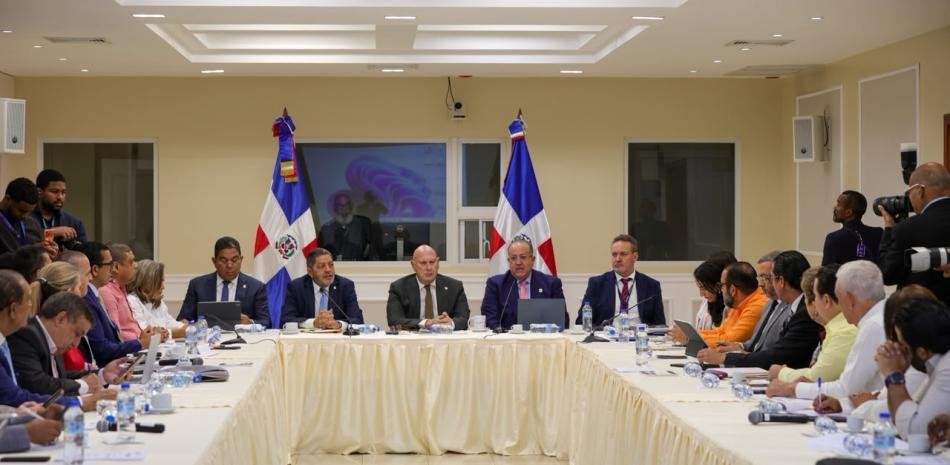
From Monday afternoon until approximately noon this Tuesday, the bicameral commission of the National Congress studied the bill sent by the Executive Branch, which seeks to increase tax collection in the country’s Tax Code and other modifications.
In that period, the pro-government legislators and their allies were able to agree to approve a report, with which they will recommend to the plenary session of the Senate of the Republic and the Chamber of Deputies. vote favorably on the Government’s proposal sent by President Luis Abinader.
Therefore, according to the president of the Commission, Pedro Catraín, the document would be presented this Wednesday in a session, thus being enabled to be approved or rejected by that legislative body.
“There will be a session in the Senate tomorrow (Wednesday). The report is ready and could be presented in the session”Catrain informed the media.
The only sectors heard by the commission that makes up more than 20 congressmen were the Minister of Economy and Finance (MEH), Magín Díaz, and a group of delegates from the Association of Industries of the Dominican Republic (AIRD).
“A previously prepared report”
However, according to some representatives of the opposition political groups, the commission has become part of a “hustle” to support the Government, without weighing the concerns expressed by various sectors of society.
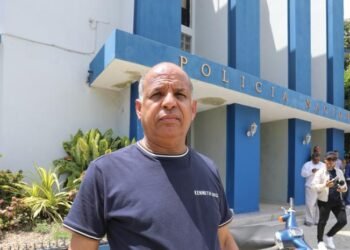
Deputy Danilo Díaz, leader of the Dominican Liberation Party (PLD), assures that the president of the commission, Pedro Catrain, had the report ready, regardless of the observations that the businessmen or the other congressmen would present.
“A great lack of respect on the part of the president of the commission. They just approved the report, but they already had it ready, everything was a piece of paper. It was a package tailored to the Government without the weighting of sectors. The businessmen brought several rational proposals protecting the national interest, But they invited him to relax them because before they entered the meeting he (Catrain) was already announcing that the report was ready. “It is a gross lack of respect,” Díaz told the press.
The PLD legislator considers that the bill sent last Friday by the Executive Branch had to be subjected to a dialogue process in the rooms of the Economic and Social Council (CES) before going to the Legislative Branch.
“If they send a project it is for them to review it, for it to be modified and enriched, but they really weren’t taking any slack because what they did was listen for nothing because they already had the report ready. They approved the report, but they already had it ready,” he reiterated.
Deputy Félix Michell, from the People’s Force (FP) bloc, agreed with the statements made by Díaz.
“It’s the first time that a tax reform has been resolved in two hours. They already had the report done, it’s a huge mistake they’ve made here,” he said when interviewed by reporters.
Michell regretted that the Government is trying to raise around 50,000 million pesos by adding taxes, without making clear what they would be used for.
“They are going to hit the Dominican people without a clear objective because when I asked the minister (Magín Díaz) what the money was for, he simply limited himself to saying that it was to cover the fiscal deficit and subsidies,” he said.
Finally, he recommended that citizens be aware of the course of the government initiative in the National Congress, since, if it were converted into law, society would only receive new tax burdens, without any benefit in reducing the cost of food, medicines and other essential products.
“The Government is like a bad father: He doesn’t have money to pay for his son’s school, but you see him on the street wasting money. This is unprecedented, they come here with their package made, two hours there, it is discussed and they already had it predetermined,” he said.
What are the AIRD’s concerns?
The executive vice president of the AIRD expressed to journalists the discriminatory impact that some provisions of the proposed law would have. One of these is the elimination of the Transfer and Importation of Industrialized Goods tax (ITBIS) on imported asphalt.
“We really don’t understand why it has been included. It is something that directly discriminates against the local concrete and concrete manufacturing sector, it distances the possibilities of these materials being used in road paving programs in the country. It continues to widen that gap between imports and local production,” he stated.
Pujols commented that the same would happen with some articles that privilege imports, exempting the payment of ITBIS from products and equipment that would be used by some trusts headed by the Government.
Although he considers the approval of the bill necessary to respond to the international oil crisis, he understands that the aforementioned points must be analyzed to avoid harming national production.
“We have analyzed the measures, we have not received any concern from our associates, but we continue analyzing,” he stated.
“We listen to them”
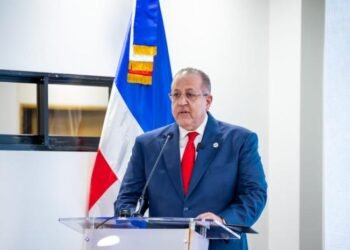
Minister Magín Díaz clarified that he is aware of the concern expressed above; However, he indicated that “obviously what all sectors want cannot be reflected in the proposal.”
Díaz understands that the content of the piece is sensible and balanced, since it is based on the principle of progressivity: he who has the greatest contributory capacity pays.
“It has some collections, but above all it is a structural improvement to the tax system, improvements that the Tax Code has had for years are being corrected and, if approved, it would be the first in 14 years in tax matters in the country and that would already be a great gain,” he expressed.
Meanwhile, it is up to the Bicameral Commission to decide when it will officially present the report to the full Senate.