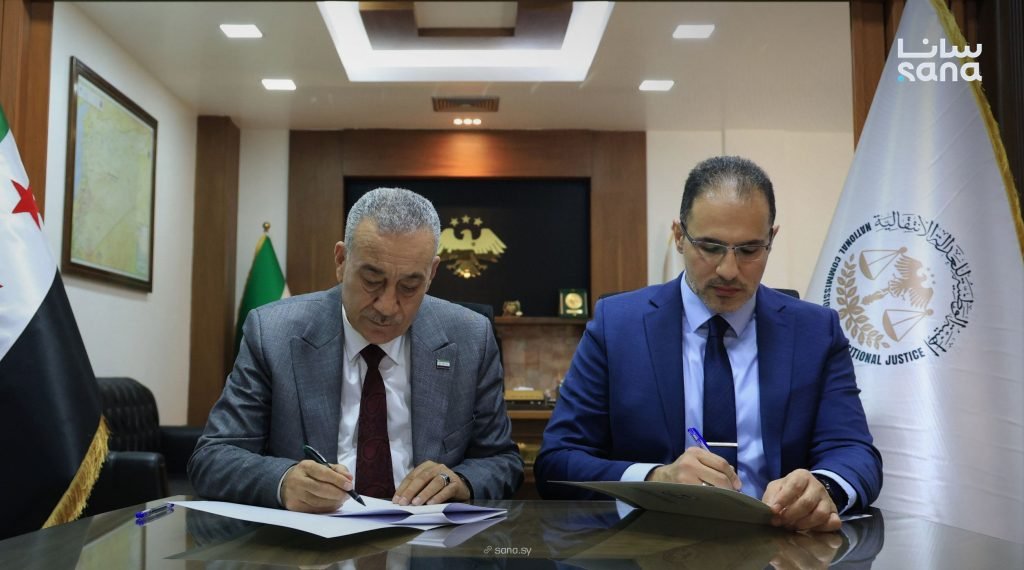
Damascus, June 23 (SANA) The National Commission for Transitional Justice signed a memorandum of understanding on Tuesday with the Syria Justice and Accountability Centre (SJAC) in Washington, D.C., aimed at enhancing technical and institutional cooperation to support the implementation of a comprehensive, Syrian-led national transitional justice program, the Commission announced.
The MoU aims to leverage specialized expertise in developing contextual and open-source investigations, harmonize methodologies for classifying violations and analyzing their patterns in line with international humanitarian law and human rights law, and support capacity-building and database development to serve truth-seeking and accountability processes, according to a Commission statement on Telegram.
The Commission said the step is part of its efforts to strengthen its ability to handle files of grave violations efficiently and professionally, contributing to more accurate documentation of facts, supporting victims’ rights and enhancing access to justice.
The Commission added that the MoU represents a practical step toward transferring and localizing expertise and technical knowledge within national institutions, ensuring that Syrians themselves lead the transitional justice process in their country, in accordance with internationally recognized professional and legal standards.
The National Commission for Transitional Justice was established on May 17, 2025, by Presidential Decree No. 20, with Abdulbaset Abdullatif appointed as its head. The Commission is tasked with uncovering the truth about serious violations committed under the deposed regime, coordinating with relevant institutions to hold perpetrators accountable, providing reparations to victims and their families, and promoting guarantees of non-repetition.
The Syria Justice and Accountability Centre (SJAC), founded in 2012 and headquartered in Washington, D.C., works to ensure that human rights violations in Syria are comprehensively documented and preserved for use in transitional justice and peace-building. SJAC collects documentation of violations from all available sources, stores it in a secure database, catalogues it according to human rights standards, and analyzes it using legal expertise and big data methodologies. Its missing persons program utilizes forensic methods to investigate missing persons and mass graves in northeastern Syria.
KhA