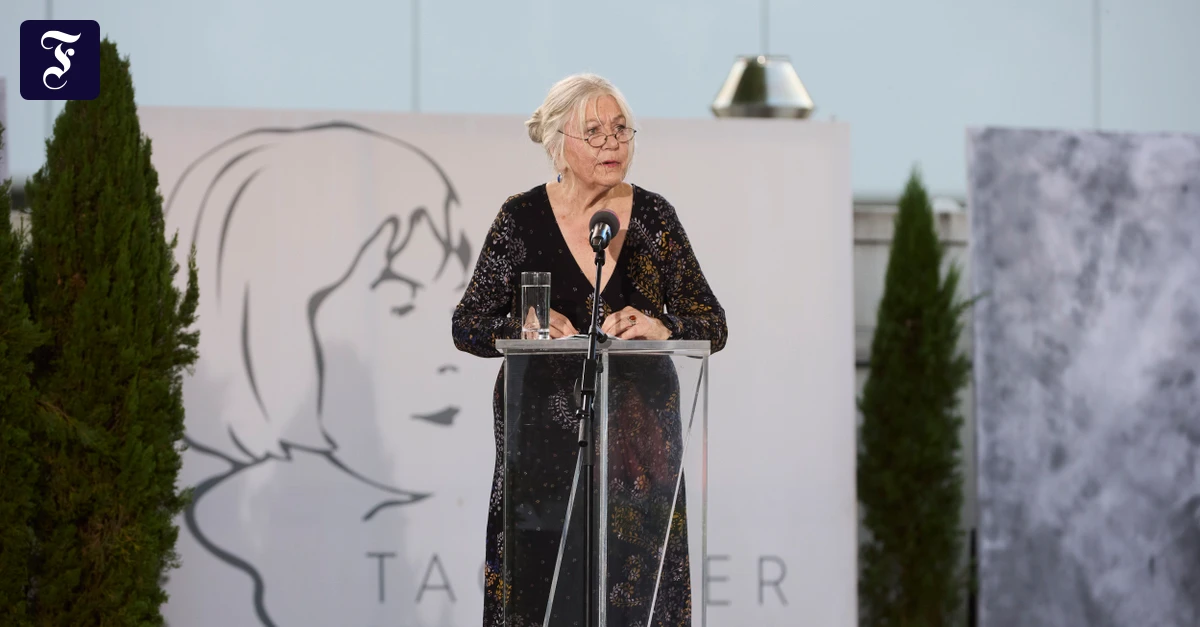
Anyone who listened to Helga Schubert might have thought Slata Roshal was naughty. Schubert, who returned to Klagenfurt at the age of 86 to give the speech on literature, remembered how she had participated in the competition for the first time in 1980 Bachmann Prize was invited and would have liked to come – but the GDR Writers’ Association wouldn’t let her leave.
Roshal, who was born in St. Petersburg in 1992 and now lives in Munich, is invited as a participant in the Bachmann Prize competition this year, the year of the 50th anniversary, but she said in an interview with the “Süddeutsche Zeitung” that it was not her job to listen to a jury, that there was something humiliating about it, so she would read her text and then get up. This was an anecdote that was whispered about in conversations at the summer reception in front of the ORF State Theater on the evening of the opening – but it was not a major topic of excitement: in fifty years of Bachmann Prize history, taking part in the competition while simultaneously insulting the conditions has long been part of folklore.
Do the writers only serve to legitimize the jury?
Of course it remains cute, Klagenfurt like Roshal to criticize as a “media event” and yet take part in it yourself. But she also makes some good points in the interview: For example, when she claims that “the authors are more of an opportunity to legitimize the jury”: The nice thing about the Bachmann Prize is that the jury openly demonstrates its self-centeredness and doesn’t even pretend that it’s about authors and texts.
Touché? At least you can think of a few moments in recent years when that was the case. However, there are also those that speak for the opposite. So maybe, gratitude or rebelliousness, everything is just fine with the Bachmann Prize competition? That would be great, considering how endangered its continued existence recently seemed until clear signs came from the organizers that it should continue next year. The importance of the competition, far beyond Carinthian tourism, was also invoked in some of the speeches at the opening: a good thing.
Honoring Bachmann: away from biography and towards the work
In her speech, Helga Schubert quoted entries in her Stasi files from April 1980. It says that the Bachmann Prize competition was “obviously not an Austrian event, but a Federal Republic of Germany enterprise” chaired by the “notorious anti-communist Reich-Ranicki”. She then described how she finally became a juror in Klagenfurt during the GDR era and, in old age, even a prize winner. Above all, she used the speech to pay tribute Ingeborg Bachmannwho was “born a hundred years ago and could still be alive.”
As is well known, Ingeborg Bachmann’s life ended in sad circumstances in 1973, but Schubert described how she broke away from the prevailing image of the always “tormented poet” and renounced biography in order to recognize the greatness of the work. To this day, Bachmann is often reduced to the final image of “nylon nightgown and cigarette.” She wanted to reply to anyone who did that: “The poet Ingeborg Bachmann, whom you are simplifying and classifying with your indiscreet question of assurance, wrote the ‘Invocation of the Big Bear’ and ‘Malina’ and ‘To the Sun’.” In the speech manuscript there is a period after the sentence. It was said with exclamation marks.