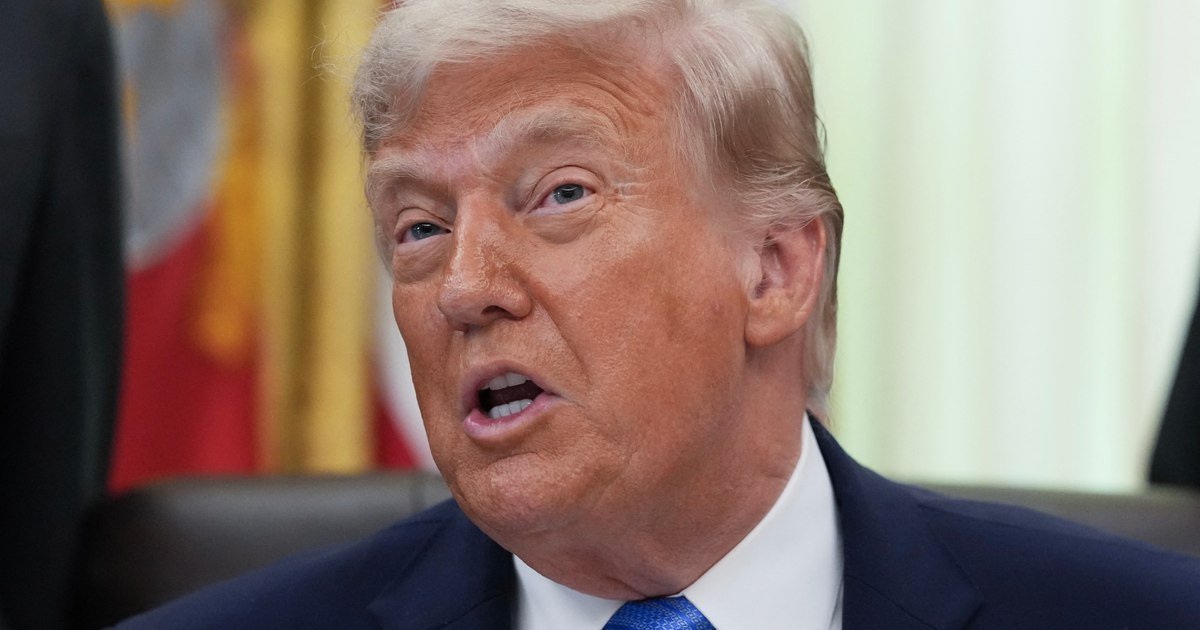
US President Donald Trump’s administration has launched an ambitious new plan to develop quantum technologies, signing two executive orders aimed at both building a high-powered quantum computer by 2028 and protecting government infrastructure against future cyber threats posed by the technology.
Donald Trump wants new technologies PHOTO: AFP
The decision comes at a time when the technological competition between the United States and China is intensifying, and quantum computing is considered one of the fields capable of redefining the global balance in research, industry and security.
Washington is banking on the quantum revolution
The announcement was made after American researchers demonstrated that some of the complex problems associated with quantum computing can be solved without the use of an actual quantum processor. Specialists emphasize, however, that this discovery does not reduce the importance of quantum technology, but helps to identify more precisely the areas in which it can offer significant advantages over conventional computer systems.
In this context, the White House wants to accelerate the development of a quantum infrastructure capable of giving the United States a strategic advantage in global competition.
“We think this goal can be reached as early as 2028,” said Michael Kratsios, director of the White House Office of Science and Technology Policy.
Protecting government systems
One of the executive orders signed by Donald Trump calls for the transition of major government computer systems to post-quantum cryptography by 2030–2031.
The reason is simple: sufficiently powerful quantum computers could in the future break many of the encryption methods that currently protect the communications and sensitive data of state institutions.
Unlike classical computers, quantum computers use the principles of quantum mechanics for information processing, which allows them to solve certain extremely complex problems in an incomparably shorter time than the most powerful supercomputers existing today.
The same capability that makes them valuable for research and industry also raises serious cybersecurity questions.
Quantum sensors for military applications
Another important element of the new American strategy is the development and implementation of quantum sensors by 2028.
According to the documents signed by Trump, these systems could be used to navigate aircraft in areas where the GPS signal is disrupted or blocked, a common situation in modern conflicts.
The AI war has reached the point of no return. What’s next?
In the future, the technology could also have space applications. Installed on satellites, quantum sensors could detect underground activity, including the construction of tunnels, bunkers or missile silos.
“Quantum sensors can provide many exciting capabilities even before the advent of fully functional quantum computers. The goals set are achievable”, said Matthew Kinsella, CEO of Infleqtion, present at the signing ceremony held in the Oval Office.
Billion dollar investments
Washington’s strategy is also supported by massive investment in the private sector.
Last month, the US Commerce Department announced that it would take stakes valued at around $2 billion in nine companies active in the field of quantum computing, including a project developed by IBM.
The new executive orders also call for stronger international cooperation to protect intellectual property and secure supply chains amid technological competition with states considered strategic rivals of the United States.
Over the next five years, all federal agencies will need to develop concrete plans for the integration of quantum technologies, including sensors and networks based on quantum principles.
An important step towards quantum computers capable of continuous operation
In parallel with these government initiatives, American companies continue to make important progress in the field.
Recently, the company Atom Computing presented a system capable of self-healing during operation. The technology allows automatic replacement of lost qubit atoms without interrupting the calculation process.
The researchers developed an architecture made up of five distinct zones, including compartments dedicated to storing, processing and measuring qubits, as well as a reserve of exchange atoms.
In tests, the system was able to successfully replace lost atoms in 41 consecutive operating cycles without affecting the processed data.
The result is considered an important step towards the development of quantum computers capable of continuous operation and widespread use in research, industry and national security.
As major powers invest billions of dollars in this technology, the race for quantum supremacy is becoming one of the most important strategic competitions of the 21st century.