San José de las Lajas/The night falls early on San José de las Lajas (Mayabeque), not because the clock says so, but because the current goes out. As if someone had blown out a gigantic candle, the lights disappear and the town is plunged into a thick darkness that is barely broken by a few light bulbs powered by power plants or improvised batteries. Three weeks ago, when the arrival of the Russian ship carrying oil to Cuba was announced, many were hoping for relief. But in this city of Mayabeque, the news feels distant, almost abstract, as if the fuel would have landed in another country.
In the private cafeteria El Elegante, located a few blocks from the central park, time seems stopped. It’s just after six in the afternoon and the place already looks half empty. A stationary fan hangs from the ceiling and the refrigerator remains closed to preserve the cold as long as possible. The clerk on duty watches the clock insistently, as if she could push the hands towards ten at night, the official closing time.
“Since six o’clock the only thing I have sold is a package of crackers,” he tells 14ymedio with a tired gesture. “I have told the owner that being here so late is for pleasure because the town turns off.”

/ 14ymedio
It’s not a metaphor. Just walk a few blocks to see it. On 47th Avenue, where there used to be a corridor of cafes and small private businesses, lowered blinds and empty storefronts now predominate. The blackouts have changed consumption habits and also the nocturnal geography of San José de las Lajas, a municipality that, according to neighbors, goes to bed earlier and earlier.
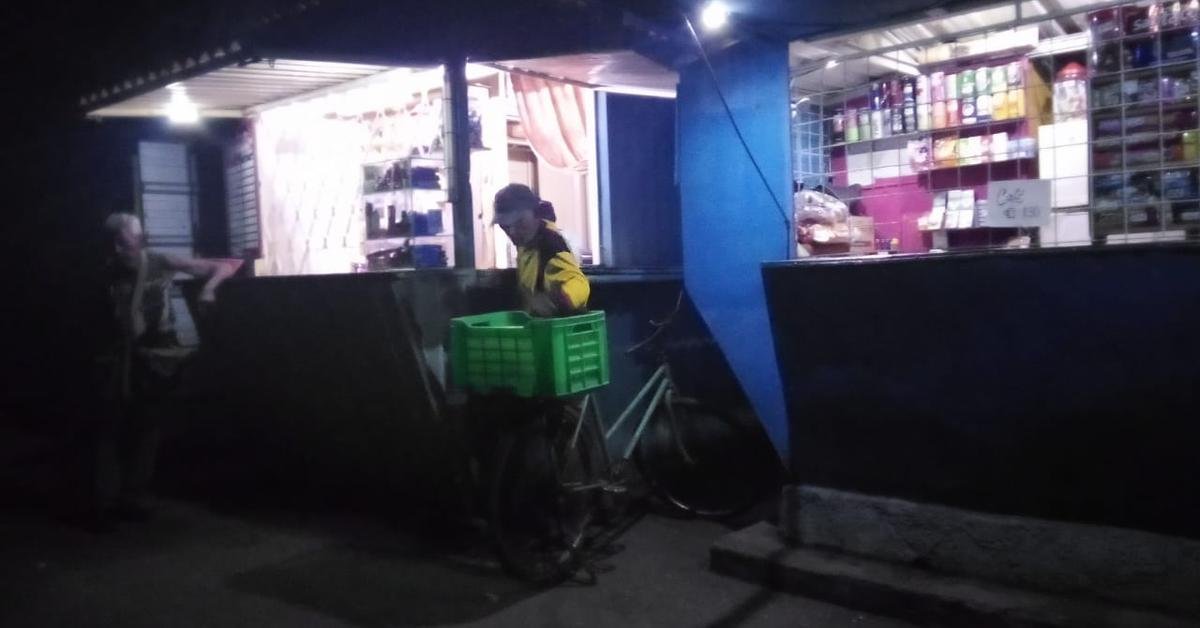
The scene is repeated in the rental car pit in front of the old train terminal. There, under the yellowish light of a spotlight connected to a battery, a cyclist unloads several green plastic boxes full of soft drinks and bread. The movement is fast, almost silent, as if the merchandise had to be placed safely before darkness covers everything.
One of the sellers explains that many of the products arrive at night because during the day the inspectors are stricter. The night, paradoxically, has become a time to replenish supplies, although not necessarily a time to sell.
A few meters away, an improvised kiosk keeps a small power plant on that roars like an old engine. Idael works there, working at a pizza stand that has had to reinvent its offering to survive. Where freshly baked dough used to be sold, croquettes and pre-prepared foods that require less energy are now sold.
“We had constant sales, even at dawn,” he remembers while arranging a tray. “Until this debacle started.”
“We had constant sales, even at dawn,” he remembers while arranging a tray. “Until this debacle started. Of the four shifts there were, we were left with two. Now we close at noon and it’s over.”
The contrast with the capital is inevitable. After the arrival of the Russian oil tanker, the authorities announced an improvement in electricity generation and Havana was illuminated last night as it had not been in weeks. On the other hand, in San José de las Lajas, the reality remains different. Here the nights are the territory of darkness, and the promise of energy stability is perceived as an alien story.
In a corner of the Nazareno district, a small restaurant with a guano roof tries to maintain service during the day. Two men talk while leaning on their bicycles, while the owner calculates how much fuel he has left for the generator. Investment in gasoline has become a constant expense and difficult to sustain.
“Every time the power goes out, I have to turn the plant on,” he explains. “But fuel is very expensive and it doesn’t always appear. If I continue like this, I’m going to have to close.”
Reducing hours has become a survival strategy. Michel, owner of a cafeteria near the central highway, remembers that when he started his business he dreamed of a 24-hour service, taking advantage of the proximity of the national bus terminal. Today, that idea seems almost naive to him.
“At first we were open until seven at night,” he says. “Then we went down at five, and now at four we are closing. It’s not worth staying if there are no people on the street.”
Darkness doesn’t just affect sales. It also modifies the social life of the town. On the streets, traffic slows and conversations become shorter. Young people who once gathered in cafes or bars now return home early, resigned to spending the night without electricity.
/ 14ymedio
In front of the El Chino restaurant, a boy walks quickly along the deserted sidewalk. The lights in the place remain on, but the tables are empty. Silence dominates the atmosphere, barely interrupted by the distant hum of a generator.
In another part of the municipality, a small bar decorated with baseball motifs tries to maintain its regular clientele. Behind the counter, the clerk chats with a newcomer while calculating how long the power plant will last before running out of fuel. Every hour of operation represents money that is not always recovered in sales.
Merchants agree that the problem is not only the lack of electricity, but uncertainty. No one knows exactly when service will be restored or how long the outages will last. This unpredictability makes it difficult to plan schedules, purchases and business strategies.
The initial enthusiasm for the arrival in Matanzas of the Anatoly Kolodkin and its 730,000 barrels. The fuels manufactured at the Cienfuegos refinery From Russian oil they went to Havana and other paradigmatic places in the country. Until now, Mayabeque has remained outside the route of the Cupet tanker trucks.