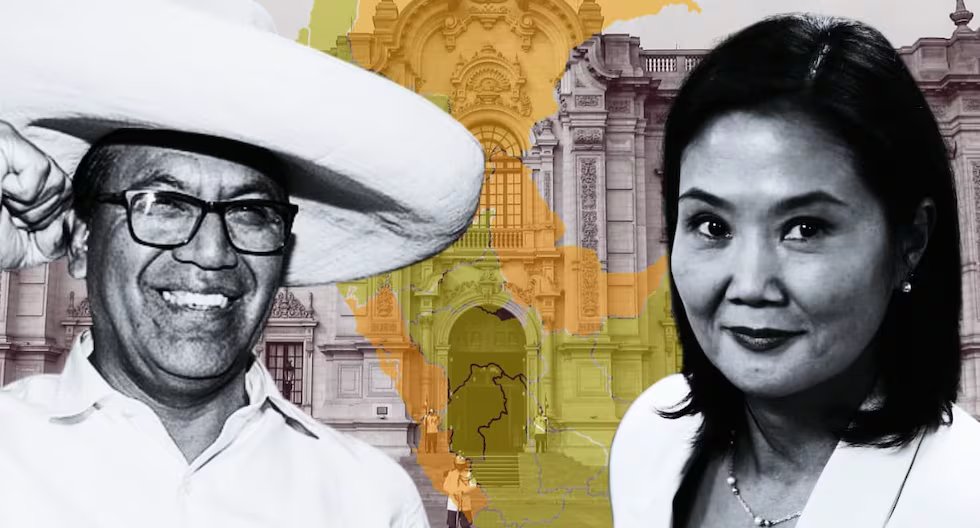
The south of Peru is the main regional block adverse to the presidential candidate Keiko Fujimori. In this year’s runoff, the leader of Popular Force He only won in three of the 46 provinces that make up the aforementioned area, all in Ica, and by a margin of less than five percentage points.
Fujimori obtained his worst national results in Puno, where he achieved only 13.6% of adhesions, while Roberto Sanchezof Together for Perucaptured 86.4% of the votes.
In no other department was such a large difference recorded in this electoral process, neither in favor of Fujimori nor Sánchez.
“Puno votes against the centralism that Lima represents and that transcends Keiko Fujimori, because with Rafael Lopez Aliaga The result would have been very similar,” explains Luis Idme Ccajma, political analyst and communicator from Puno.
Idme comments that the cohesive, almost unanimous vote in Puno is due to the fact that politics is part of daily life in the region.
“The community debates a lot in the assemblies that are held at least twice a month and that has transferred to the urban sector. Decisions are made in community. There is no other way to understand that level of cohesion,” he adds.
The panorama is similar in Cusco, where Sánchez won with 78.2% of the votes. In contrast, Fujimori lost in the 13 provinces that make up the region.
In the four runoffs in which she has competed in the last 15 years, the former congresswoman triumphed in two provinces from Puno and one from Cusco only once, in 2016, when she faced Pedro Pablo Kuczynski (PPK).
On the regional scale, Fujimori only won in Ica in 2016 (52.87%), 2021 (52.5%) and 2026 (51.9%). Meanwhile, in Cusco, Puno, Tacna, Moquegua and Arequipa, victory has been elusive until now.
“In Arequipa, political decisions are not made as communally as in Puno, but there is a strong anti-Fujimorist tradition, not necessarily leftist,” says sociologist José Luis Ramos, professor at the National University of San Antonio (UNSA).
But there is one detail: despite the clear rejection of Fujimori’s candidacy by the south, the support for Roberto Sánchez in these elections was less than that which Pedro Castillo received five years ago.
In 39 of 46 provinces, Castillo obtained better results than Sánchez. In such a close electoral race, that difference could be key.
“Sánchez, in general terms, did better in more urban areas or areas close to the coast than in rural areas. It’s not that he had done badly in rural areas, but that Castillo did better,” he told The Commerce Javier Albán, member of the Research Center of the Universidad del Pacífico.
In this regard, Luis Rivera, software engineer and algorithm teacher, said in dialogue with this newspaper that the voting trend in the southern provinces in favor of Together for Peru was also reflected at the district level.
“The general image is that at the district level everything looks green (color associated with Sánchez), except for some urban districts in Arequipa province. The other districts (in the south) where Keiko Fujimori wins are basically on the coast of Arequipa or Moquegua or Ica,” he explained.
The specialist adds that although it is true that both Fuerza Popular and Together for Peru had more votes in this election than in 2021, Fuerza Popular had a more significant increase in adhesions: 130,000 additional votes compared to 30,000 for Sánchez.