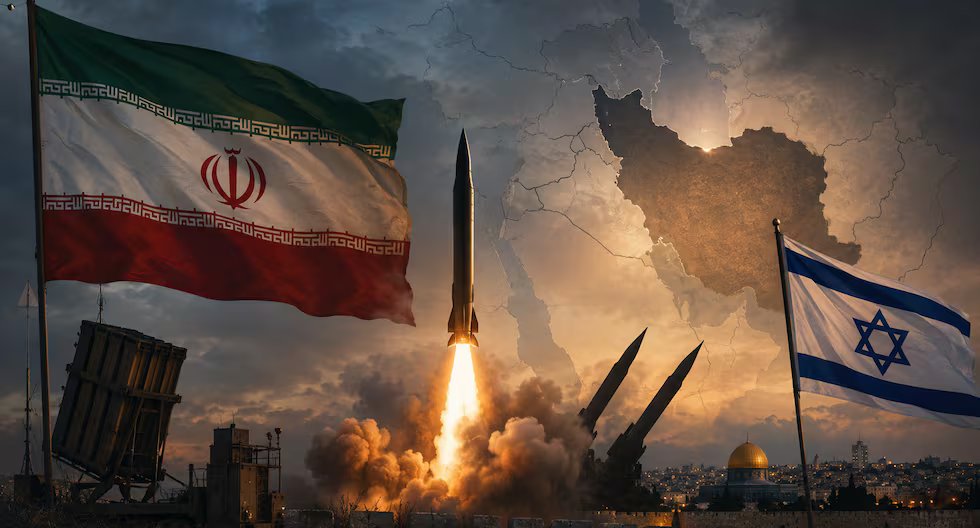
The war started by the United States and Israel on February 28 demonstrated that The greatest current danger for the Hebrew State is Iran’s ballistic missiles. For this reason, a fundamental objective of the Israeli Prime Minister Benjamin Netanyahu was to impose a limit within your reach, that rounds the 2,000 to 2,500 kilometers.
SEE ALSO: The controversial US$300 billion fund for Iran for peace: will the United States pay for it?
The distance between Israel and Iran is from between 1,000 to about 2,500 kilometersdepending on the missile launch point and the target.

A photo from May 25, 2023 shows testing of the fourth-generation Khorramshahr ballistic missile, called Khaibar, at an undisclosed location in Iran. (Photo by the Iranian Ministry of Defense / AFP).
/ –
During the negotiations, Iran He refused to include the issue as part of an agreement to end the war. It was one of his red lines.
Once peace is signed, Iran’s ballistic missile program does not appear in the 14-point agreement or as a matter of negotiation for the next 60 days.
To understand the magnitude of this omission, senior military correspondent and intelligence analyst The Jerusalem Post, Yonah Jeremy Bobstated this week in an article that the fundamental objective of Israel in the war was not to cause the fall of the Iranian regime, nor its nuclear program, but neutralize a threat it considers existential: Tehran’s ballistic missile program. From this perspective, leaving that capacity intact is equivalent to preserving the main weapon of Iran to directly threaten Israel.
Until before the war, Iran had about 3,000 ballistic missiles stored. But as Yonah Jeremy Bob explains in his article, at the end of 2024 TEherán had accelerated its production to a rate of between 200 and 300 per month, which would have allowed it to reach up to 6,000 ballistic missiles in 2026 and between 8,000 and 10,000 by 2027-2028.
During the war, Iran fired 550 missiles at Israel, with a kill rate of approximately 90%.which caused about 50 to reach their objective, causing dozens of deaths, thousands of hospitalized and nearly 30,000 claims for material damage, Bob explained.

Response teams work among the rubble of a building after the impact of an Iranian missile in the Israeli city of Bat Yam, south of Tel Aviv, in the early hours of June 15, 2025. (Photo by Jack GUEZ / AFP).
/ JACK GUEZ
The analyst warned that the impact would have been much greater if, for example, Tehran had launched 5,000 missiles. At the aforementioned rate, some 500 projectiles would have managed to penetrate the Israeli defenses and hit their targets.
Iran currently has between 500 and 1,000 ballistic missiles.since to those who shot we must add those who were destroyed by Israel in its attacks. When will accelerated pre-war production resume? Bob thinks it will be in two years.
Why are its ballistic missiles strategic for Iran?

Iranians walk past Sejjil (L) and Qadr-H ballistic missiles, displayed next to a portrait of Iranian Supreme Leader Ayatollah Ali Khamenei, on September 25, 2017, in Tehran’s Baharestan Square. (Photo by ATTA KENARE / AFP).
/ ATTA KENARE
No long-range missiles, Iran would have a much harder time hitting targets in Israel directly.
During the war, as part of their demands, The Netanyahu government even proposed that any agreement include a limit of 300 kilometers on the range of Iranian missiles. That distance would put them out of Israel’s reach.
Why is it an existential threat? A ballistic missile does not need to carry a nuclear warhead to cause significant damage. It can transport conventional explosives to hit cities, military bases, ports, airports, among other critical infrastructure.
Israel has some of the most advanced missile defense systems in the world, but they are not invulnerable. The Iranian strategy of launching waves With hundreds of missiles and drones it showed that defense can be saturated. In this scenario, even a very high interception rate could be insufficient because a small percentage of powerful impacts would be enough to cause serious damage human, economic and strategic.
In conclusion, ballistic missiles are Iran’s main deterrent against Israel. Along with the possibility of affecting traffic through the Strait of Hormuz, Tehran retains two of the most powerful tools to exert military and economic pressure in the region and on a global scale, even after the agreement with the United States.
Why did Donald Trump leave the issue out of the peace agreement? On Thursday, the vice president of the United States, J.D. Vance, answered that question. He said that You cannot tell a country that “it cannot defend itself.”
Vance stressed that what the United States seeks is that Iran cannot “build the kind of missiles that can threaten the world.” He also recalled that during the war, his country has destroyed “a substantial number” of Iran’s ballistic missiles.
Trump ended up being more concessional than expected

The launch of Iran’s Shahab-3 ballistic missile in 2006. (Mehr News Agency).
For Andrés Gómez de la Torrea specialist in defense and intelligence issues, the exclusion of the Iranian ballistic missile program reflects a change in the administration’s approach trump during the negotiations.
He explained to The Commerce that the United States and Israel initially had three main objectives: preventing Iran from developing nuclear weapons, weakening its ballistic missile capabilities, and reducing the potential of its drone industry. However, he maintained that The final result reveals a “more concessive spirit” on the part of the White House.
Gómez de la Torre noted that although the United States managed to inflict damage on Iran’s military infrastructure, it ultimately agreed to leave out of the negotiation an issue that it originally considered fundamental. “There has been a concessive angle”he stated, recalling that ballistic rocketry was one of Washington’s main concerns because, In the future, it could serve as a platform to transport an eventual nuclear warhead.

The President of the United States, Donald Trump, calls for a pardon for Israeli Prime Minister Benjamin Netanyahu for his open court cases in Israel. (SAUL LOEB / POOL / AFP)
/ SAUL LOEB
The analyst considered that this position must also be understood in the context of the recent differences between Trump and Netanyahu. He said that the disagreements that arose during the war and some unilateral decisions taken by Israel they would have partially eroded the coordination between both governments. “This difficult relationship has given Trump more freedom of action,” held.
He argued that tensions with Netanyahu could have had an unexpected effect for Israel. “Probably this unilateralism of Benjamin Netanyahu and these small tensions gave Trump more freedom of action to be more concessive on an issue that was initially fundamental,” Indian. According to Gómez de la Torre, this would explain why the United States ended up accepting that Iran retain part of a military capacity that Tehran considers strategic for its defense and deterrence.