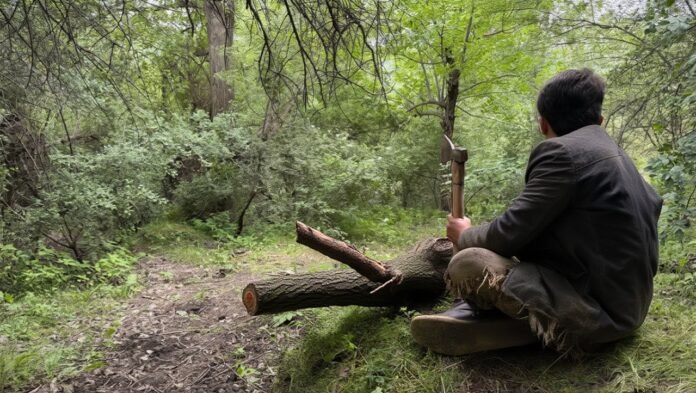
The cutting down of trees by residents and climate change are two challenges that the forests of the Kulyab region face today. Residents say that they are forced to cut down trees; responsible officials are fighting this with varying degrees of success.
This is a photo report from the Kulyab region, which clearly reflects the problem.
Who cuts down trees?
According to those responsible for forest protection, trees are mainly cut down by residents of settlements located around, using the tree for their own household needs.
Muhammadjon Barotov, an employee of the State Forestry Institution of the Khatlon region, said that in the first quarter of 2026, 162 cases of illegal logging of forest trees were identified in the region, and violators were fined a total of 86 thousand 713 somoni.

According to Barotov, in previous years, before the penalties for illegal tree cutting were tightened, a larger number of such cases were recorded, but after 2018, when the penalty doubled, such violations began to occur much less frequently.
“Previously, according to Article 183 of the Code of Administrative Offences, such a violation was subject to a fine of 5 to 10 minimum monthly wages. Now the fine has been increased to 10–20 calculated indicators. In addition, if such a violation is committed again within one year, criminal liability is provided.”

Why are trees cut down?
Some local residents, who wished to remain anonymous, explained why the trees were being cut down.
“Our winters are long. Therefore, firewood is used not only for heating houses, but also for cooking and boiling water. For this reason, some residents are forced to collect firewood. Wood is the only available type of fuel for the region’s residents,” says one of the residents living near the forest.

Another resident of this region confirms, but according to him, firewood is also needed in summer, spring and autumn, and the only reason for cutting down forest trees is precisely the need for fuel.
Muhammadjon Barotov said that they are aware of the current situation and in order to solve it, “industry employees constantly visit residents of mountain villages and explain to them the need to refrain from illegal cutting of trees.”

“Afghan” threatens
Another challenge for the forests of the Khatlon region is climate change, as well as an increase in the amount of dust and sand in the air, or, as they say, “Afghan”.

Quvwatali Nazirov, another forestry officer in the Khatlon region, noted that “in recent years, the wind, known as “Afghan”, has had a negative impact on trees, especially pistachio trees – they are drying out.

“Strong winds cause dust storms, and large amounts of dust pose a danger to pistachio seedlings. When the air remains dusty for weeks, even pistachio trees between 50 and 100 years old dry out,” says Nazirov.
According to Forestry specialists, to counteract the cutting down of trees in the Kulyab region, new forest areas are created annually on hundreds of hectares of land.

“In 2025 alone, we created new forest plantations on an area of 556 hectares and 70 acres. To increase planting density, various types of shade and fruit seedlings were planted on an area of 626 hectares. At the same time, reforestation work was carried out on an area of 918 hectares,” the department reported.