Michael O’Flaherty, the Council of Europe Commissioner for Human Rights, called on Georgia to ensure law enforcement accountability and repeal restrictive “foreign influence” laws, in an April 21 statement issued a week after his visit to the country, where he met with Georgian Dream government officials, authorities, and civil society representatives.
The visit to Georgia “focused on the continued lack of accountability of state agents for the violent dispersal of protests in 2024 and early 2025, the increasing restrictions on the rights to freedom of expression, peaceful assembly and association and on the human rights of persons in and displaced from the occupied territories of Abkhazia and Tskhinvali region/South Ossetia,” the statement said.
According to the statement, the Commissioner “expresses his gratitude” to the Georgian authorities “for their cooperation and their availability at a high level.” At the same time, he “commends the resilience of civil society, human rights defenders, and journalists who continue to work within an increasingly restrictive environment.”
Accountability and Law Enforcement
The statement said the Commissioner followed up on recommendations made after his January 2025 visit, concerning “the lack of accountability for allegations of unlawful arrests and excessive use of force against protesters and journalists by law enforcement and unidentified masked individuals” during the 2024 and early 2025 demonstrations.
The statement added that while the Commissioner welcomed a legislative proposal tabled by the Interior Ministry that would require “all law enforcement personnel” to wear visible identification numbers, he “remains concerned that no law enforcement officers have been brought to justice for the violent dispersal of protests in 2024 and early 2025.”
“In his meetings, he reiterated his call for an independent and thorough inquiry into the use of water cannons containing chemical substances against protesters,” the statement added.
Restrictions on Democratic Freedoms
“Regarding increasingly restrictive legislation affecting the rights to freedom of expression, peaceful assembly and association, the Commissioner notes the cumulative impact of these laws and observes that the authorities have since adopted even more restrictive measures,” the statement said.
The statement then reviewed a series of protest-related legislation adopted by Georgian Dream in 2025, including rules requiring protesters to give police prior notification of demonstrations, empowering police to change the venue or time of protests, and “even prohibit protesters from ‘blocking’ the pavement.”
It then reviewed legislative amendments that toughened penalties for violating protest rules, including the introduction of imprisonment for repeated offenses. According to the statement, “the Commissioner expresses concern that these amendments significantly limit the right to freedom of peaceful assembly and seem to be incompatible with the principles of necessity and proportionality” enshrined in the European Convention on Human Rights.
“In his meetings with the authorities, the Commissioner raised concerns about the chilling effect of several laws relating to ‘foreign influence’ on civil society organisations (CSOs), human rights defenders (HRDs) and journalists,’ as well as administrative and criminal proceedings against dozens of CSOs for receiving foreign funding and/or for alleged involvement in aggravated sabotage,” the statement said.
The Commissioner is then quoted as saying he discussed “the human rights implications” of the Foreign Agents Law, officially known as the Law on Transparency of Foreign Influence, adding that he “expressed concern” about the Foreign Agents Registration Act (FARA), as well as amendments to the Law on Grants and the Law on Broadcasting.
According to the statement, the Commissioner said, “While increasing transparency regarding the funding of CSOs may be a legitimate objective, the wide-ranging restrictions appear inconsistent with the criteria of legality, legitimacy, necessity and proportionality” within the Convention, “as well as with the principle of non-discrimination.”
“I call for repeal of the GEOFARA law [Foreign Agents Registration Act] and for repeal or substantial revision of other oppressive legislation to ensure compliance with the Convention,” he said.
“I further recall that CSOs, HRDs and journalists play an essential role in safeguarding human rights and civic space,” he said, adding, “I therefore call upon the Georgian authorities to ensure that the ongoing administrative and criminal proceedings into dozens of CSOs are in strict compliance with the state’s obligation under the Convention.”
Human Rights of Persons In and Displaced from Occupied Territories
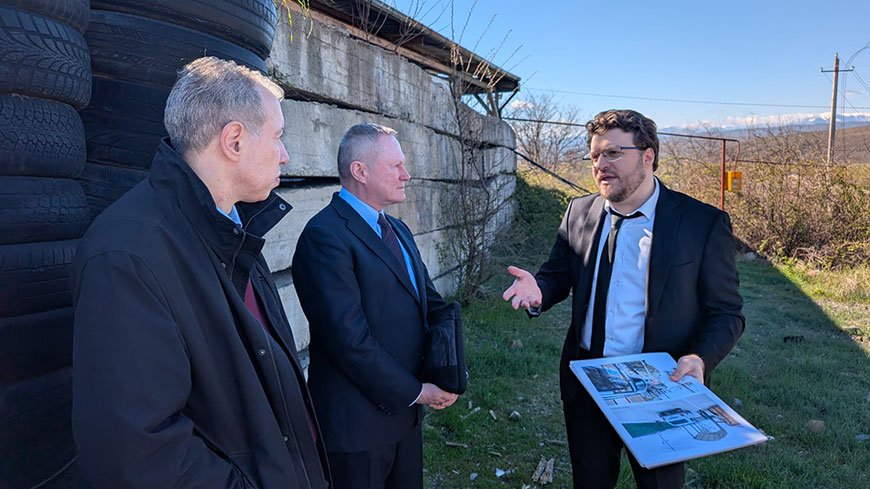
According to the statement, the visit also marked the Commissioner’s first engagement on the human rights situation of people living in and displaced from the occupied Abkhazia and Tskhinvali regions.
“I acknowledge the efforts of the Georgian authorities to provide assistance, including free healthcare and education, to persons in and displaced from these territories,” he said after meeting with IDPs in the Tserovani settlement, noting that “IDPs continue to face challenges with integration.” He called on authorities to maintain “sustained attention” to housing, employment, and education needs.
“The Commissioner also commended the Georgian authorities’ support for the right of IDPs to return to their homes under conditions of safety and dignity, as well as their right to freedom of movement across the occupation lines. He is committed to continuing to focus on these issues in his work.”
Also Read: