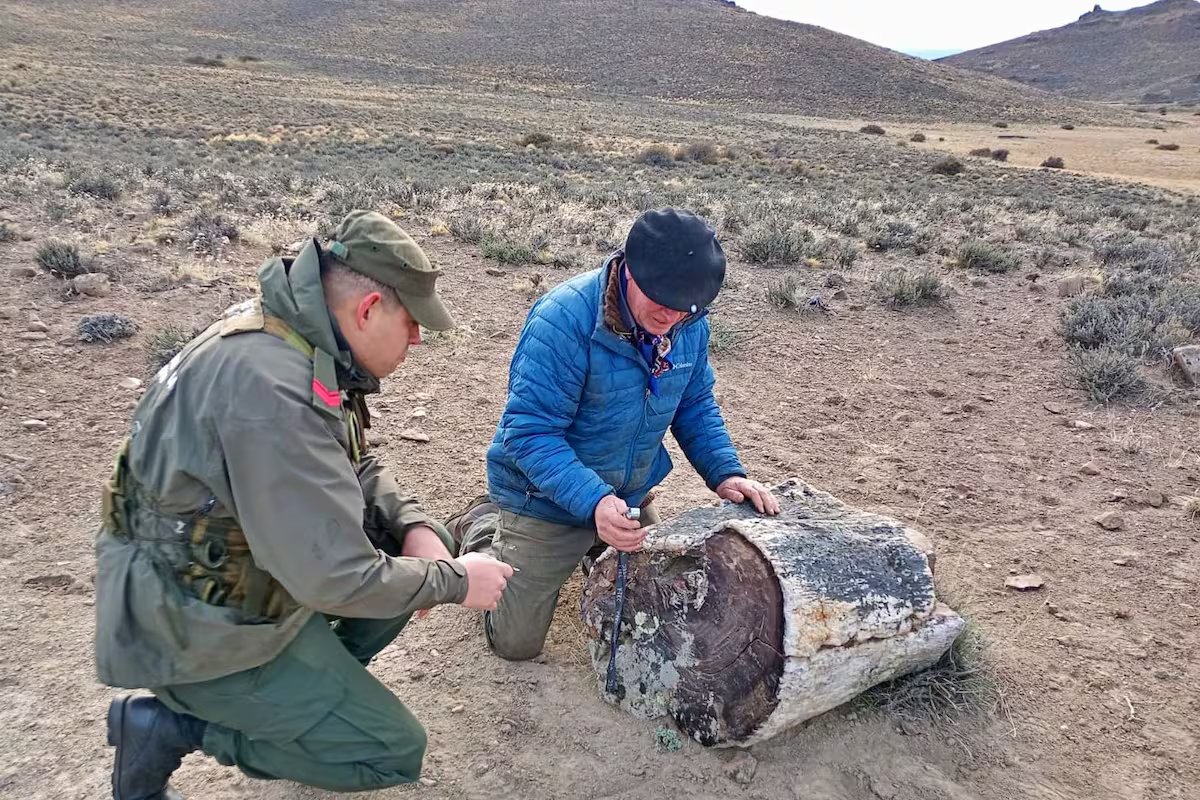
The arid Rio Negro landscape once again revealed an unknown part of the geological history of Patagonia. In a ranch located near Pilcaniyeu, specialists confirmed the discovery of a petrified forest made up of 13 fossil trunks about 50 million years olda record that could provide new information about the ecosystems that existed in the region during the Eocene and open new lines of research on the environmental evolution of northern Patagonia.
The discovery occurred based on a complaint made about the presence of possible fossil remains in a rural establishment located about 80 kilometers south of San Carlos de Bariloche, in an area where the mountains and basaltic plateaus characteristic of Patagonia meet. Following the notice, members of the Bariloche Paleontological Association traveled to the site along with an environmental patrol from Squadron 34 of the National Gendarmerie, which provided assistance during the survey and preservation tasks.
Once on the property, and with the authorization of its owner, the investigators were able to corroborate the existence of a set of fossilized trunks belonging to different species of conifers and angiospermsthe plant group that includes flowering plants. Preliminary analyzes allowed us to establish that The specimens correspond to the Eocenea geological period between approximately 56 and 34 million years ago.
During the Eocene, Patagonia It presented environmental conditions very different from today’s. In much of the region, warmer and more humid climates predominated, capable of supporting extensive forest formations. The landscape that today is associated with wide steppes, low vegetation and semi-desert conditions was very different then. The remains found near Pilcaniyeu They represent vestiges of those disappeared environments and offer an opportunity to understand what the flora that occupied the territory was like long before it acquired its current configuration.
Specialists consider that the study of the identified species could provide data on environmental transition occurred between the mountain range sectors and the Patagonian plains. The location of the discovery, in an area where mountain ranges and basaltic plateaus converge, is especially relevant because allows us to analyze ecosystems that developed in a complex and dynamic geographical environment.
The preservation of the trunks for millions of years was possible thanks to a series of geological processes. For a tree to become a fossil must be quickly covered by sediment that prevent their decomposition. Over time, mineral-rich water passes through plant tissues and gradually replaces the original organic matter. This phenomenon, known as petrification or permineralization, allows to preserve the structure of the trunk and even microscopic details of the wood.
The geological characteristics of large sectors of Patagonia favored this type of processes. The volcanic activity that marked different stages of regional history generated abundant mineral deposits that, millions of years later, contributed to the preservation of plant remains. For this reason, the region is home to some of the most important petrified forests in South America and continues to provide new findings of scientific interest.
The work of specialists
After confirming the relevance of the finding, the researchers moved forward with a series of procedures intended to document and protect the place. The tasks included the identification of the specimens, the photographic record of the area, the precise geolocation of the remains and the extraction of samples for future research.
Geolocation constitutes a fundamental tool for this type of studies. Knowing the exact location of each specimen allows us to relate the remains to the geological formations that contain them, reconstruct the context in which they were preserved and facilitate future research campaigns. Furthermore, this information contributes to the protection of the site and its incorporation into records specialized.
Later it was carried out the collection of samples that will be subjected to more detailed studies. The recovered materials were conditioned following specific conservation and transfer protocols to avoid alterations or damages that could compromise future investigations. The preservation of each fragment is key, since even small samples can provide relevant information on the composition of the wood, the conditions of fossilization and the age of the specimens.
By order of the authorities, the remains and the samples obtained were under protection at the Paleontological Museum of Bariloche. They will remain there while scientific analyzes progress that will allow us to know more precisely the characteristics of the identified species and the environmental context in which they lived.
The intervention was developed within the framework of the Provincial Law No. 3656 on the Protection and Conservation of the Cultural and Natural Heritage of Río Negro. The regulations establish mechanisms aimed at preserve assets of historical, scientific and natural valueand expressly includes paleontological sites among the elements that are part of the provincial heritage.
The legislation also contemplates scientific investigation of this type of findings and provides for the reporting of accidental discoveries that may have heritage relevance. Besides, considers that paleontological sites constitute assets that must be preserved to guarantee its study and conservation for future generations.
In that sense, protection does not only extend to recovered fossils. It also includes the place where they were foundsince the geological and spatial context in which they appear is essential to understand their scientific meaning.