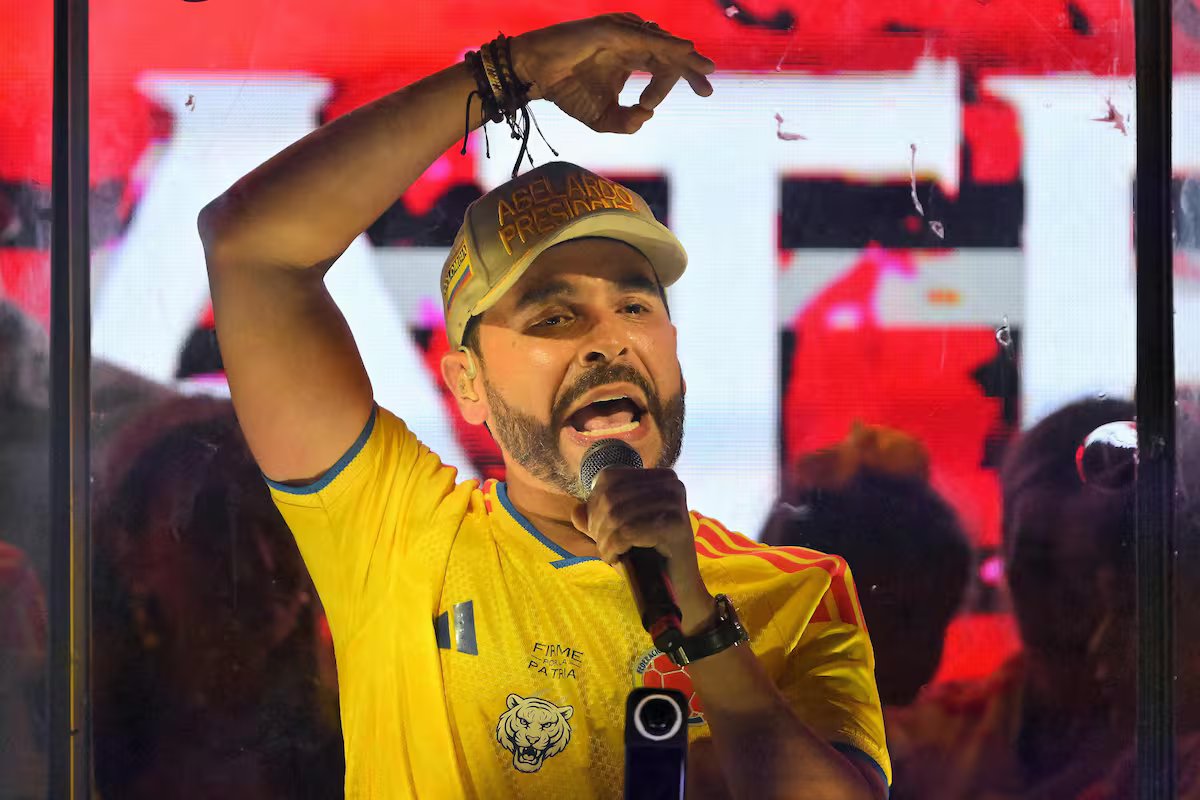
BOGOTA.– Less than 24 hours before what is anticipated to be a fierce runoff in Colombiathe disruptive representative of the Colombian right, Abelardo de la Espriellafrom Defenders of the Homeland, seems to have the lead over the official candidate of the Historical Pact, Ivan Cepeda.
With an economic program inspired by the president of Argentina, Javier Mileiand a “strong hand” security proposal in the style of the president of El Salvador, Nayib Bukelehe outsider of national politics trusts that the replica of the campaign manual of the new global rights I took him to the House of Nariño.
“What De la Espriella has in common with Bukele and Milei is that they say they are fighting against an alleged elite that has forgotten the peoplewhich is corrupt and has taken over the power of the State, forming a kind of political caste,” he analyzed for THE NATION Christian Julián Fajardoprofessor of the Department of Political Science at the Pontificia Universidad Javeriana.
The crash of the middle class
The best sector to understand the phenomenon of Abelardo de la Espriella’s rise is that Colombian middle and lower middle class that historically voted for more progressive options, but that in the first round of these presidential elections accompanied to the right-wing candidate.
The Teusaquillo area, in Bogotá, is a clear example of this shift. With its quiet neighborhood and its low but spacious houses, this typical haven of the city’s middle class contributed to the victory of the outgoing president Gustavo Petro in 2022but voted for From Espriella last May 31.
“Abelardo comes to correct the errors of a government that took the wrong coursewho did not keep his promises and who leaves things worse than they were,” he told THE NATION Jacintaa 66-year-old retiree, in front of the garden of her English-style house.
Your opinion represents that of many Colombians disenchanted with the performance of the retiring administrationwhich despite having promoted a historic increase in the minimum wage, managing to reduce the country’s monetary poverty from 36.6% to 28%, leaves the State in a fiscal crisis, the health system broken and, more importantly, an outstanding debt regarding security.
“Those of us who have already lived through much of Colombia’s history know what happens in this country when you want to dialogue with the guerrillas.”Jacinta completed.
The woman’s reference has to do with the failed dialogue approach known as “Total Peace”, with which Petro sought to negotiate with the armed groups in pursuit of their demobilization but led to the expansion of these groups, and It became one of the heaviest legacies of his government.
The government of “the nevers”
Like the Argentine presidentwho built his political identity around the fight against “caste”, De la Espriella has sought to position himself as the standard bearer of “the nevers”that is, those excluded from politics, but even more so, from Colombian society.
“We are the nevers. Those of us who have never lived off the back of the State, those of us who have never stolen a pesothose of us who never give up or stay complaining. Those of us who have never done politics”, said the then unknown right-wing candidate in the first days of his campaign.
From this epic, De la Espriella has tried to be at the same time the representative of sectors of the lower, middle and upper classes for whom The fundamental cleavage of the country is not divided between the poor and the rich, but between the rulers and the governed..
In that sense, “Abelardo is part of a global right that has undertaken not so much a material struggle, but rather a cultural struggle”Fajardo explained.
Regarding this reading of Colombian society, The 47-year-old lawyer articulated the government program he calls the “Miracle Homeland”whose main proposals – condensed in a brief document as an outline – focus on the “extreme coherence”, that is, “common sense applied to the nation”.
According to the official website of Defenders of the Homeland, the main axes of common sense are “family, property, work, faith and security”.
“Your proposal differs from others for, among other reasons, re-adopt religiosity and propose an ethical and moral restoration of the State“, he said to THE NATION the international policy consultancy Maria Alejandra Trujillo.
Thus, De la Espriella has managed to align behind him not only the traditional voter of the Colombian rightbut also to all those who, more than voting for Abelardo, They vote against Petro and the continuation of his program.
Although the president leaves the presidency with a high percentage of positive image –more than 40%–a large part of the rest of Colombian society sees in him a failed ruler and the greatest exponent of a left. who they fear will try to perpetuate themselves in power indefinitely following the example of Chavismo.
The tiger and the lion
In a gallery in the commercial area known as San Andresito de la 38, Bogotá’s equivalent to the Buenos Aires neighborhood of Once, from its video game supplies store, Jeison told LA NACION that he would vote convinced for the right-wing candidate.
“He is a businessman, so he understands us merchants. And he knows that this government has stolen a lot. We need him to put the country in order so that things work,” explained the 35-year-old man, who also assured that many of his fellow sellers share his position.
Jeison’s support has to do with the image that De la Espriella himself intends to convey, that of a successful businessman who reaped huge profits in all the areas in which he wanted to do business – for example, with a luxury men’s clothing brand, a liquor brand and Místico, a restaurant in Miami– but, more importantly, he did it single-handedly.
Throughout his campaign, the right-wing candidate has shown himself as a born entrepreneur whose only ideological flag in economic terms is the free market.
In particular, De la Espriella has been a declared admirer of the economic program of the Argentine government – as well as of the North American president, donald trump– proposing the elimination of market restrictions and a drastic cut of the State.
Although he does not use the “chainsaw” metaphor, De la Espriella proposes reducing 40% public spending and eliminate some 700,000 positions between officials and contractors.
To fulfill this promise of “comprehensive reform of the State,” the candidate assures that if elected he would sign 90 decrees in the first days of his government.
In addition to economic measures, Both politicians share a fascination with feline figures. Similar to the president, who is often represented with the image of a lion, De la Espriella has adopted the nickname “The Tiger”, an animal that became omnipresent in his campaign.
From his call to vote, with “put the line on the tiger”and his merchandising official full of references to the animal, down to its multiple artificial intelligence videos in which he appears represented by the big catthis became one of the unmistakable brands of the right-wing candidate.
After the partial victory of the “Tigre” in the first round, The President himself responded to the winks by getting fully involved in the Colombian campaign and he was very explicit in his support for De la Espriella.
“The path is clear, more economic freedom, more security, more trade and zero tolerance for transnational organized crime and drug trafficking”Milei wrote in X, where he commented having spoken with the candidate days before the runoff.
“Hard hand” for Colombia
From the Bukele model, on the other hand, De la Espriella intends to take the “iron fist” approach and rhetoric that has characterized the Central American leader..
One of the Colombian’s main proposals is to imitate Bukele’s megaprison systemwhich has been denounced by Amnesty International and Human Rights Watch for inhumane conditions and human rights violations.
At the same time, De la Espriella calls for close cooperation in intelligence matters with United States and Israelties broken by the Petro government, and proposes an “aerial fumigation” of 330 thousand hectares of illicit crops which he calls “Pax Romana”.
Regarding armed groups, The candidate proposes ending the peace talks initiated by the Historical Pact government and assures that it will reduce violence in the country by 50% and regain control of the territories in the hands of criminal organizations.
If elected, “El Tigre” has stated, he will give “the order to bomb all narcoterrorist camps” trying to generate “the least impact on the civilian population.”